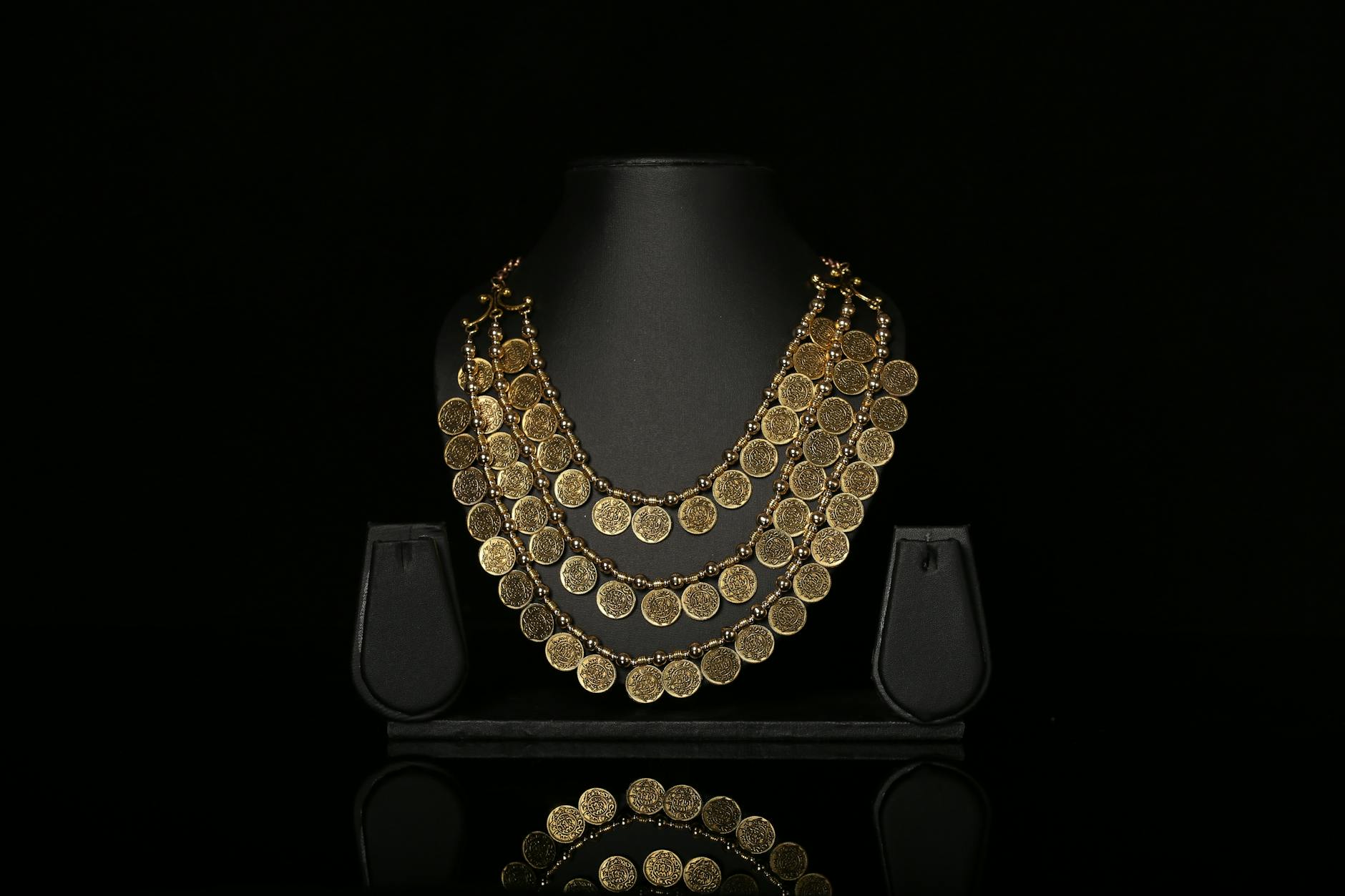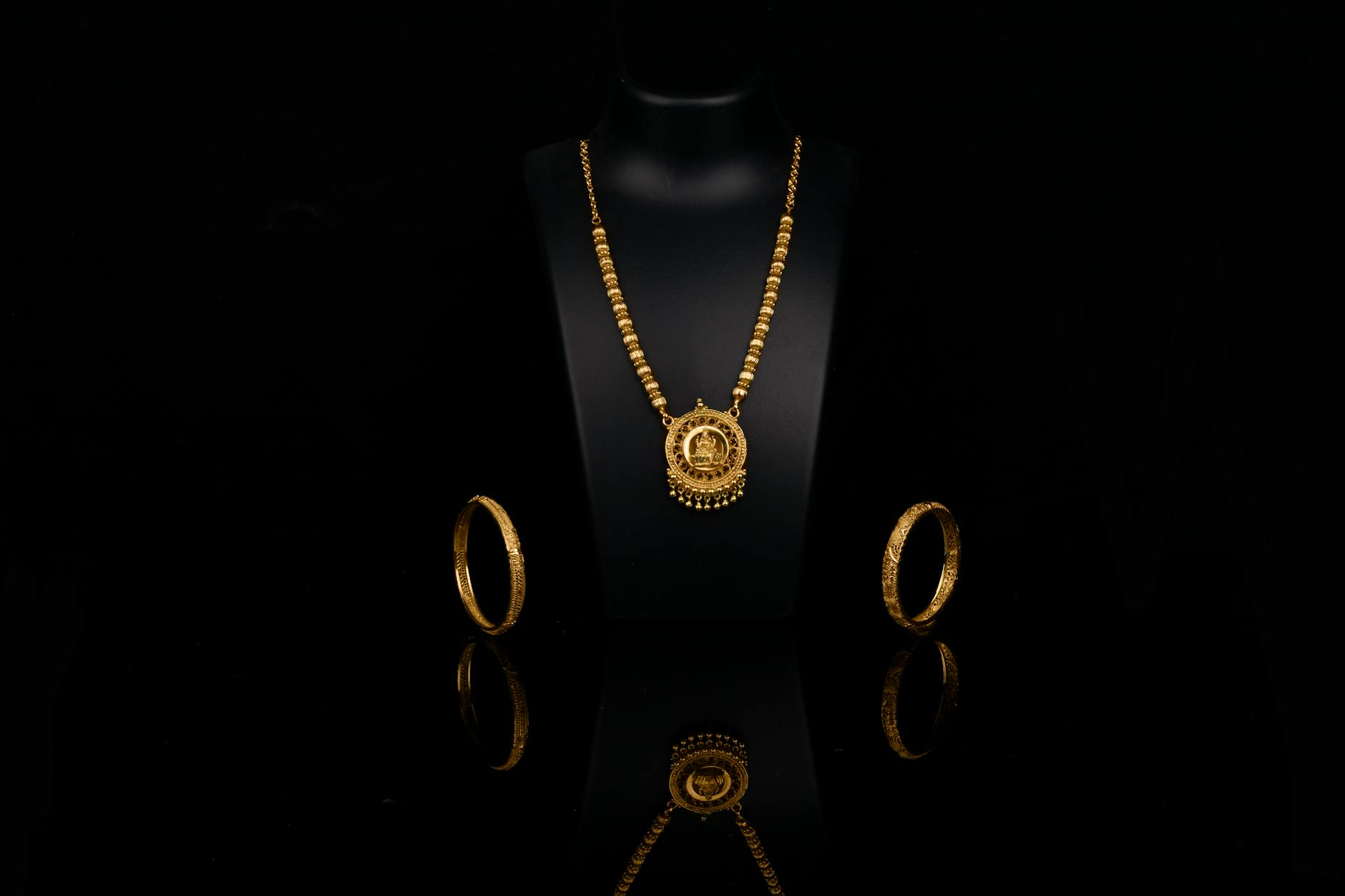
The Minnu is the Kerala Christian bride's wedding pendant — a tiny 22K gold leaf or heart suspended from a humble yellow thread, tied around the bride's neck by the groom at the altar. To an outsider it looks deceptively simple. But this small ornament carries the entire weight of Syrian Christian wedding theology — a tradition that fuses ancient Kerala goldsmithing with the Christian faith brought to Malabar by Saint Thomas the Apostle in 52 CE.
This 2026 heritage guide explains the Minnu's design and meaning, how it differs from (and parallels) the Hindu thaali, the manthrakodi tradition that surrounds it, today's pricing and weight ranges, and where to commission an authentic piece — particularly in Kerala's verified jeweller hubs of Thrissur, Kottayam, and Ernakulam.
The Minnu's design: seven dots in a cross
A traditional Minnu is shaped like a stylised heart, peepal leaf, or simple oval. The base is hammered from a thin sheet of 22K gold, edged with a delicate beaded border. On the front face, seven small gold dots are individually soldered in the form of a cross — three dots forming the vertical, three the horizontal, and the seventh dot at the intersection. Each dot is no larger than a mustard seed, and the alignment is done by hand under a magnifier.
The seven dots carry layered theological meaning. The cross itself represents Christ's sacrifice. The seventh central dot is variously interpreted as Christ Himself, the Holy Spirit, or the unity of the seven sacraments of the Syrian Christian tradition. The number seven also recurs in Saint Thomas Christian liturgy — the seven canonical hours, the seven mysteries — making the pendant a compact summary of the bride's faith inheritance.
A second design school, common around Kottayam and Pala, uses a leaf-shape (often the peepal or banyan leaf, predating Christianity in Kerala iconography) with the same seven-dot cross. The leaf form gestures back to pre-Christian Dravidian gold traditions while carrying Christian content — a quiet sign of how Kerala's Christianity grew within, rather than against, local culture.
Comparing the Minnu to the Hindu thaali
The Minnu and the Tamil/Malayali Hindu thaali (or thirumangalyam) share a common South Indian wedding grammar — a small gold pendant tied around the bride's neck at the muhurat moment by the groom. But the differences encode the religious distinction:
- Symbol on the pendant: the thaali bears community-specific motifs — Vaishnava (Tirupati Venkateswara), Shaiva (Lingam), Iyer/Iyengar variations. The Minnu uniquely bears the seven-dot Christian cross.
- Number of knots tied: in Hindu weddings the groom typically ties three knots (representing manasa, vacha, karmana — thought, word, deed). In the Syrian Christian wedding the priest blesses the Minnu and the groom ties a single knot at the altar.
- Thread material: both use a yellow cotton thread, but the Hindu manjal-kayiru is dyed with turmeric while the Syrian Christian thread is simple yellow cotton, blessed by the priest before the ceremony.
- Continuity after marriage: the Hindu thaali stays on the original yellow cord for life, often replaced or restrung. The Minnu is similarly worn for life, though many modern Christian women transfer it to a 22K gold chain after the ceremony for daily wear durability.
This parallel structure with distinct content is itself characteristic of Kerala's syncretic culture. Both pieces are 22K gold, both are tied at the altar/mantap, both are worn for life — but each carries its community's distinct theological content. For a fuller view of how regional bridal pendants vary, see our Indian wedding gold buying checklist covering community-specific traditions.
The manthrakodi tradition
The Minnu cannot be understood apart from the manthrakodi — the wedding sari that the groom presents to the bride. Traditionally the manthrakodi is a Kanchipuram silk in cream, ivory, gold or pale gold, often with a temple-border pattern. The bride wears the manthrakodi for the wedding service, and the Minnu is tied while she is in this sacred garment.
After the ceremony, the manthrakodi is set aside as a sanctified garment — worn only on important religious anniversaries or family occasions. Some Syrian Christian families preserve the manthrakodi for the bride's daughter's wedding, where it becomes an heirloom. The Minnu, by contrast, is a daily-wear piece — restrung, transferred to chains, and sometimes refurbished, but never permanently removed.
This pairing — temporary sacred sari + permanent gold pendant — is particular to Syrian Christian weddings and survives largely intact even in modern church ceremonies in Kochi, Bangalore, and the Gulf diaspora.
Weight, making charge, and 2026 pricing
Authentic Minnu weight ranges depend on family preference and budget:
- Light traditional (4g 22K): Gold value ₹54,500. Hand-soldered seven-dot detail at 16% making: ₹8,720. GST (3% gold + 5% making): ₹2,070. Total: ~₹65,300.
- Standard bridal (6g 22K): Gold value ₹81,770. 14% making: ₹11,450. GST: ₹3,025. Total: ~₹96,250.
- Heavy heritage with chain (8g pendant + 12g chain = 20g): Gold ₹2.73 lakh. Combined 13% making: ₹35,400. GST: ₹9,300. Total: ~₹3.18 lakh.
- Diamond-accent modern Minnu (6g + small diamonds): Adds ₹40,000–₹1.2 lakh depending on diamond grade. Total typically ₹1.5–2.4 lakh.
You can verify any quote against today's live IBJA-aligned 22K gold rate. The making charge is the critical variable — a hand-soldered seven-dot cross legitimately commands 14–18%, while machine-stamped versions should not exceed 8–10%. If a jeweller quotes 18% for a clearly machine-made piece, negotiate hard or walk away.
Identifying a heritage handcrafted Minnu
Five signs distinguish an authentic master-karigar Minnu from a commercial machine-pressed piece:
- Dot alignment: in handcrafted pieces the seven dots show 0.1–0.3mm variation in spacing. Machine-pressed pieces are perfectly geometric.
- Solder marks: hand-soldered dots leave faint copper-toned discolouration around the base, only visible under 10× magnification. Machine-stamped designs have no solder marks.
- Edge finish: heritage pieces have a slight hammered texture on the back; machine pieces are flat-pressed.
- Bail (loop) attachment: hand-attached bails show subtle solder ring around the join. Machine pieces have stamped or moulded bails.
- BIS hallmark and HUID: any genuine 22K Minnu sold after 16 June 2021 carries a 916 hallmark plus a 6-character HUID. Verify this via the BIS Care app — see our HUID verification guide for the four-step process.
Where to source: Thrissur, Kottayam, Ernakulam
Three Kerala hubs are the natural sources for an authentic Minnu:
- Thrissur (Naduvilal, Round South, Kuruppam Road): Kerala's gold capital. The 80-plus jewellers around the Vadakkumnathan temple precinct include Christian-owned shops with master karigars who specialise in seven-dot detailing. Pricing is competitive thanks to high local competition.
- Kottayam and Pala: the heart of the Syrian Christian community. Family-run jewellers carry generations of design memory; many will reproduce a grandmother's Minnu pattern from a photograph. Custom commissions take 2–4 weeks.
- Ernakulam / Kochi (MG Road, Broadway): the broadest retail mix — heritage Christian-owned shops alongside national chains. Better for last-minute purchases; slightly higher retail margins than Thrissur.
For tehsil-level shops outside these three hubs, our verified Kerala jeweller directory lists BIS-licensed shops with current 22K rates and contact details. Allow at least three weeks of lead time if you want a hand-soldered piece rather than a machine version.
The Minnu in modern weddings and the diaspora
For Syrian Christian families in Bangalore, Mumbai, the Gulf and beyond, the Minnu retains its place at the centre of the wedding ceremony even when other elements adapt. Most Kerala diaspora couples specifically order their Minnu from Thrissur or Kottayam ahead of the wedding — sometimes through a relative back home — because chain stores in metro cities rarely carry the seven-dot cross in handcrafted form.
Some modern adaptations are now common: pairing the Minnu with a 22K gold chain (rather than the original yellow thread) for daily wear after the ceremony; small diamond accents on the pendant face; and lighter constructions for second-marriage or renewal-of-vows ceremonies where the original Minnu is preserved as an heirloom. Each adaptation respects the seven-dot core — change the metal weight or the chain, but never remove the cross.
Care, restringing, and inheritance
The yellow cotton thread is the Minnu's most fragile element. Restringing every 12–18 months is normal — any Kerala jeweller will redo it for ₹50–₹150. Many Christian women transfer the pendant to a 22K gold chain after the wedding to extend daily-wear durability while keeping the original blessed thread in a memento box.
For long-term care, follow the same routine as any 22K piece: weekly cleaning with mild soap and a soft toothbrush; remove during heavy domestic chores; store separately to avoid scratching. Heritage Minnu pieces inherited from grandmothers should be re-hallmarked at a BIS-recognised assaying centre before being passed forward — this stamps a fresh HUID and confirms purity for the next generation.
Authoritative references
For BIS hallmarking standards governing the Minnu's 22K purity and HUID requirements, see bis.gov.in. For today's IBJA gold rate that determines your gold-value baseline, see ibjarates.com. To compare regional bridal traditions, read our companion guides on the Maharashtrian Thushi, the men's gold chain styles, and the broader Indian wedding gold checklist.
More in Wedding & Bridal
Share this article
Our editorial team comprises jewellery industry veterans, certified gemmologists, and passionate writers with decades of combined experience across India's gold, diamond, and gemstone markets. Every article is researched, fact-checked, and written to help Indian buyers make smarter, safer jewellery decisions.
Passionate about jewellery and love to write? We'd love to hear from you.
Join us as a writer →Ready to buy? Find verified jewellers near you
Browse 10,000+ BIS hallmark certified jewellers across India. Compare ratings, check today's gold rate, and book a visit.
Keep Reading