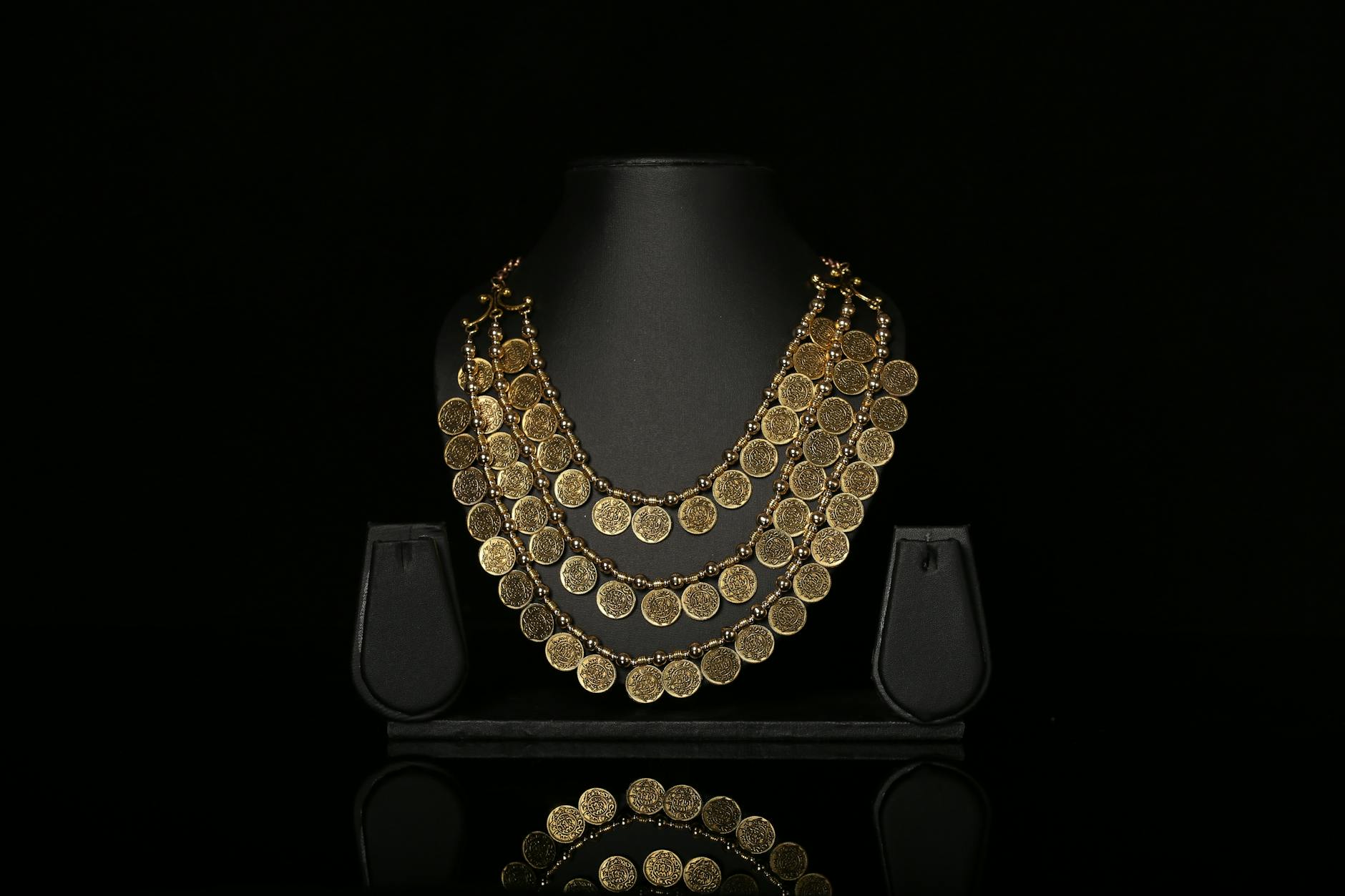
The Kasu Mala is the most investment-grade piece of South Indian bridal jewellery — a long necklace strung with overlapping 22K gold coins, each embossed with a seated Lakshmi figure. Unlike ornate bridal sets that lock value into making charges, the Kasu Mala stores wealth as near-bullion: low making cost, hallmarked coins, and 92–95% resale liquidity at any BIS-licensed jeweller. For Tamil, Telugu, Kerala and increasingly Karnataka brides, it is both a heritage marker and a serious wealth-storage instrument.
This 2026 guide compares the three regional traditions (Tamil Kasu Malai, Telugu Kasulaperu, Malayalam Kasu Mala), explains the ritually-significant coin counts of 21, 27, and 33, walks through the investment-grade economics, and identifies the authentic sourcing hubs in T. Nagar Chennai, Charminar Hyderabad, and Thrissur Kerala.
The piece: overlapping Lakshmi coins on a chain
A Kasu Mala consists of two structural components: the gold chain (typically 22K, 8–18g, depending on length and chain style) and the coins (each 22K, 1.5–4g, attached individually with small jump-rings or fixed bails). The coins overlap like fish-scales so the chain itself is barely visible; the visual effect is of a continuous gold drape rather than a chain plus separate pendants.
Each coin is a thin disc, 1.2–1.8 cm in diameter. The face is embossed with one of three classical motifs:
- Seated Lakshmi (Padmasana posture, two arms or four arms): the most common motif across all three regional traditions. The coin face reproduces the iconography of the actual gold Lakshmi coins minted historically by Vijayanagar and Mughal-era kingdoms.
- Tirupati Venkateswara: common in Telugu and Tamil Sri Vaishnava families; the namam (V-shaped tilak) is the dominant feature.
- Hanuman or Subramanya: regional variants found in Tamil Nadu and parts of Kerala, particularly for families with kuldevta affiliations to these deities.
The reverse face is plain or carries a small mantra inscription. The bail (loop) at the top of each coin is hand-soldered and connects to the main chain via a jump-ring. The coins overlap by 30–45% of their diameter, depending on the bridal style preference.
Coin counts: 21, 27, 33 and their meanings
The number of coins is ritually selected, not arbitrary. Three primary counts dominate:
- 21 coins (Tamil light bridal, modern Telugu): 21 = 7 × 3 — the seven classical planets (Navagraha minus the two shadow planets) multiplied by the three modes of human action (manasa, vacha, karmana). This is the lightest standard bridal Kasu Mala, suitable for daily-wear-after-wedding use.
- 27 coins (standard bridal — Tamil and Telugu): 27 corresponds to the 27 nakshatras (lunar mansions) of Vedic astrology. This is the most common bridal coin count and is considered to bring all the nakshatra blessings.
- 33 coins (heavy heritage — Kerala and Andhra): 33 corresponds to the 33 Vedic deities (Trayastrimsa Devata). This is the heaviest standard variant, typically reserved for ceremonial wear rather than daily.
- 45, 51 coins: custom heavy heritage pieces, often passed mother-to-daughter as anniversary additions.
- 108 coins: the rarest and heaviest configuration — 108 is the supreme auspicious number in Hindu tradition. A 108-coin Kasu Mala is a once-in-a-generation commission, typically using 4g coins for a total of ~430g of 22K gold. Only a handful are commissioned each year.
Within each regional tradition the coin count signals the bride's family's wealth and the wedding's scale. A 21-coin Kasu Mala is a respected modest bridal piece; a 33-coin announces a substantial wedding; a 51 or 108 is rarefied territory.
Regional comparison: Tamil, Telugu, Kerala
Although the underlying piece is the same, three distinct regional styles have evolved:
- Tamil Kasu Malai: typically 21–27 coins of 1.5–2.5g each. Coin face carries seated Lakshmi with shallow embossing. The chain is often a kerala-pattern flat link or simple curb. Tamil tradition prefers slightly longer Mala (40–46 cm) so the Mala drapes mid-chest.
- Telugu Kasulaperu: 27–33 coins of 2–3g each, slightly larger and heavier than Tamil. Coin face often Tirupati or Lakshmi with deeper carving. Chain is heavier (12–18g). Telugu tradition prefers shorter length (35–40 cm) so the Mala sits at collarbone level. See our companion Telugu Mangalasutram guide for how the Kasulaperu pairs with the twin-disc pendant.
- Malayalam Kasu Mala: 27–51 coins of 2.5–4g each — the heaviest of the three traditions. Coin face is deep-carved Lakshmi with elaborate detailing. Chain can be heavier still (15–22g). Kerala tradition prefers very long Mala (45–55 cm) reflecting the Malayali preference for layered heavy bridal jewellery.
Modern brides in inter-community marriages or in metro cities often blend elements — a Tamil-base 27-coin design with the Kerala-deeper carving, for instance. Custom orders allow this freely; the coin count and weight remain the customer's choice.
The investment-grade economics
The Kasu Mala is one of the few traditional Indian bridal pieces where the value-retention math is genuinely strong:
- Low making charge: coins are largely flat discs with shallow embossing. Making charges typically run 8–12% — much lower than ornate jewellery (18–25%) or temple-jewellery sets (22–35%).
- Hallmark across coins: each individual coin should carry a 916 BIS hallmark and HUID (or a master HUID for the assembled piece). This makes verification at resale straightforward via the BIS Care app — see our HUID verification guide.
- High resale liquidity: BIS-licensed jewellers across India readily buy back hallmarked Kasu Mala. Typical buy-back rates are 92–95% of today's IBJA rate, against 75–82% for heavily-worked bridal sets. On a 27-coin / 70g Mala, that's a difference of ~₹1.4 lakh in resale value.
- Per-coin liquidity: if the family needs partial liquidity, individual coins can be removed and sold separately. Each coin functions as a 2–3g gold coin with full hallmark.
Compare this to a heavily-worked Polki or Kundan bridal set where 30–50% of the purchase price is making charges that are permanently lost on resale. The Kasu Mala loses only the 8–12% making and the 5–10% buy-back margin — total round-trip cost of 13–22% versus 50–60% for ornate pieces.
2026 pricing examples
Worked pricing using today's 22K rate of ₹13,628/g:
- 21-coin Tamil light bridal (1.5g each + 8g chain = 39.5g 22K): Gold ₹5.38 lakh + 10% making (₹53,800) + GST (₹19,300). Total: ~₹6.10 lakh.
- 27-coin Telugu standard (2.5g each + 12g chain = 79.5g 22K): Gold ₹10.83 lakh + 10% making (₹1.08 lakh) + GST (₹38,700). Total: ~₹12.30 lakh.
- 33-coin Kerala heritage (3g each + 15g chain = 114g 22K): Gold ₹15.54 lakh + 12% making (₹1.86 lakh) + GST (₹56,000). Total: ~₹17.96 lakh.
- 108-coin custom heritage (4g each + 22g chain = 454g 22K): Gold ₹61.87 lakh + 10% making + GST. Total: ~₹70.50 lakh.
Verify any quote against today's live IBJA-aligned 22K rate. Watch for jewellers quoting 18% or higher making — for a Kasu Mala this is excessive given the coin disc design. Negotiate firmly to 10–12% range.
Sourcing: T. Nagar, Charminar, Thrissur
Three South Indian hubs dominate the Kasu Mala supply:
- Chennai's T. Nagar (Pondy Bazaar, Ranganathan Street, Usman Road): the largest concentration of Tamil bridal jewellers in the country. Both heritage family-run shops and major chains (Saravana, GRT, Lalitha, Joyalukkas, Tanishq) compete intensely, keeping making charges low. The Tamil Kasu Malai style is most authentic here. Custom orders take 3–5 weeks.
- Hyderabad's Charminar / Lad Bazaar: the master-karigar hub for Telugu Kasulaperu, particularly for the deep-carved Lakshmi or Tirupati coins. Custom commission lead times of 4–6 weeks for hand-carved pieces. Pricing is competitive thanks to high local competition.
- Thrissur, Kerala (Naduvilal, Round South, Kuruppam Road): the gold capital of Kerala and the source for the heaviest heritage Malayalam Kasu Mala. Multiple master karigars produce 33+ coin Mala with deep coin carving. Allow 4–8 weeks for fully heritage-grade pieces.
For sub-district shops outside these three hubs, our India-wide jeweller directory lists BIS-licensed shops who can custom-order Kasu Mala through their T. Nagar, Hyderabad, or Thrissur suppliers. Kerala in particular has dense BIS-licensed coverage even in smaller tehsils thanks to the state's high household gold ownership.
Care, restringing, and adding coins over time
Kasu Mala maintenance is simpler than for ornate bridal pieces. Weekly cleaning with mild soap and a soft toothbrush keeps the coin embossing crisp. Restringing every 5–8 years is normal — any BIS-licensed jeweller will redo the chain or jump-rings for ₹2,000–₹8,000.
One characteristic Kasu Mala practice is incremental coin addition over the marriage. Many South Indian families commission a base 21- or 27-coin Mala at the wedding and add 1–2 coins each year as anniversary gifts or at the birth of children. Over 20–30 years a 27-coin Mala can grow to a 51-coin Mala with embedded family memory — each coin marked internally with the date of addition. This practice combines the heritage value with the investment value in a way unique to the Kasu Mala among Indian bridal pieces.
For broader bridal gold planning, see our Indian wedding gold buying checklist covering all major regional traditions.
Authoritative references
For BIS hallmarking standards governing each Kasu Mala coin's 22K purity and HUID, see bis.gov.in. For today's IBJA 22K rate (the baseline against which any Kasu Mala quote should be checked, and against which resale rates are calculated), see ibjarates.com. For verified Tamil Nadu, Telangana, Andhra Pradesh and Kerala jewellers offering authentic Kasu Mala / Kasulaperu, browse our Tamil Nadu directory, Telangana directory, and Kerala directory.
More in Wedding & Bridal
Share this article
Our editorial team comprises jewellery industry veterans, certified gemmologists, and passionate writers with decades of combined experience across India's gold, diamond, and gemstone markets. Every article is researched, fact-checked, and written to help Indian buyers make smarter, safer jewellery decisions.
Passionate about jewellery and love to write? We'd love to hear from you.
Join us as a writer →Ready to buy? Find verified jewellers near you
Browse 10,000+ BIS hallmark certified jewellers across India. Compare ratings, check today's gold rate, and book a visit.
Keep Reading