The Telugu Mangalasutram is the central wedding ornament of the Andhra and Telangana bride — a pair of carved 22K gold discs strung on a yellow turmeric-dyed cotton thread. Unlike the North Indian mangalsutra (single pendant on a black-bead chain), the Telugu version uses TWO discs — one from each family — and three ritual knots tied during the wedding muhurat. The structure encodes the joining of two lineages with theological precision.
This 2026 Andhra-Telangana guide covers the twin Pustelu discs and their motifs, the three-knot ceremony, how the Mangalasutram pairs with the Vaddanam, Kasulaperu and Vanki, today's pricing, and where to source authentic pieces — particularly in Hyderabad's Charminar precinct and Andhra Pradesh's regional jeweller hubs.
The two Pustelu discs
Each disc — called Pustelu or Bottu in Telugu — is a small flat 22K gold piece, typically 1.5 to 2.5 cm in diameter. The face is hand-carved with a community-specific deity or symbol:
- Sri Vaishnava Telugu families typically carve Tirupati Venkateswara (Lord Balaji) on the disc — the namam (white V-shaped tilak) is hammered into the gold surface.
- Smartha Telugu Brahmin families often carve Lakshmi in seated lotus posture, with subtle hand-carved details on the face and ornaments.
- Reddy and Kamma families use a wider variety — sometimes a Lakshmi-Saraswati pair carving, sometimes simple geometric mandalas.
- Other communities may use the Tirumala temple emblem, the family kuldevta, or stylised flowers.
The two discs are conventionally identical in motif but provided separately — one by the bride's family (commissioned in advance), the other by the groom's family. This dual-provision symbolises that the marriage is not a unidirectional gift of the bride to the groom, but a mutual binding between two lineages. After the wedding the discs are strung together on the same yellow thread; the bride wears them for life as a single piece.
The reverse face of each disc is plain or carries a small engraved kuldevta name. The bail (loop) at the top is hand-soldered. Heritage pieces from Hyderabad's Lad Bazaar karigars carry deeper carving with sharper edges than mass-produced retail versions.
The three-knot ceremony at muhurat
The Mangalasutra-tying moment in the Telugu wedding is called Kanyadaanam-following Pustelu Kattadam. The sequence at the muhurat is:
- The bride is seated on the wedding stage in her ceremonial sari (typically a red or kumkum-coloured Kanchipuram or Dharmavaram silk).
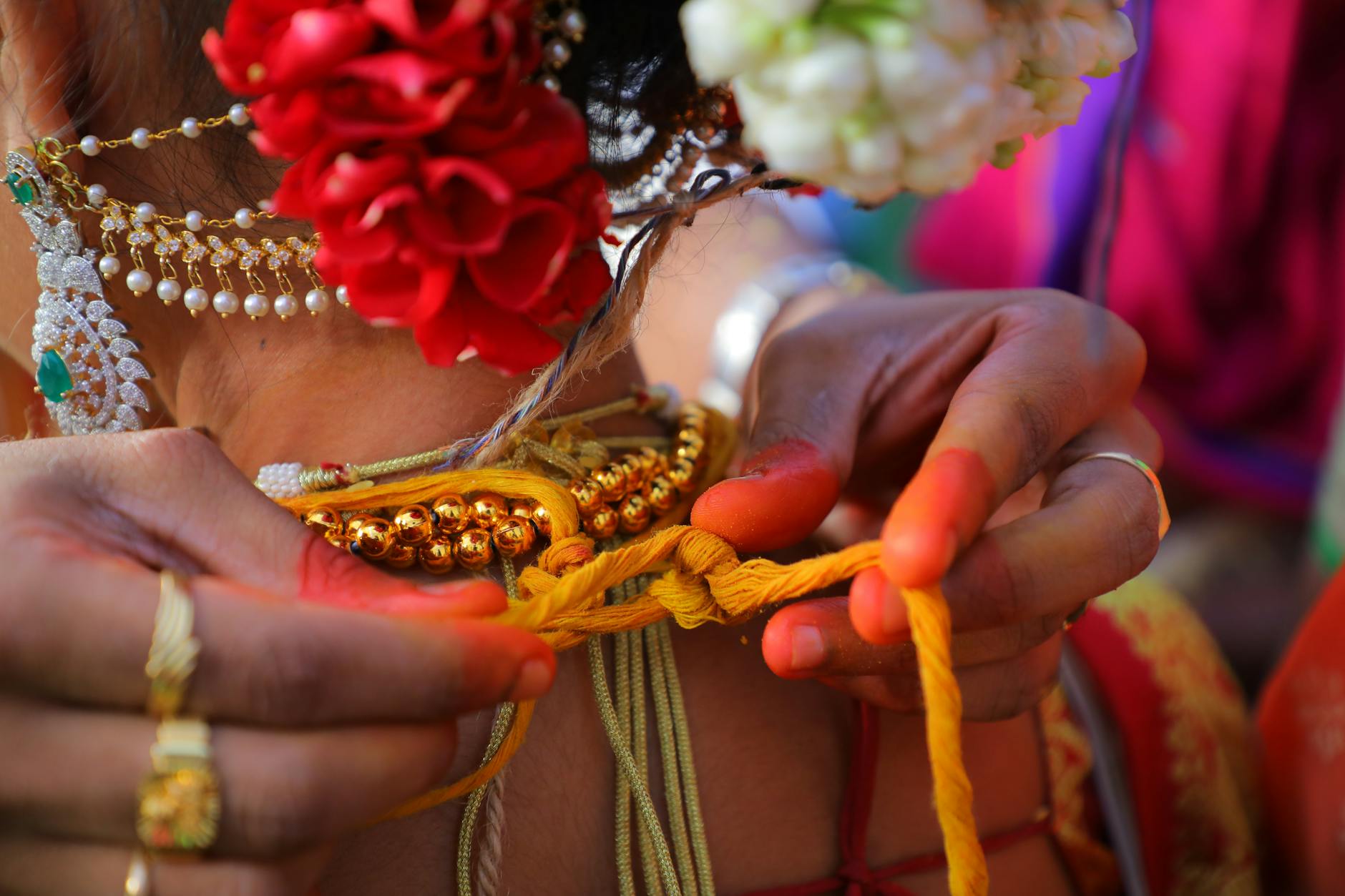
- The two discs are placed in the priest's hand. The yellow thread (Pasupu Thaaru, dyed with turmeric) is threaded through the bails of both discs.
- The priest blesses the thread with chants invoking Lakshmi, Saraswati, and Parvati.
- The groom places the thread around the bride's neck. He ties the first knot — representing manasa (thought).
- The groom's sister then ties the second knot — representing vacha (word).
- The groom's sister ties the third knot — representing karmana (deed).
- The conch is sounded, and the marriage is formally registered in Telugu Hindu tradition.
The three knots together commit the couple at three levels of human action — thought, word, and deed — making the marriage a complete vow. The yellow thread is preserved as long as it lasts (often 6–18 months of wear); when it weakens, the bride transfers the discs to a fresh yellow thread or to a 22K gold chain. The original three knots are preserved in a memento box.
Pairing with the Vaddanam, Kasulaperu, and Vanki
The Mangalasutram is the centrepiece, but the complete Telugu bridal set comprises four pieces, each marking a part of the body:
- Mangalasutram (neck) — 12–30g 22K: the marital pendant.
- Vaddanam (waist) — 100–250g 22K: the heavy waist belt with carved Lakshmi medallions and small bells.
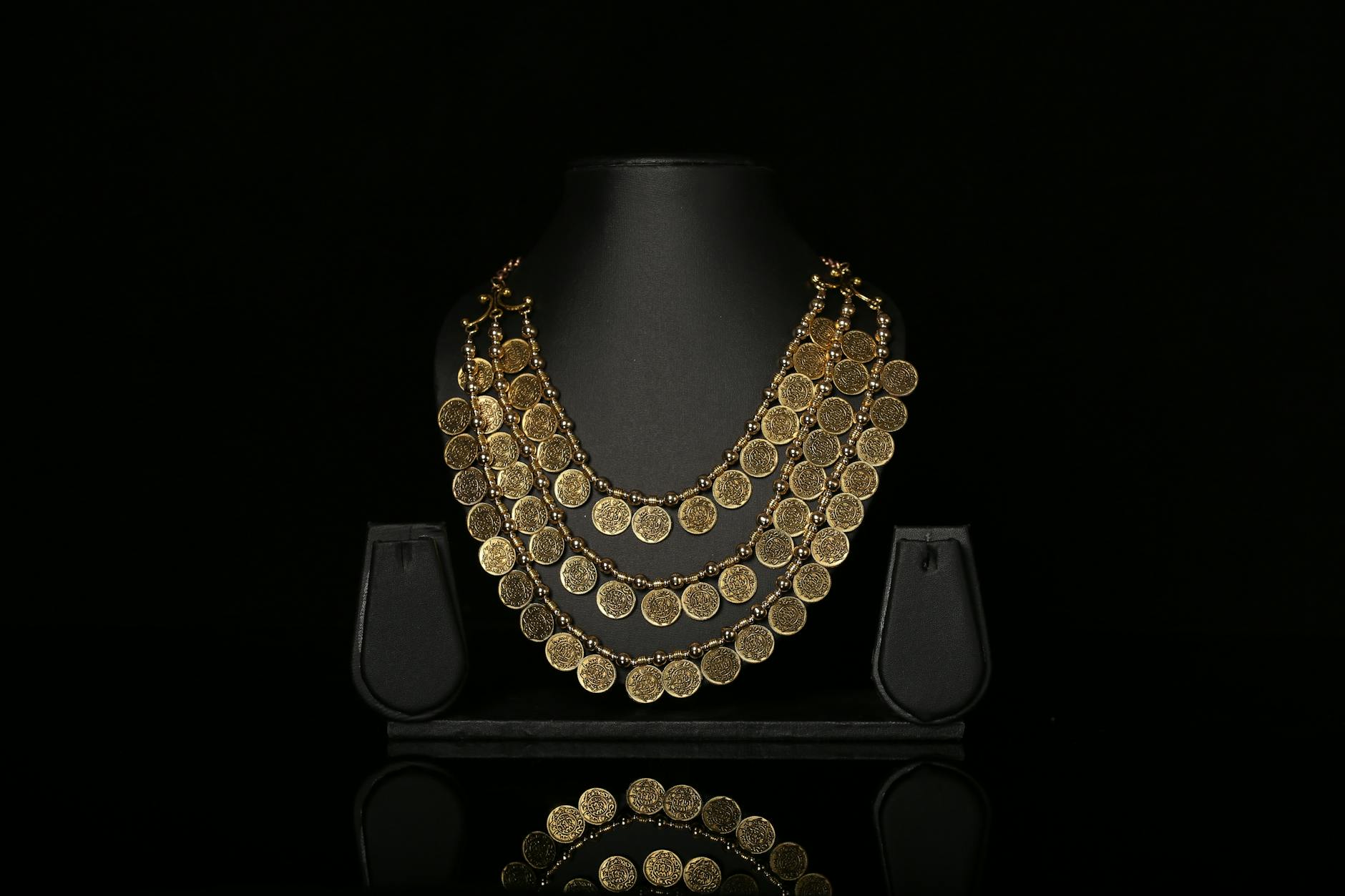
- Kasulaperu (long necklace) — 60–150g 22K: the long coin necklace strung with overlapping gold Lakshmi coins. See our Kasu Mala / Kasulaperu guide for the full design history.
- Vanki (upper arm) — 15–40g per arm 22K: the V-shaped armlet worn high on the upper arm, typically with a peacock or Lakshmi central motif.
The four pieces together can total 200–500g of 22K gold for a heavy traditional Telugu bridal set — a substantial wealth-storage commitment alongside their ritual function. Many Telugu families plan the bridal set's gold accumulation over 8–15 years of marriage saving, or pass selected pieces (especially Vaddanam and Kasulaperu) mother-to-daughter through generations. For broader bridal-set planning across Indian communities, see our Indian wedding gold buying checklist.
Weight, making charge, and 2026 pricing
Mangalasutram pricing examples for the twin-disc pendant only (excluding the broader bridal set):
- Light traditional pair (6g + 6g = 12g 22K, plain Lakshmi carving): Gold ₹1.64 lakh + 18% making (₹29,400) + GST (₹6,150). Total: ~₹1.99 lakh.
- Standard bridal pair (10g + 10g = 20g, deep-carved Tirupati or Lakshmi): Gold ₹2.73 lakh + 20% making (₹54,500) + GST (₹10,900). Total: ~₹3.38 lakh.
- Heavy heritage pair (15g + 15g = 30g, hand-engraved with diamond accents): Gold ₹4.09 lakh + 22% making + diamond cost. Total: ~₹6.50–8.50 lakh.
- Modern designer pair (12g + 12g = 24g, with Polki or Burmese ruby accents): Total typically ₹4–6 lakh.
Verify any quote against today's live IBJA-aligned 22K gold rate. Hand-carved Pustelu legitimately commands 18–22% making — the deity face requires precise sculpting. Machine-stamped versions should not exceed 10–12%.
Identifying a heritage hand-carved Mangalasutram
Five signs distinguish authentic master-karigar work:
- Carving depth variation: hand-carved deity faces show 0.1–0.3mm depth variation in features (eyes, nose, lips); machine-stamped pieces are uniformly flat.
- Edge crispness: hand-carved edges are sharp and slightly faceted; machine pieces have rounded, almost-pillow edges.
- Backplate finish: heritage pieces have a subtly hammered backplate; machine pieces are mirror-polished both sides.
- Bail soldering: hand-attached bails show a faint solder ring; machine pieces have moulded one-piece bails.
- BIS hallmark + HUID: any 22K Pustelu sold after 16 June 2021 must carry a 916 hallmark plus a 6-character HUID. Verify via the BIS Care app — see our HUID verification guide.
Sourcing in Hyderabad and beyond
Three Hyderabad precincts dominate Mangalasutram supply:
- Charminar / Lad Bazaar: the historic centre. Master karigars have carved Pustelu for over 200 years, particularly the Tirupati Venkateswara and Lakshmi face-carvings. Deep-carved heritage pieces are virtually exclusive to this precinct. Custom orders take 3–5 weeks. Prices are competitive thanks to high local competition.
- Abids / Sultan Bazaar: the established mid-tier retail centre. Mix of family-run jewellers and national chains. Better for last-minute purchases and standard motif pieces; slightly higher retail margins than Lad Bazaar.
- Jubilee Hills / Banjara Hills: the premium designer hub. Modern Mangalasutram with diamond, Polki or Burmese ruby accents. Higher retail margins; faster turnaround for stocked designs.
Beyond Hyderabad, regional Andhra centres include Vijayawada (Besant Road), Visakhapatnam (Daba Garden), and Tirupati (the temple-town has dedicated Pustelu specialists with theological accuracy on the Tirumala motif). Our Andhra Pradesh jeweller directory and Telangana directory list BIS-licensed shops in tehsils across both states.
The Mangalasutram in modern Telugu weddings
Modern Telugu families adapt the Mangalasutram in three common ways while preserving the twin-disc core. First, lighter Pustelu (6–8g each) for daily-wear durability — the heavy heritage discs are kept for ceremonial use only. Second, fitting the discs to a 22K gold chain after the original yellow thread weakens — the chain is more durable than turmeric-dyed cotton in modern urban environments. Third, diamond or Polki accents on the disc face for fusion bridal looks that retain the Lakshmi or Tirupati core.
Each adaptation respects the twin-disc theological core — the two families' contribution remains visible, and the three knots are preserved when the thread is replaced. For inheritance, the discs are typically passed mother-to-daughter as a complete pair, with the daughter's wedding using either the inherited discs (rethreaded with fresh yellow thread) or fresh discs commissioned to the same motif.
Authoritative references
For BIS hallmarking standards governing the Pustelu's 22K purity and HUID requirements, see bis.gov.in. For today's IBJA gold rate (your baseline against any quote), see ibjarates.com. For verified jewellers in Hyderabad, Vijayawada, Tirupati and other tehsils, browse our India-wide jeweller directory. For comparative regional bridal traditions see our Maharashtrian Thushi guide.
More in Wedding & Bridal
Share this article
Our editorial team comprises jewellery industry veterans, certified gemmologists, and passionate writers with decades of combined experience across India's gold, diamond, and gemstone markets. Every article is researched, fact-checked, and written to help Indian buyers make smarter, safer jewellery decisions.
Passionate about jewellery and love to write? We'd love to hear from you.
Join us as a writer →Ready to buy? Find verified jewellers near you
Browse 10,000+ BIS hallmark certified jewellers across India. Compare ratings, check today's gold rate, and book a visit.
Keep Reading