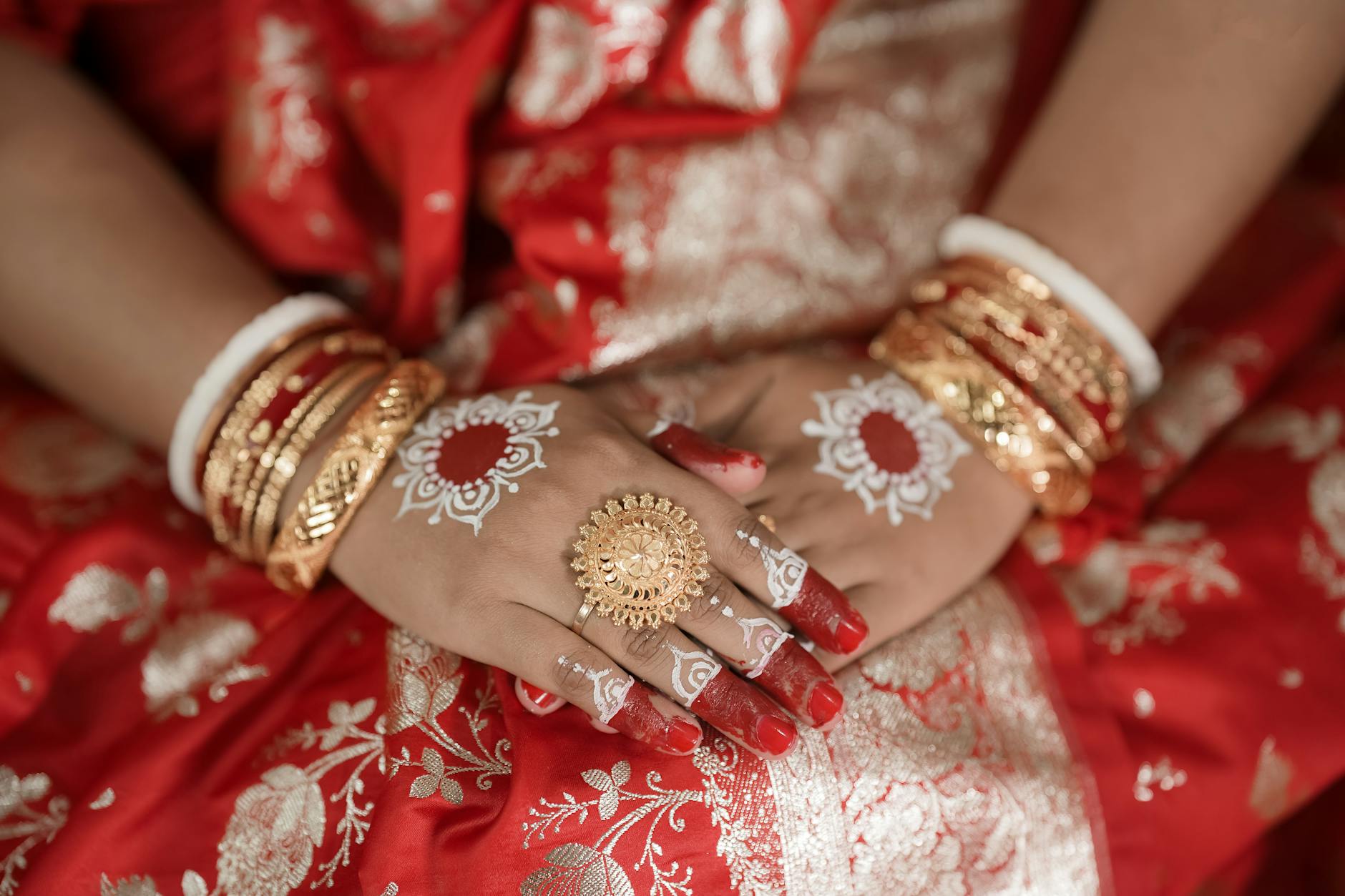
Shakha-Pola are the Bengali Hindu bride's lifelong marital symbol — a white conch-shell bangle (Shakha) paired with a red coral bangle (Pola), worn together on each wrist from the day of the wedding until widowhood. To anyone unfamiliar with Bengali tradition, the immediate question is: where is the mangalsutra? The answer is that Bengalis don't wear one. The Shakha-Pola is the marital symbol — older than the mangalsutra and rooted in a different ritual lineage entirely.
This 2026 guide explains the Shakha-Pola's materials and meaning, why Bengali tradition diverges from the mangalsutra-using communities, the Aiburo Bhaat ceremony where the bangles are first worn, modern gold-cased versions, and where to source authentic pieces in Kolkata's Bow Bazaar and beyond.
The materials: conch shell and red coral
Shakha is carved from the white conch shell of Turbinella pyrum — the species from which the sacred Hindu shankh is also made. Master craftsmen on Kolkata's Bow Bazaar have been carving conch bangles for over two centuries; the technique requires steaming the shell to soften it, hand-shaping the bangle ring, and polishing the inner and outer surfaces to a smooth finish. Each Shakha is sized to the wearer's wrist circumference; a properly-fitted Shakha slides over the hand only with effort.
Pola is traditionally made from red coral — the deep blood-red coral imported from the Mediterranean and Indian Ocean. In modern practice, however, most Pola bangles are made from red lac (a natural resin) coloured to match the coral hue, because genuine coral has become both expensive and ecologically restricted. The red colour is theologically essential — it represents life-energy, fertility, and the active principle of Shakti — so the substitution from coral to red lac preserves the symbolic content while making the piece affordable.
The two materials together — white Shakha for spiritual purity (sattva) and red Pola for life-force (rajas) — encode the Bengali Hindu wedding's theological framework. The bride wears the symbolic union on her wrists for the rest of her married life.
Why no mangalsutra?
The question is theologically important because it reveals how regional Hindu traditions developed independently before later cross-pollination. The mangalsutra is primarily a South Indian (Tamil, Telugu, Kannadiga) and Maharashtrian tradition — the gold pendant tied around the neck during the muhurat. It spread to North India through the 19th and 20th centuries with Sanskritising movements and pan-Indian Bollywood imagery, but Bengal had its own marital symbol set already in place.
The Bengali Hindu marital tradition draws on Vedic-Tantric heritage where the wrists, rather than the neck, carry the marital signs. This is consistent with broader Bengali Shakta traditions (Kali, Durga worship) that emphasise the active life-force housed in the wrists and arms. The bride who wears Shakha-Pola is making a statement: I am married within the Bengali tradition specifically, with its older lineage. Comparable wrist-based marital symbols exist in Maharashtrian (kada-bichhua) and other regional traditions, but Bengal's Shakha-Pola is unique in pairing two distinct materials.
Some modern Bengali brides — particularly in inter-community marriages or in the diaspora — also wear a mangalsutra alongside the Shakha-Pola. Both can coexist; the addition is acceptable but strictly optional within Bengali tradition.
The Aiburo Bhaat and the Saat Suhagin
The Shakha-Pola is not put on by the bride herself or by the groom. The ritual is unusual within pan-Indian wedding ceremonies because the bride's wrist-decoration happens before she even leaves for the wedding venue.
The night before the wedding, the bride is given Aiburo Bhaat — her last meal as an unmarried woman, served at her parents' home. The meal is elaborate: bhaat (rice), shorshe maach (fish in mustard), traditional Bengali sweets like roshogolla and mishti doi, and savoury preparations. Her wrists are bare during this meal. After the meal she is bathed and dressed in the morning ceremonial wear (typically a red Banarasi or Tussar silk).
The Shakha-Pola is then put on by Saat Suhagin — seven married women from the bride's extended family who are themselves wearing intact Shakha-Pola (i.e., neither widowed nor with broken bangles). Each woman touches the bride's wrists in turn while reciting blessings. The first Shakha and Pola are slid onto the right wrist, then the left. The bride's wrists must be slightly oiled to allow the snug-fitted Shakha-Pola to pass over the knuckles.
From this moment until the formal Saat-Pak (seven circumambulations) at the wedding, the bride is considered partially-married in Bengali tradition. The Shakha-Pola is the ritual sign of the threshold transition.
Gold-cased Shakha-Pola: the modern version
For practical and prestige reasons, most Bengali brides today wear gold-cased Shakha-Pola — where a 22K gold band is fitted around the conch and around the coral/lac respectively. The gold case serves three purposes: it protects the fragile conch and lac from cracking; it adds wealth-storage value to the marital piece; and it allows the bride to wear richer ornamentation in keeping with the heavy gold tradition of Indian bridal jewellery.
The gold case can be plain (a smooth band) or ornate (engraved with peacock, fish, or floral motifs that are characteristically Bengali). Heritage Shakha-Pola from Kolkata's master karigars often feature the alpana-style geometric border that is unique to Bengali metalwork.
2026 pricing for gold-cased pairs:
- Light gold-cased pair (8g 22K total): Conch+lac base ₹3,500. Gold value ₹1.09 lakh + 14% making (₹15,260) + GST (₹3,070). Total: ~₹1.31 lakh.
- Standard bridal pair (15g 22K, plain band): Materials ₹6,000. Gold ₹2.04 lakh + 14% making (₹28,600) + GST (₹5,750). Total: ~₹2.45 lakh.
- Heritage hand-engraved pair (25g 22K, alpana motifs): Materials ₹8,000. Gold ₹3.41 lakh + 18% making (₹61,300) + GST (₹11,000). Total: ~₹4.20 lakh.
- Diamond-accent modern pair (15g + small diamonds): Add ₹40,000–₹1.5 lakh depending on stone grade.
Verify any quote against today's live IBJA-aligned 22K rate. Gold cases legitimately attract 12–18% making depending on engraving complexity. Anything over 22% is excessive for a relatively simple band shape.
Sourcing in Kolkata: Bow Bazaar and beyond
Kolkata's Bowbazar (Bow Bazaar) is the historic centre of Shakha-Pola craft. Two distinct sets of artisans work side-by-side there:
- Shankhakar (conch carvers): the families on Bow Bazaar's Sankha Patti have carved Shakha for 200+ years. They source raw conch from Tamil Nadu's Rameswaram, steam-soften it, and hand-shape each bangle to wrist-fit. Custom Shakha takes 1–3 days for plain pieces.
- Goldsmith ateliers: adjacent to the Shankhakar are 22K goldsmiths who fit the gold cases around the finished Shakha and Pola. The two trades work in coordination — the Shakha is sized first, then the goldsmith fabricates the matched gold band.
Outside Bow Bazaar, North Kolkata's Bagbazar and Shyambazar each have a handful of established Shankhakar families. South Kolkata's Gariahat carries newer retail of finished gold-cased pairs without on-site carving. For Bengali families settled outside Kolkata — in other West Bengal districts, Mumbai, Delhi or the diaspora — most local jewellers can custom-order through Bow Bazaar suppliers, with 4–6 weeks lead time including the gold-casing.
Care, replacement, and the symbolism of breakage
A broken Shakha or Pola is a powerful symbol in Bengali tradition. It is considered inauspicious — historically read as a sign of imminent widowhood. For this reason Bengali married women are exceptionally careful with their bangles: removed during heavy domestic work involving impact, kept lubricated with light oil to prevent stiffness, and replaced in a quiet ceremony if a piece does crack.
If a Shakha or Pola breaks accidentally during the wearer's married life, it is replaced individually (not as a pair). The replacement is done quietly at home with no fanfare — the Saat Suhagin ceremony is only for the original wedding-day fitting. Practical replacement of plain (non-gold-cased) Shakha or Pola costs ₹500–₹3,000.
Upon widowhood, the Shakha-Pola is removed by family elders in a separate ritual — the Bengali tradition's marker of the end of married life. The bangles are typically immersed in the Ganga or otherwise ritually disposed of.
Authoritative references
For BIS hallmarking standards governing the gold case on a Shakha-Pola pair, see bis.gov.in. For today's IBJA gold rate (your baseline for verifying any gold-case quote), see ibjarates.com. For verified West Bengal jewellers offering gold-cased Shakha-Pola, browse our West Bengal jeweller directory. For comparative regional bridal traditions see our Thushi guide and broader Indian wedding gold checklist.
More in Wedding & Bridal
Share this article
Our editorial team comprises jewellery industry veterans, certified gemmologists, and passionate writers with decades of combined experience across India's gold, diamond, and gemstone markets. Every article is researched, fact-checked, and written to help Indian buyers make smarter, safer jewellery decisions.
Passionate about jewellery and love to write? We'd love to hear from you.
Join us as a writer →Ready to buy? Find verified jewellers near you
Browse 10,000+ BIS hallmark certified jewellers across India. Compare ratings, check today's gold rate, and book a visit.
Keep Reading