The Dejhoor is the lifelong wedding symbol of the Kashmiri Pandit bride — a pair of small hexagonal 22K gold pendants suspended through the upper-ear piercings on a humble yellow thread. Worn from the day of the Devagon ceremony until the day she is cremated, the Dejhoor outlasts every other piece of bridal jewellery a Kashmiri Pandit woman owns. It is, in effect, the Kashmiri Pandit mangalsutra — but worn at the ears, not the neck.
This complete 2026 guide explains the Dejhoor's hexagonal design and meaning, the Devagon ceremony where it is first worn, the Athpos red-thread addition by the groom's family, today's gold weight and pricing, and where to source authentic pieces in Srinagar and Jammu as well as Delhi's Karol Bagh — the de facto capital of the Kashmiri Pandit diaspora.
The hexagonal design and its meaning
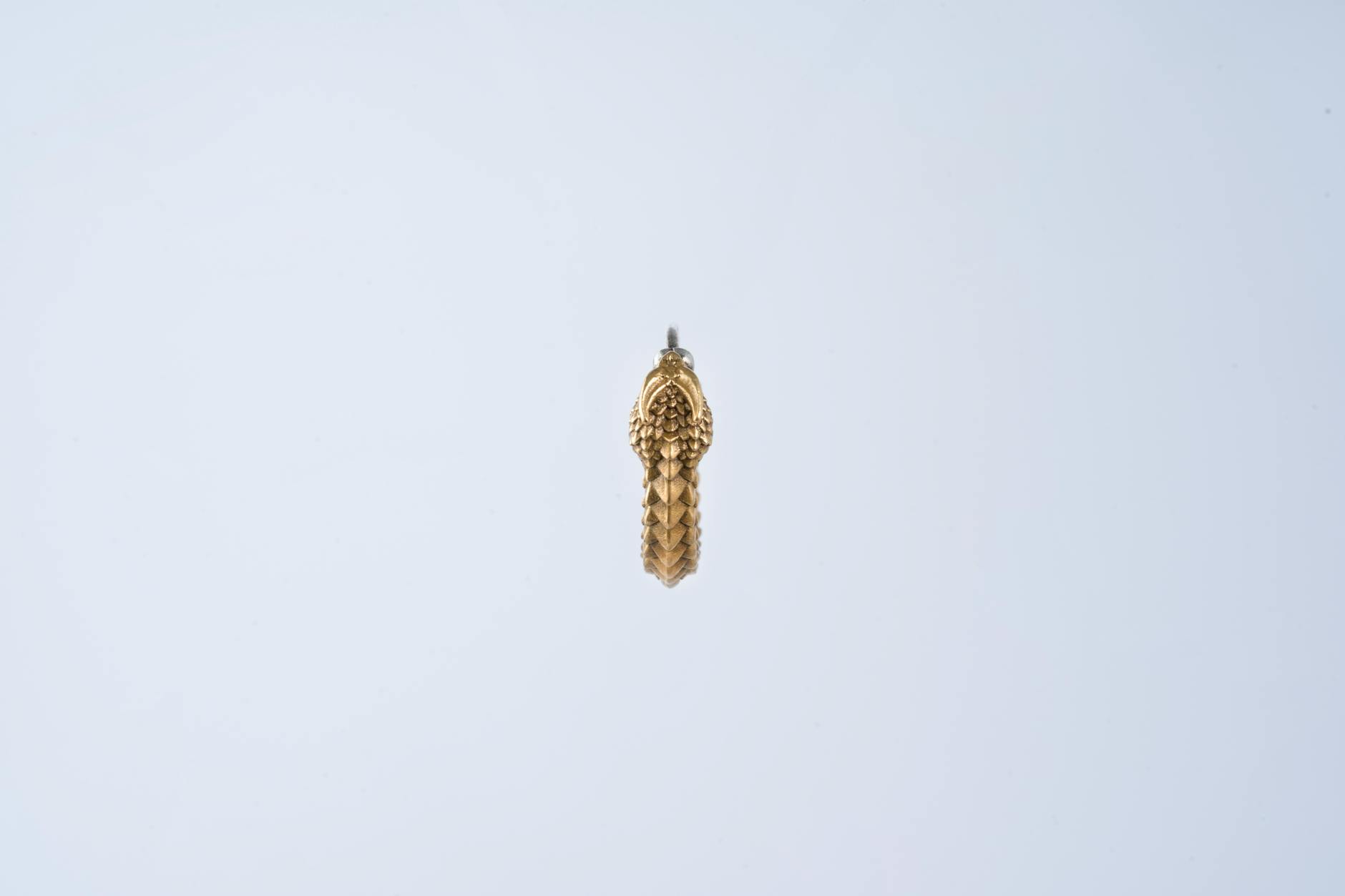
The traditional Dejhoor is a flat hexagonal pendant — six straight sides of equal length — measuring roughly 1.2 to 2 cm across. The hexagonal form is itself ritually significant: six is the number of philosophical schools (shad-darshana) in the orthodox Hindu tradition, and the hexagram is also an ancient yantra geometry associated with the union of Shiva and Shakti. In Kashmiri Pandit theology, where the Trika tradition (Kashmir Shaivism) is dominant, the hexagonal pendant carries this symbolism naturally.
The pendant face is flat and either plain-polished or hand-engraved with a simple lotus, sun-disc, or geometric mandala. Heritage pieces from older Srinagar karigars carry deeper engraving with sharper edges; modern machine-stamped versions are flatter and more uniform. A small loop (the bail) at the top of the hexagon allows the Athoor (yellow thread) to pass through.
The pair is mirror-symmetric — both pendants identical in weight, design and finish. They are worn through the helix or upper-cartilage piercing of each ear, hanging downward against the side of the neck. Length when worn is typically 7–12 cm from the ear lobe, depending on the Athoor length the bride prefers.
The Devagon ceremony
The Devagon is the ritual where the Dejhoor first enters a woman's life. It is conducted at the bride's home, usually 2–3 days before the formal Lagan (wedding) ceremony. The pre-conditions are specific: the bride must have completed the Mehndiraat ritual the night before; the family priest (Pandit) must be present; the kuldevta (family deity) must be ritually invoked through a small havan.
The sequence is: havan with chants invoking Shiva, Shakti, and the kuldevta; ritual washing of the Dejhoor in milk and water; piercing of the upper ear (or threading through an existing helix piercing); knotting of the yellow Athoor by the priest or family elder; and finally a blessing where the bride's mother and aunts touch the Dejhoor while reciting traditional verses.
The Devagon is theologically significant because it marks the spiritual transition into married life — even before the wedding ceremony itself. From this moment, the bride is considered partially married in the Kashmiri Pandit tradition. The Lagan ceremony 2–3 days later is the formal civil and social transition, but the spiritual marriage begins at the Devagon.
The Athpos: the groom's family red thread
On the wedding day itself, after the Lagan rituals, the groom's family adds a second thread — the Athpos — to the Dejhoor's existing yellow Athoor. The Athpos is a fine red silk cord, sometimes embellished with small gold beads or tiny pearl drops at the tips. It is tied alongside (not replacing) the original yellow thread.
The two-thread arrangement is the visible community signal that a woman is fully married rather than only Devagon-betrothed. From a distance, the colour combination — yellow + red against the side of the neck — is unmistakable as Kashmiri Pandit marital identity. The Athpos is also said to symbolise the joining of the two families: the bride's yellow original and the groom's red addition, knotted together.
After 6–12 months of married life, many modern Kashmiri Pandit women replace the Athpos red thread with a slim 22K gold chain for daily-wear durability — silk threads fray with regular wear, particularly in dry diaspora climates very different from Kashmir. The original yellow Athoor is preserved underneath the gold chain so that the ritual continuity is maintained even when the visible material changes. Older women in the community, however, prefer to retain the silk Athpos through their lifetime, replacing it every 2–3 years when it weakens.
Weight, making charge, and 2026 pricing
Dejhoor pricing varies by weight, finish, and whether it is plain or stone-set:
- Light traditional pair (4g + 4g = 8g 22K, plain hexagonal): Gold ₹1.09 lakh + 18% making (₹19,640) + GST (₹4,250). Total: ~₹1.33 lakh.
- Standard bridal pair (6g + 6g = 12g, hand-engraved): Gold ₹1.64 lakh + 20% making (₹32,700) + GST (₹6,560). Total: ~₹2.03 lakh.
- Heavy ceremonial pair (10g + 10g = 20g, deep engraving + small diamonds): Gold ₹2.73 lakh + 22% making + diamond cost. Total: ~₹4.20–5.50 lakh.
- Heritage refurbished (grandmother's piece, re-engraved): Polishing + re-engraving: ₹8,000–₹25,000 depending on labour. Re-hallmarking adds ₹50–₹500.
Verify any quote against today's live IBJA-aligned 22K rate. The making charge for a hand-engraved hexagonal Dejhoor is legitimately 18–22%, reflecting the precision required to keep the six sides geometrically equal while engraving the inner pattern. Anything over 25% is excessive; anything under 12% almost certainly indicates a machine-stamped piece.
Identifying a heritage hand-engraved Dejhoor
Five signs distinguish a master-karigar piece from a commercial machine version:
- Edge sharpness: hand-engraved hexagons have crisp, slightly faceted edges; machine-stamped pieces have rounded, almost-pillow edges.
- Engraving depth variation: hand engraving shows 0.05–0.15mm depth variation across a single line, visible under 10× magnification. Laser or machine engraving is uniformly flat.
- Backplate: heritage pieces have a slightly hammered (not polished) backplate; machine pieces are mirror-polished both sides.
- Bail soldering: hand-attached bails show a faint solder ring at the join; machine pieces have moulded one-piece bails.
- BIS hallmark + HUID: any new 22K Dejhoor sold after 16 June 2021 must carry a 916 hallmark plus a 6-character HUID. Verify via the BIS Care app — see our HUID verification guide for the exact steps.
Sourcing: Srinagar, Jammu, Karol Bagh
Three hubs serve Kashmiri Pandit families in-Kashmir and across the diaspora:
- Srinagar (Maharaj Bazaar, Lal Chowk): for families still in or visiting Kashmir, the historic centre. Several family-run shops have continuously crafted Dejhoor pendants for over a century. Prices are competitive but lead times can be longer due to a smaller labour pool.
- Jammu (Raghunath Bazaar, Kanak Mandi): the largest Dejhoor hub for displaced Kashmiri Pandit families since the 1990 exodus. Multiple Pandit-owned jewellers maintain the traditional designs, often with the family's pre-1990 pattern books still in use. Custom orders take 3–4 weeks.
- Delhi (Karol Bagh, Lajpat Nagar, Pamposh Enclave): the diaspora's commercial centre. Karol Bagh in particular has multiple Kashmiri Pandit-owned shops that specialise in Dejhoor for the NCR community. Heritage and modern adaptations both available; faster turnaround (2–3 weeks) due to larger karigar networks.
For Pandit families settled outside these hubs, our verified national jeweller directory includes BIS-licensed shops that can custom-order the Dejhoor through their Karol Bagh or Jammu suppliers. Allow 4–8 weeks of lead time for fully hand-engraved pieces.
Heritage continuity and inheritance
The Dejhoor is traditionally not replaced or upgraded across a Kashmiri Pandit woman's life — the same pair is worn from Devagon to her cremation. This makes the original commission unusually important; quality matters because the piece will be worn 365 days a year for 50–70 years.
For inheritance, the conventions vary by family. Some Pandit families pass the Dejhoor mother-to-daughter at the daughter's wedding (the original is melted and recast as part of the new pair). Others preserve the original Dejhoor as a memorial ornament after the wearer's death and commission a fresh pair for the next generation. Either way, the pendants stay within the family lineage — they are rarely sold, even in financial hardship, because of their ritual significance.
For a broader view of regional bridal pieces and their lifecycle, see our companion guides on the Maharashtrian Thushi and the complete Indian wedding gold checklist.
Authoritative references
For BIS hallmarking standards governing the Dejhoor's 22K purity and HUID, see bis.gov.in. For today's IBJA gold rate (the baseline against which all Dejhoor quotes should be checked), see ibjarates.com. For verified jewellers in Jammu & Kashmir and the broader diaspora, browse our Jammu & Kashmir jeweller directory or the Delhi directory for Karol Bagh / Lajpat Nagar shops.
More in Wedding & Bridal
Share this article
Our editorial team comprises jewellery industry veterans, certified gemmologists, and passionate writers with decades of combined experience across India's gold, diamond, and gemstone markets. Every article is researched, fact-checked, and written to help Indian buyers make smarter, safer jewellery decisions.
Passionate about jewellery and love to write? We'd love to hear from you.
Join us as a writer →Ready to buy? Find verified jewellers near you
Browse 10,000+ BIS hallmark certified jewellers across India. Compare ratings, check today's gold rate, and book a visit.
Keep Reading