South Indian bridal jewellery is in a category of its own.
Where North Indian bridal jewellery tends toward Kundan, polki, and coloured stones, South Indian tradition is defined by an uncompromising commitment to 22K yellow gold in its purest, heaviest, most magnificent form.
Temple motifs — Lakshmi, Balaji, the lotus, the peacock, the mango — are the vocabulary of this jewellery tradition, and the pieces are so closely tied to ceremony and meaning that they have remained essentially unchanged for centuries.
This guide walks through every piece a South Indian bride might wear and what each means.
The Long Haaram: The Defining Piece
If there is one piece that defines South Indian bridal jewellery in the popular imagination, it is the long haaram — a necklace of 30–36 inches that hangs well below the bust, often with an elaborate pendant or pendant section at the base.
Unlike the layered necklace look of North Indian bridal jewellery, the haaram is worn as a singular statement piece, sometimes layered with a shorter choker at the collar but always dominant as the centrepiece of the neck.
Haaram designs vary by region and community. The Lakshmi haaram (featuring goddess Lakshmi pendants along the chain) is among the most traditional.
Temple haaram designs feature temple pillars and deity motifs in high-relief 22K gold work.
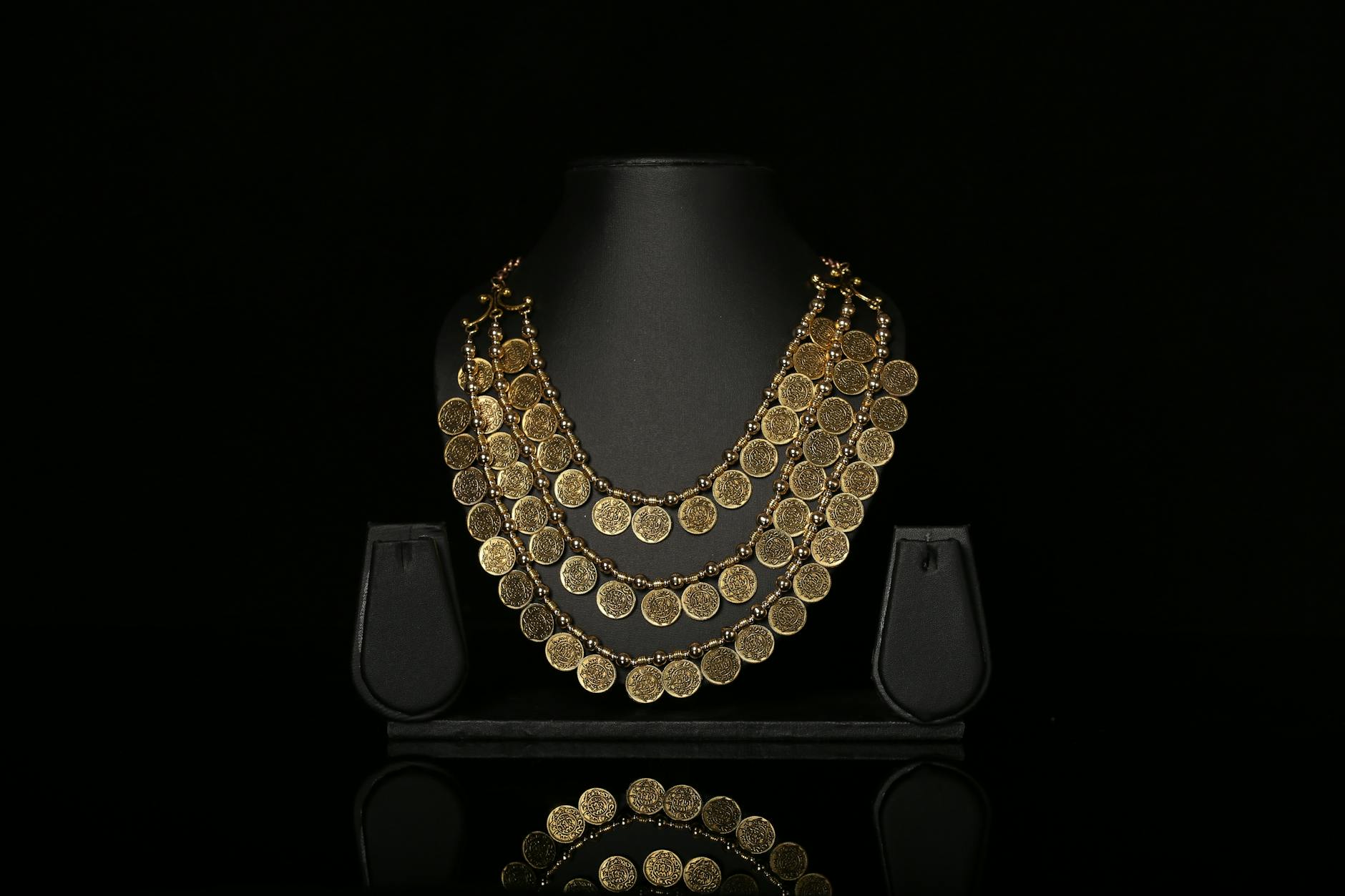
The kasumala — a haaram made of individual gold coins (kasu) — is a particularly beautiful and ancient form that doubles as a visual statement of family wealth.
The Thaali / Thali: The Sacred Mangalsutra
The thaali is the South Indian equivalent of the mangalsutra — the gold pendant tied around the bride's neck by the groom during the marriage ceremony.
Unlike the North Indian mangalsutra with its black bead chain, the thaali's design, material, and tying method vary significantly across South Indian communities:
- Tamil Nadu (Brahmin traditions): A simple gold pendant (often the thirumanagalyam) on a yellow thread; the thread may be replaced with a gold chain after the ceremony
- Tamil Nadu (Nadar/Vellalar): More elaborate pendant designs, often multiple small pendants on the chain
- Kerala: The minnu — a very simple small gold pendant on a yellow thread; Kerala's thaali is characteristically understated compared to Tamil Nadu traditions
- Karnataka: Varied by community; often a distinctive pendant design specific to the community's tradition
- Andhra Pradesh and Telangana: Distinctive designs with elaborate pendants, often featuring filigree work
The thaali is the one piece of South Indian bridal jewellery that carries the deepest sacred significance.
It is not merely ornamental — it is the visible symbol of the marriage itself and is treated accordingly.
The Vanki: The Armlet of the South
The vanki is a curved armlet worn on the upper arm, a piece with almost no equivalent in North Indian bridal tradition.
Its characteristic shape — a curved band that wraps around the bicep — is designed to fit the arm when it hangs naturally and to slide slightly when raised, creating a dynamic visual effect.
Vanki designs commonly feature the serpent (naga), Lakshmi, or the peacock, executed in high-relief 22K gold.
Some very traditional families insist on the vanki as an absolute bridal essential; in others, it is optional but remains one of the most visually striking South Indian bridal pieces.
The Nethi Chutti / Mathapatti: The Forehead Ornament
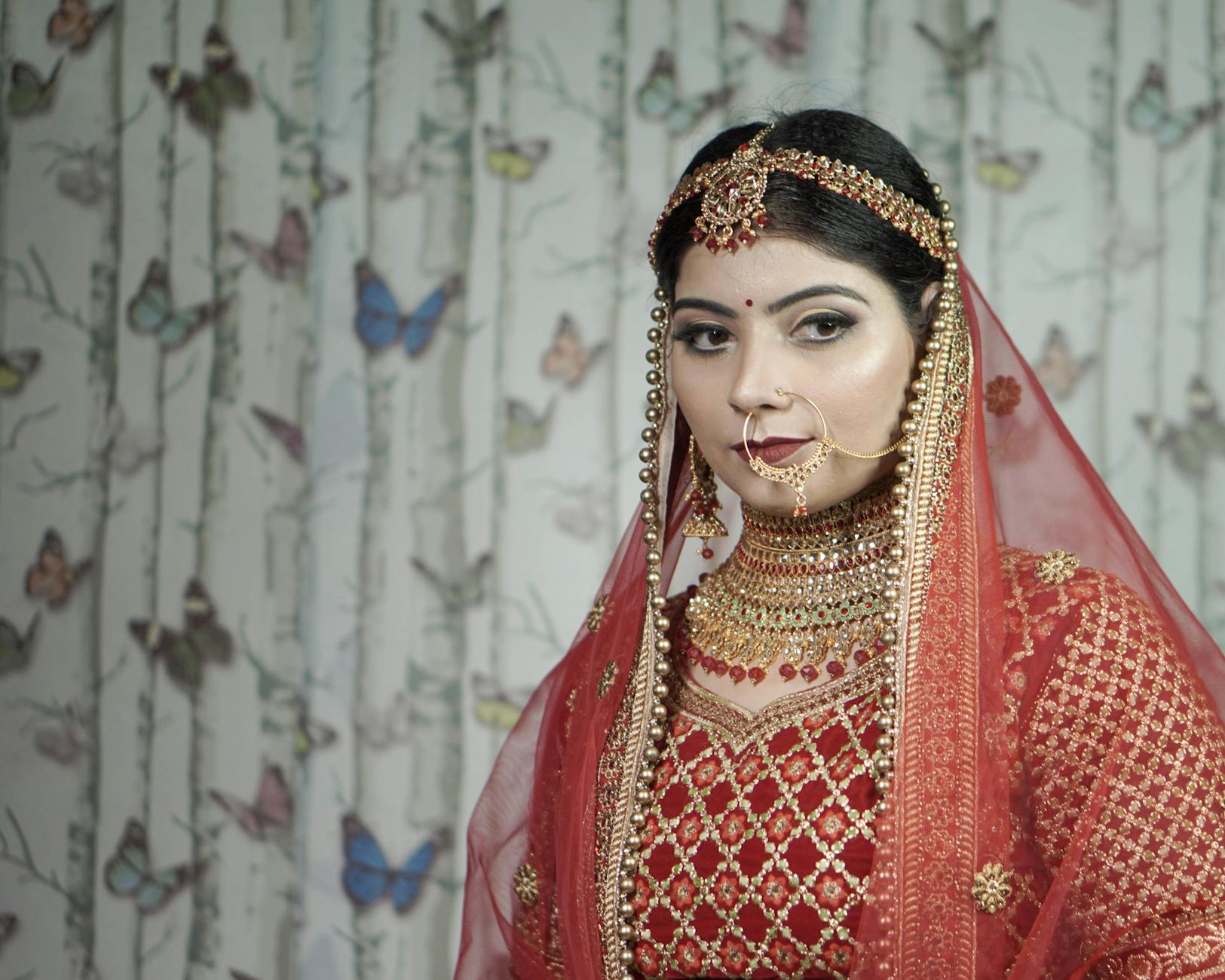
Unlike the North Indian maang tikka (which hangs from the centre hair parting), South Indian brides wear the nethi chutti — a gold ornament that spreads across the forehead along the hairline.
It is secured with small chains to the hair on both sides, creating a headband of gold across the brow.
The mathapatti is a more elaborate version that extends further across the forehead and is often combined with flowers in the hair.
Both are distinctly South Indian — photographed on brides across Tamil Nadu and Kerala in particular — and both require a skilled hairdresser who knows how to secure them properly during a ceremony that can last several hours.
The Jimikki / Jhumka: The South Indian Earring
The jimikki (as it is known in Tamil and Malayalam) or jhumka is a bell-shaped drop earring that has become so associated with South Indian culture that a famous Malayalam film song about it became a pan-India phenomenon.
South Indian jhumkas in 22K gold tend to be larger, more heavily worked, and more temple-motif-influenced than their North Indian counterparts.
Bridal jhumkas commonly feature multiple tiers of gold bells and peacock or lotus motifs in relief work.
The Oddiyanam: The Gold Waist Belt
The oddiyanam is one of the most spectacular pieces of South Indian bridal jewellery and one of the least commonly seen outside the South — a broad gold belt worn around the waist over the silk saree.
Traditional oddiyanams are solid gold pieces of significant weight, typically 80–150 grams and sometimes considerably more, with elaborate repousse work featuring temple motifs along their width.
They are worn over a silk Kanjivaram saree, and the contrast of the luminous silk with the heavy gold belt is one of the most visually striking combinations in any bridal tradition in the world.
Weight Considerations for South Indian Bridal Sets
South Indian bridal gold is heavy — 100–400 grams for a full traditional set is not uncommon.
A full set including oddiyanam, long haaram, vanki, mathapatti, and earrings can easily reach 300–500 grams of 22K gold.
This is not merely a financial consideration (at ₹7,000/gram, 300 grams = ₹21,00,000+ in gold value alone) — it is a physical one.
Discuss wearability honestly with your jeweller before purchasing.
Consider whether each piece is genuinely necessary for your ceremony or whether a lighter contemporary interpretation preserves the tradition while being more comfortable.
Regional Variations: Tamil Nadu vs Kerala vs Karnataka vs Andhra
| State | Distinctive Pieces | Style Character | Typical Full Bridal Set Weight |
|---|---|---|---|
| Tamil Nadu | Long haaram, oddiyanam, vanki, nethi chutti, jimikki | Heavy temple motifs, maximum gold | 200–500 grams |
| Kerala | Kasumala, elakkathali, pathakkam, minnu (thaali) | Coin necklaces dominant; elegant restraint | 150–300 grams |
| Karnataka | Distinctive thaali design, gold sets influenced by both Tamil and North styles | More varied — city and community determine style | 100–250 grams |
| Andhra / Telangana | Jadau-influenced sets, distinctive pendant designs, navratna traditions | More stone work than pure Tamil; Mughal-influenced | 150–350 grams |
Where to Buy Authentic South Indian Temple Jewellery
The best sources for authentic South Indian temple jewellery are the dedicated goldsmith communities in Chennai (T. Nagar's Usman Road), Kanchipuram (silk and gold), Thrissur in Kerala (Kerala's gold capital), and Hyderabad for Andhra-influenced designs.
Major trusted names include GRT Jewellers, Vummidi Bangaru Jewellers (one of India's oldest jewellery houses), Saravana Stores' jewellery section, and Lalitha Jewellery in Tamil Nadu.
In Kerala, Bhima Jewels and Josco Jewellers are long-established names.
Budget Ranges for South Indian Bridal Sets
| Set Type | Approximate Gold Weight | Indicative Cost (at ₹7,000/gram 22K) |
|---|---|---|
| Minimal traditional (haaram + earrings + thaali) | 50–80 grams | ₹3,50,000–₹5,60,000 |
| Standard traditional (above + vanki + mathapatti) | 100–150 grams | ₹7,00,000–₹10,50,000 |
| Complete traditional (all pieces including oddiyanam) | 200–350 grams | ₹14,00,000–₹24,50,000 |
| Grand traditional (museum-quality sets) | 350–500+ grams | ₹24,50,000–₹35,00,000+ |
These costs are in gold value alone — making charges for temple jewellery's intricate relief work can add 15–25% on top of metal value.
South Indian temple jewellery represents some of India's most demanding craftsmanship, and those making charges reflect genuine artisan expertise that has been developed over generations.
More in Wedding & Bridal
Share this article
Our editorial team comprises jewellery industry veterans, certified gemmologists, and passionate writers with decades of combined experience across India's gold, diamond, and gemstone markets. Every article is researched, fact-checked, and written to help Indian buyers make smarter, safer jewellery decisions.
Passionate about jewellery and love to write? We'd love to hear from you.
Join us as a writer →Ready to buy? Find verified jewellers near you
Browse 10,000+ BIS hallmark certified jewellers across India. Compare ratings, check today's gold rate, and book a visit.
Keep Reading