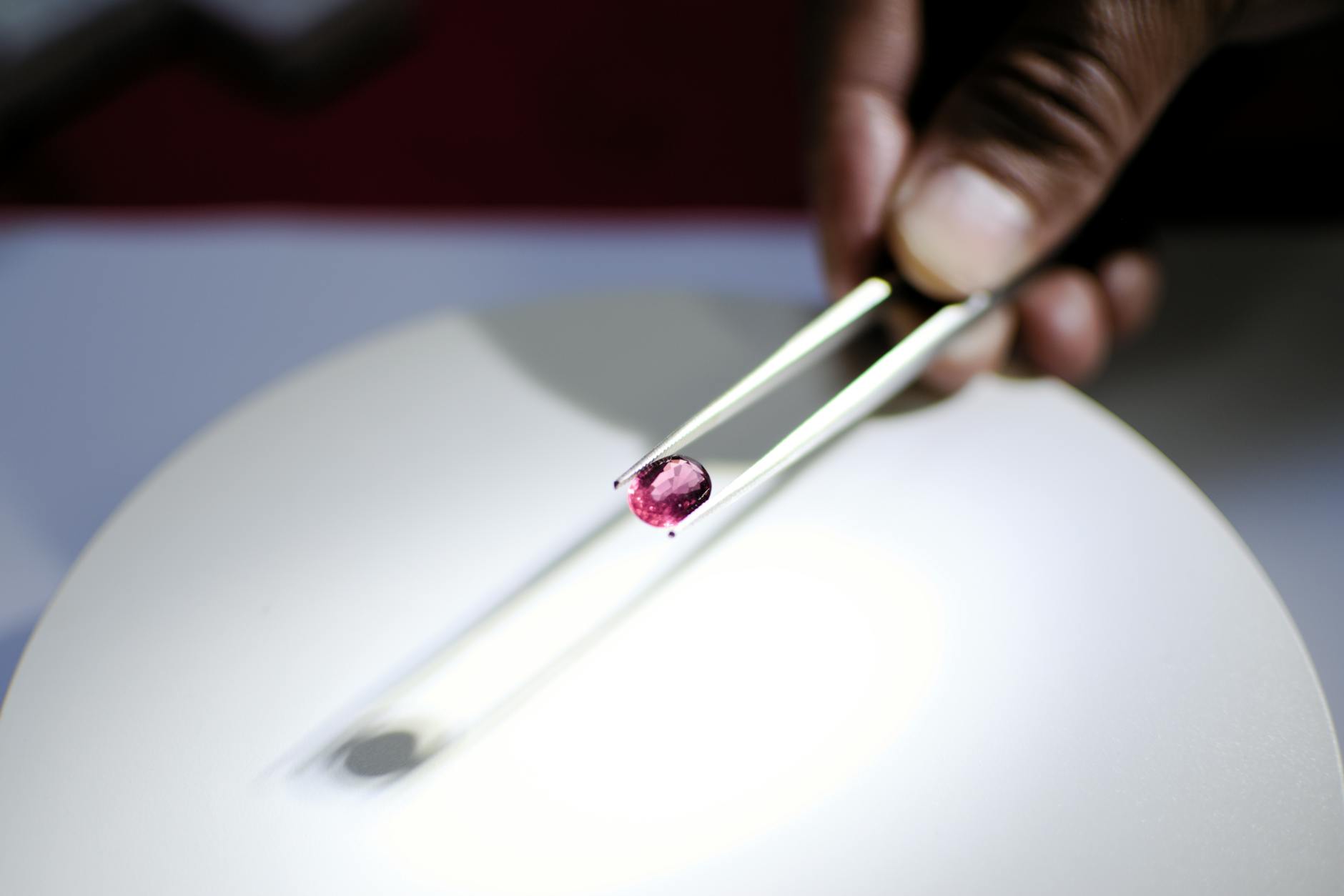
Rubies are among the most prized gemstones in India, carrying deep cultural significance in bridal jewellery, temple jewellery, and Vedic astrology. Yet the ruby market in India — particularly at mid-range and budget price points — is flooded with glass-filled rubies that look stunning but are worth a fraction of what buyers pay for them. This guide explains what glass-filling is, how to spot it, and how to protect yourself when buying rubies.
What is Glass-Filled (Fracture-Filled) Ruby?
Most natural rubies mined from the earth contain internal fractures — microscopic to visible cracks running through the stone. In low-to-medium quality rubies, these fractures are extensive. On their own, such stones would be nearly opaque and commercially worthless.
The glass-filling treatment works by injecting lead glass (a high-refractive-index silica glass) into these fractures under heat and pressure. The glass fills the cracks, dramatically improving the stone's clarity and colour. The result looks like a vivid, clear, red ruby — but it is partially made of glass.
Industry estimates suggest that 80–90% of rubies sold in the affordable price range in Indian markets (under ₹5,000 per carat, and even up to ₹20,000 per carat in some markets) are glass-filled. They are sold under various names: "composite ruby," "hybrid ruby," "lead glass filled ruby," and sometimes simply "ruby" with no disclosure at all.
⚠️ Why It Matters: The Value Difference is Enormous
A glass-filled ruby of 3 carats might sell for ₹3,000–₹9,000. A comparable natural ruby of the same size and colour (without glass filling) would be worth ₹50,000–₹5,00,000 or more. Glass-filled rubies are worth approximately 90–95% LESS than natural rubies of equivalent apparent quality. You are essentially buying a piece of glass with a thin ruby matrix around it.
How to Identify Glass-Filled Rubies
Several visual and physical clues can help you identify glass-filled rubies, even without laboratory equipment:
1. The Orange Flash Effect
The most distinctive visual giveaway of glass filling is an orange or bluish flash seen when you tilt the stone under a bright light source. This flash — distinct from the normal red reflection of ruby — is caused by the difference in refractive index between the ruby crystal and the lead glass filling. Natural rubies do not show this orange flash. To check: hold the stone under a single incandescent bulb or LED torch and tilt it back and forth. If you see a golden-orange flash in the fracture planes, the stone is almost certainly glass-filled.
2. "Fish-Scale" Pattern Under Magnification
Under a 10x loupe or magnifying glass, glass-filled rubies show a characteristic pattern in the filling areas that resembles fish scales or fingerprint whorls. This is the glass interface within the fractures. Natural ruby inclusions look completely different — they appear as rutile needles (silk), fingerprint inclusions, or crystal inclusions, but not like the smooth, slightly curved fish-scale pattern of glass filling.
3. Gas Bubbles
Under magnification, gas bubbles — tiny spherical or elongated voids — are sometimes trapped in the glass filling. Gas bubbles in a gemstone are a definitive indicator of glass treatment; they do not form in natural crystal growth.
4. UV Fluorescence Test
Natural rubies (especially Burmese/Myanmar rubies) fluoresce a strong orange-red colour under longwave UV light (365nm UV lamp). Glass-filled rubies often show irregular, patchy, or weak fluorescence because the glass filling does not fluoresce the same way as the ruby material. If you have access to a UV lamp (available cheaply online), this is a quick screening test. However, some synthetic rubies also fluoresce well, so UV alone is not conclusive.
Ruby Price Comparison Table
| Ruby Type | Origin Example | Price Range (per carat) | Certification Needed? |
|---|---|---|---|
| Natural Unheated Burmese | Myanmar (Mogok) | ₹50,000–₹10,00,000+ | GRS / Gübelin essential |
| Natural Heated — Fine | Myanmar / Thailand | ₹10,000–₹1,00,000 | GIA / GRS recommended |
| Natural Heated — Commercial | Thailand / Mozambique | ₹2,000–₹15,000 | IGI India acceptable |
| Glass-Filled (Composite) | Any origin | ₹200–₹2,000 | No reputable lab certifies these as "ruby" |
| Synthetic Ruby | Lab-grown | ₹100–₹500 | Certificate should say "synthetic" |
Heat Treatment vs Glass Filling — An Important Distinction
These are two completely different treatments, and it is crucial not to confuse them:
Heat treatment involves heating the ruby to high temperatures (1200–1400°C) to improve colour and reduce inclusions. Approximately 90%+ of natural rubies on the market are heat-treated. Heat treatment is widely accepted in the gem trade and does not dramatically affect value (though unheated rubies command a premium). Heat treatment is a permanent change to the crystal structure.
Glass filling is an additive treatment — foreign material (lead glass) is introduced into the stone. It is not accepted in the gem trade as producing a natural ruby, and reputable labs (GIA, GRS, Gübelin) will not issue a "natural ruby" certificate for a glass-filled stone — they categorise it as a "composite ruby" or "lead glass-filled ruby."
💡 Pro Tip
When buying a ruby, always ask specifically: "Is this stone glass-filled or fracture-filled?" A reputable dealer will answer clearly. If the answer is vague or defensive, walk away. Also ask: "Is this stone heat-treated?" An honest dealer will tell you — most natural rubies are, and that is acceptable.
Glass-Filled Rubies and Vedic Astrology
In Vedic (Jyotish) astrology, the Manik (ruby) is the gemstone of the Sun (Surya). Wearing a natural ruby is believed to strengthen the Sun's influence in one's horoscope, bringing health, confidence, leadership, and vitality.
Glass-filled rubies are NOT suitable for astrological purposes, according to Jyotish principles. The reason: the gemstone works through its natural crystalline energy and vibration. A stone that is 50–80% glass is not a ruby from an energetic standpoint — it is a composite material. Most qualified Jyotish practitioners will explicitly advise against glass-filled or composite rubies for astrological rings. If you are buying a Manik for astrological purposes, invest in a natural, certified ruby — even a smaller one is preferable to a large glass-filled stone.
Professional Testing and Certification
For rubies above ₹10,000 per carat in total value, professional gemological testing is strongly advised. The following laboratories are recognised internationally and in India:
- GRS (Gem Research Swiss Lab): Top-tier for rubies — specifically identifies treatments, origin, and quality. Essential for Burmese rubies.
- Gübelin Gem Lab (Switzerland): One of the most prestigious labs globally for ruby origin and treatment reports.
- GIA (Gemological Institute of America): Widely respected, issues treatment identification reports for rubies.
- IGI India: More accessible and affordable in India — suitable for commercial-grade rubies.
After-Care for Glass-Filled Rubies — Critical Warnings
If you already own glass-filled rubies — perhaps inherited or purchased before you knew the difference — they require special care that natural rubies do not:
- No acid cleaning: Many jewellers use acid (particularly sulphuric acid or hydrofluoric acid solutions) to clean jewellery. Acid dissolves lead glass rapidly, destroying the filling and turning your ruby opaque.
- No steam cleaning: High-pressure steam cleaning can cause the glass filling to crack or cloud due to thermal shock and pressure.
- No ultrasonic cleaning: Ultrasonic vibration can fracture the glass filling and worsen the stone's appearance.
- Safe cleaning: Mild soapy warm water with a soft brush — nothing more.
More in Diamonds & Gemstones
Share this article
Our editorial team comprises jewellery industry veterans, certified gemmologists, and passionate writers with decades of combined experience across India's gold, diamond, and gemstone markets. Every article is researched, fact-checked, and written to help Indian buyers make smarter, safer jewellery decisions.
Passionate about jewellery and love to write? We'd love to hear from you.
Join us as a writer →Ready to buy? Find verified jewellers near you
Browse 10,000+ BIS hallmark certified jewellers across India. Compare ratings, check today's gold rate, and book a visit.
Keep Reading