Here is a truth that bridal stylists know but rarely say plainly: bad jewellery-outfit coordination is the most common problem in Indian bridal photography. Not bad jewellery.
Not a bad outfit. Both can be beautiful individually and still create a visual disaster together.
The principles of coordination are learnable and, once understood, make every jewellery decision much clearer.
This guide covers every major Indian bridal silhouette and exactly how to approach the jewellery choices for each.
The Foundational Principle: One Visual Anchor
Before looking at specific outfits, understand the single most important principle of jewellery-outfit coordination: every look can sustain one area of maximum visual complexity.
The outfit provides complexity, the jewellery provides complexity, but the eye needs somewhere to land.
When multiple elements — heavily embroidered fabric AND elaborate necklace AND elaborate earrings AND elaborate maang tikka — compete at the same level of visual loudness, the result is visual noise.
The solution is always the same: identify the most important element and let everything else defer to it.
The Bridal Lehenga
The Heavily Embroidered Lehenga (Zari, Zardozi, Stone Work)
A heavily embroidered bridal lehenga — the kind with gold zari work across the entire surface, or dense zardozi stone embroidery — is already a maximum-complexity garment.
The mistake is to add maximum-complexity jewellery and expect the combination to be coherent. It will not be.
The outfits speak too loudly; the jewellery should match but not compete.
The principle: one focal point in jewellery.
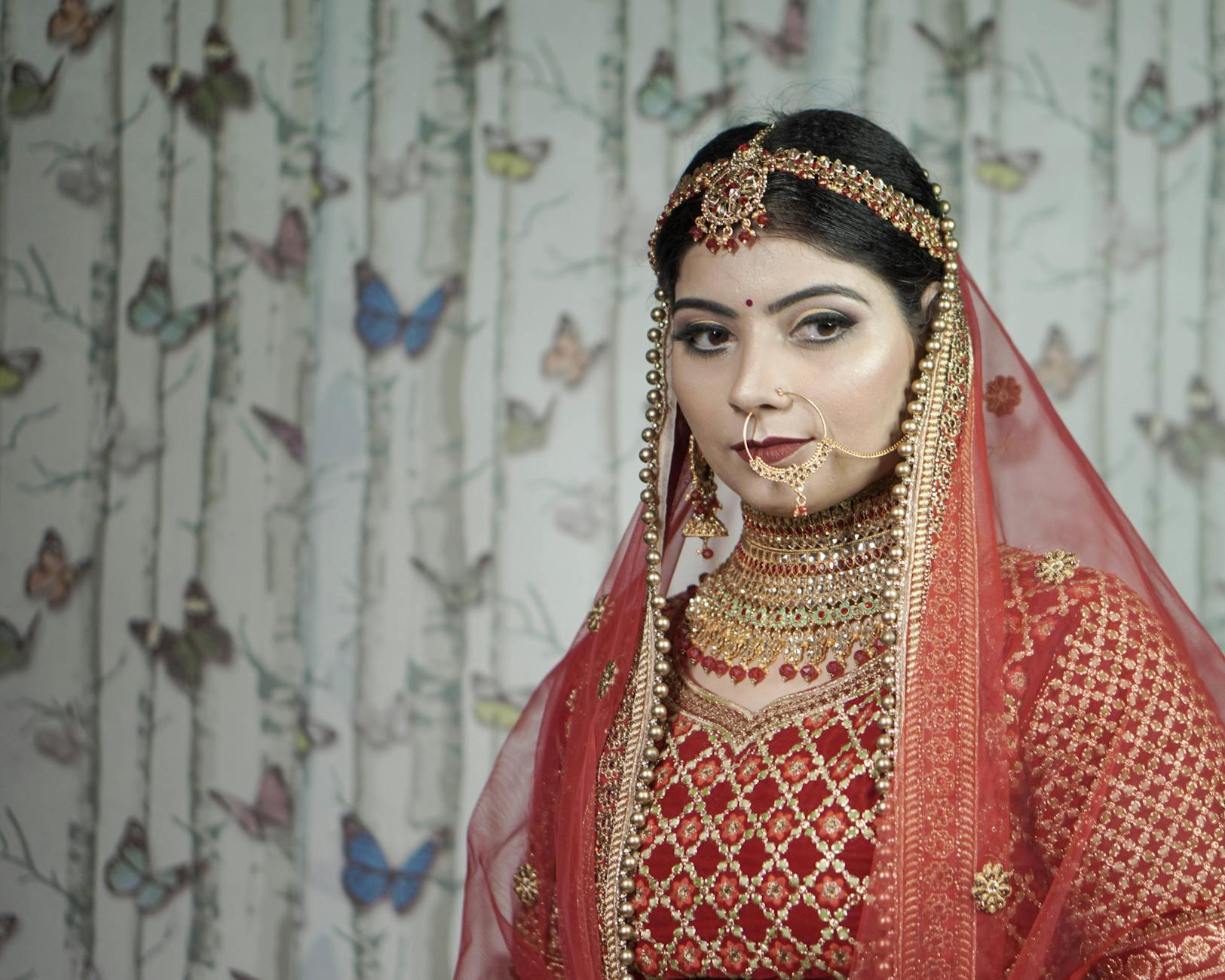
If the lehenga has heavy embroidery at the chest and neckline (as many do), choose a choker-height necklace or a very close-sitting collar piece that frames the neckline without duplicating its complexity further down the chest.
A long statement haaram worn over a heavily embroidered chest area creates layered visual confusion.
Instead: a close-sitting choker, clean earrings (statement jhumkas or chandbalis are right — they hang below the embroidery zone), and a beautiful maang tikka.
That combination allows the lehenga to be seen.
The Contemporary Minimally Embroidered Lehenga
Contemporary bridal lehengas — a-line silhouettes in solid blush, ivory, or pastel tones with minimal or strategic embroidery — are increasingly chosen by brides who want the lehenga silhouette without the traditional maximalism.
This silhouette actively invites jewellery to be the statement.
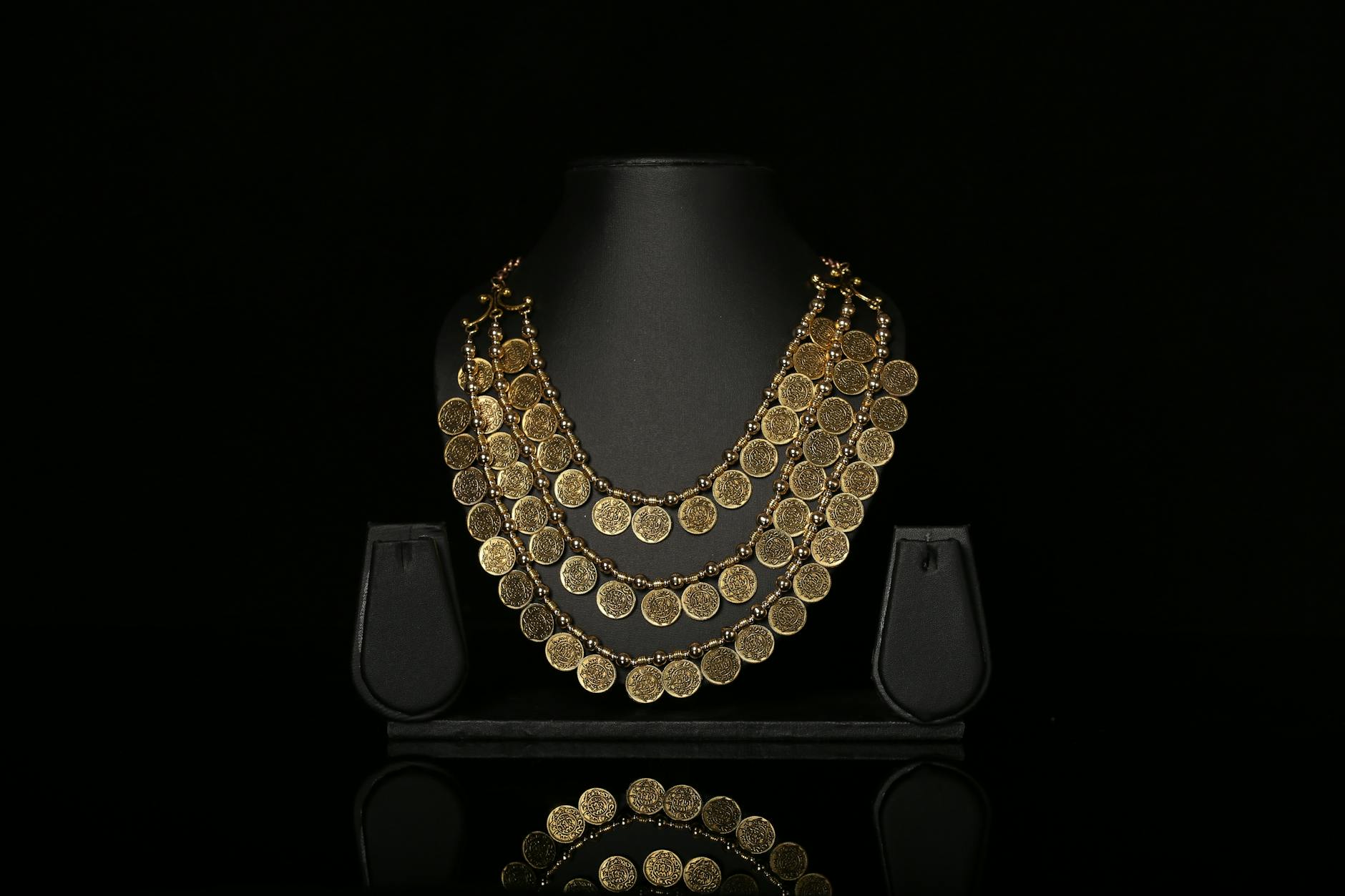
A bold Kundan choker-and-haaram combination, or a dramatic polki set, becomes the focal point of the look in a way it cannot when competing with heavy embroidery.
The Silk Saree
Traditional South Indian Kanjivaram or Banarasi Silk
A Kanjivaram silk saree is one of the most powerful garments in the world — its weight, lustre, and colour are extraordinary.
The traditional approach (and the correct one) is traditional jewellery in the regional style of the saree.
A Kanjivaram saree calls for South Indian gold jewellery: long haaram, jimikki earrings, gold vanki.
A Banarasi calls for North Indian jewellery forms — a layered necklace set, Kundan or polki, jhumka earrings.
The saree drape opens the neckline differently from a lehenga's fitted blouse.
The broad expanse of the blouse's neckline with the pallu draped over the shoulder is a different canvas than a lehenga dupatta.
Choose necklace length to work with your blouse neckline: a deep-V blouse suits a pendant that follows the V; a round or square blouse neckline suits a choker that sits just above the neckline edge.
Contemporary Silk Saree (Organza, Tissue, Chanderi)
Contemporary bridal sarees in lighter silk or fabric — organza, tissue silk, chanderi — tend to have more fluid draping and often minimal embroidery, making them ideal for a curated jewellery approach.
A single statement piece — perhaps a magnificent necklace — worn with minimal earrings (diamond studs, small gold hoops) against a contemporary saree produces one of the most elegant looks available to a modern Indian bride.
The Anarkali and Gharara
The anarkali silhouette — a long, flared kurta that falls to ankle length — and the gharara (wide-legged palazzo pants with a fitted short kurta) share a vertical quality.
The fabric falls from the chest downward, creating a long uninterrupted visual line.
This is ideal for necklace layering: the long vertical silhouette accommodates and even flatters a longer necklace in a way that a lehenga blouse does not.
For anarkali and gharara: a layered necklace approach works beautifully — a choker with a mid-length statement pendant necklace (not a very long haaram, which would disappear into the fabric folds).
Statement earrings — chandelier earrings that are visible above the outfit's neckline — are the ideal companion.
The earring length can be more generous here than with a lehenga, because the outfit's fabric does not have a dupatta catching on them.
Contemporary Bridal Wear (Gowns, Fusion Lehengas)
Contemporary bridal wear — including Western-influenced white or ivory gowns chosen by some Christian brides, or fusion saree-gown hybrids — requires a fundamentally different jewellery logic.
The principle is restraint paired with one extraordinary piece:
- A contemporary gown suits one significant necklace or one pair of significant earrings — not both at maximum intensity.
- Diamond jewellery in white gold or platinum coordinates with the Western/contemporary silhouette in a way that 22K yellow gold typically does not.
- A single statement piece — a magnificent diamond necklace, or a pair of extraordinary earrings — against a simple contemporary gown is one of the most powerful bridal looks available.
Colour Coordination: The Metal-to-Outfit Rule
The metal you choose should harmonise with your outfit's colour temperature:
| Outfit Colour | Best Metal | Why | Gemstone Colours That Work |
|---|---|---|---|
| Red, orange, maroon, gold | 22K yellow gold | Warm tones resonate — the metal feels of a piece with the outfit | Ruby, garnet, coral, topaz, citrine |
| Ivory, cream, champagne | Yellow gold or pearl | Warm neutrals suit the warmth of yellow gold; pearls are classically ivory | Pearl, diamond, light sapphire, rose quartz |
| Deep teal, emerald, forest green | Yellow gold | Deep greens + yellow gold is a classic Indian combination going back centuries | Emerald, green tourmaline, diamond |
| Royal blue, navy, midnight blue | White gold or yellow gold both work | Blue suits both metal temperatures — choose based on undertone | Sapphire, aquamarine, diamond |
| Blush, powder pink, peach | Rose gold or yellow gold | Warm pinks resonate with rose gold; yellow gold adds contrast that photographs beautifully | Rose quartz, pink sapphire, diamond |
| Lavender, lilac, purple | White gold or yellow gold | Cool purples suit white gold; yellow gold creates deliberate warm-cool contrast | Amethyst, tanzanite, diamond |
The Embroidery Zone Problem
The most frequent specific mistake in Indian bridal jewellery coordination: placing jewellery in the same visual zone as the outfit's heaviest embroidery.
If the lehenga blouse has dense stone work across the entire front panel — from neckline to waist — adding a 30-inch haaram creates a wall of texture and colour that the eye cannot process.
Move the jewellery complexity to a zone the outfit leaves open: if the blouse front is heavy, use a choker-level necklace (above the embroidery zone) and elaborate earrings (outside the embroidery zone).
If the shoulders are heavily embroidered, skip the elaborate necklace and focus on the earrings, which hang below the embroidered shoulder area.
The Trial Run: Non-Negotiable
No amount of advice replaces a physical trial run.
Two to three months before your wedding, wear your exact outfit (or a close approximation in colour and fabric weight) with your complete jewellery set in front of a full-length mirror in natural daylight — and photograph it.
Look at the photographs, not yourself in the mirror.
The camera captures the visual impression your guests will receive, which is different from your own perception while wearing the pieces.
Adjust based on what the photograph tells you, not what you feel wearing it. This single practice will prevent more coordination errors than any guide.
Outfit-to-Jewellery Coordination Quick Reference
| Outfit Type | Necklace Approach | Earring Approach | What to Avoid |
|---|---|---|---|
| Heavily embroidered bridal lehenga | Choker-level only; no long haaram over embroidered chest | Statement jhumka or chandbali — hang below the embroidery zone | Long haaram layered over dense chest embroidery |
| Minimal contemporary lehenga | Bold layered set — this is the statement moment | Matching earrings to the necklace set | Under-jewelling — the outfit invites the jewellery to speak |
| Kanjivaram silk saree | Traditional South Indian forms — haaram or close-sitting layer | Jimikki or heavy traditional drops | Contemporary white gold with traditional silk saree — the aesthetics clash |
| Contemporary light silk or organza saree | One magnificent piece — necklace or earrings, not both elaborate | Diamond studs if necklace is statement; elaborate if necklace is minimal | Over-jewelling — light fabric is overwhelmed by heavy sets |
| Anarkali / Gharara | Layered choker + mid-length pendant | Long chandeliers visible above the neckline | Very long haaram that disappears into fabric folds |
| Contemporary gown / fusion | One statement piece at most | Minimal if necklace is statement; statement if necklace is minimal | Full traditional bridal set with Western silhouette — tonally incoherent |
Coordination is ultimately about clarity — visual clarity that tells a coherent story about who you are and what this day means to you.
Every bridal look, at every price point, becomes more beautiful when it is internally coherent.
The jewellery should feel like it belongs with the outfit, the outfit should feel like it was made for the jewellery, and both together should feel like they were made for you.
More in Wedding & Bridal
Share this article
Our editorial team comprises jewellery industry veterans, certified gemmologists, and passionate writers with decades of combined experience across India's gold, diamond, and gemstone markets. Every article is researched, fact-checked, and written to help Indian buyers make smarter, safer jewellery decisions.
Passionate about jewellery and love to write? We'd love to hear from you.
Join us as a writer →Ready to buy? Find verified jewellers near you
Browse 10,000+ BIS hallmark certified jewellers across India. Compare ratings, check today's gold rate, and book a visit.
Keep Reading