Indian wedding jewellery budgets generate more family anxiety than almost any other wedding expense — because unlike catering or decoration, gold jewellery is simultaneously an aesthetic choice, a social statement, and a financial investment. This guide strips away the sentiment and gives you a practical framework: what things cost at 2026 rates, what is worth spending on, and where you can cut without your photographs looking anything less than magnificent.
Understanding the Cost Drivers
Every bridal jewellery piece costs you two things: gold weight and making charges. Understanding both is non-negotiable before you start shopping.
Gold Weight Cost
At April 2026 rates, approximately ₹7,200/gram for 22K gold. This is the baseline — every piece you buy costs at least this per gram of gold in it. A 20-gram necklace contains ₹1,44,000 of gold value before a single rupee of craftsmanship.
Making Charges
Making charges (MC) are the jeweller's craft fee. These vary dramatically:
- Machine-made chains and plain bangles: ₹150–₹400/gram
- Handcrafted traditional pieces: ₹400–₹1,500/gram
- Kundan, Polki, or intricate stone-set pieces: ₹1,500–₹5,000+/gram (or charged as a flat fee)
For a Kundan bridal necklace with 30 grams of gold and ₹2,000/gram making charge: 30 × ₹7,200 (gold) + 30 × ₹2,000 (MC) = ₹2,76,000 gold + ₹60,000 MC = ₹3,36,000. Making charges represent 18% of the price here — and they have zero resale value.
Stone Charges
For diamond or gemstone-set pieces, stone value is added. A diamond ring worth ₹1,50,000 may have ₹40,000 of gold and ₹1,10,000 of diamond value. Understand the stone premium before comparing prices.
Budget Tiers: What You Get in 2026
Budget: ₹1–3 Lakh
Approximately 15–40 grams of gold + basic making charges
This budget covers a functional wedding jewellery set: a simple necklace (10–15g), earrings (4–6g), simple bangles (8–12g), and a small tikka (2–4g). Making charges should be kept minimal — machine-made or simple handwork. No stone-set pieces.
Strategy: Rent any statement pieces (heavy necklace, waist belt) to create visual impact without the purchase cost. Focus bought purchases on pieces worn post-wedding (bangles, earrings).
Budget: ₹3–7 Lakh
Approximately 40–90 grams of gold
The solid middle range. This budget allows: a proper necklace set with stones (15–25g), good earrings, tikka, simple bangles, and a small ring. Consider allocating ₹1.5–2 lakh for a higher-quality necklace set and supplementing with rentals for the most expensive occasion-only pieces.
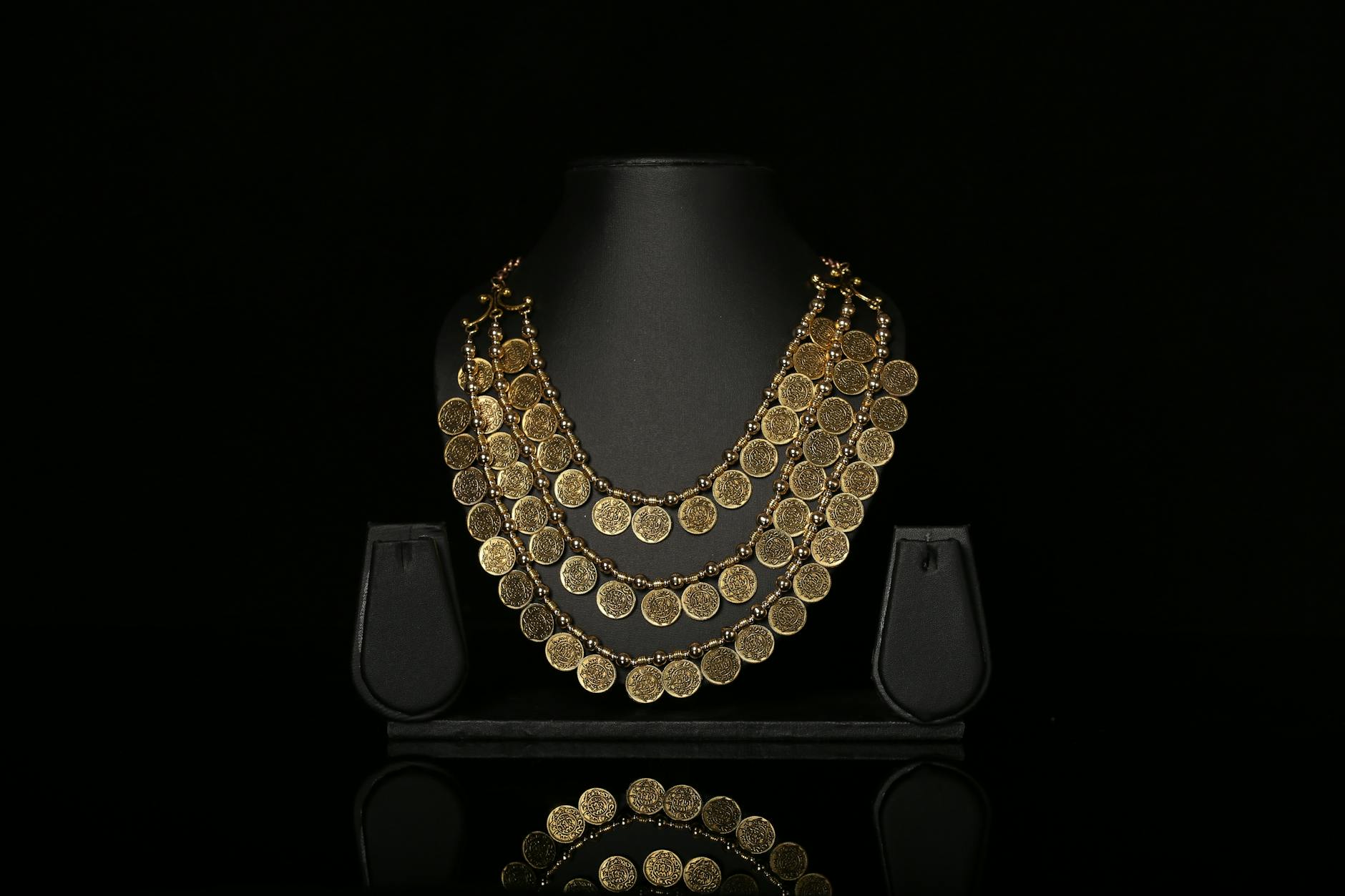
Community consideration: For South Indian weddings at this budget, a Kasu Mala or Lakshmi Haram rental + purchased simpler pieces provides a traditional complete look.
Budget: ₹7–15 Lakh
Approximately 90–200 grams of gold
A generous budget that allows real flexibility. You can purchase all primary pieces — necklace set, earrings, bangles, tikka, ring — plus have funds for either a second ceremony look or a statement piece like a waist belt. Diamond jewellery enters the range here (18K diamond necklace set at ₹3–5 lakh; diamond ring ₹1–3 lakh).
Budget: ₹15–30 Lakh+
200–400+ grams of gold
Heirloom-level purchases. At this budget, full Kundan or Polki sets are accessible; certified natural emerald and diamond pieces; multiple ceremony looks each with purchased (not rented) pieces. The emphasis shifts from "enough" to curation: investing in pieces with lasting aesthetic and financial value.
Community-Specific Gold Weight Expectations
| Community | Traditional Range | Urban Contemporary Range |
|---|---|---|
| Tamil Hindu | 80–300g+ | 40–120g |
| Kerala Hindu/Christian | 80–250g+ | 40–100g |
| Telugu Hindu | 100–400g+ | 50–150g |
| Punjabi Hindu/Sikh | 80–500g+ | 50–150g |
| Gujarati Hindu/Jain | 60–200g | 30–100g |
| Marathi Hindu | 40–150g | 25–80g |
| Bengali Hindu | 40–120g | 20–60g |
| Muslim (across regions) | Varies widely | 30–100g |
These are indicative ranges, not prescriptions. Family capacity and individual values are primary determinants.
Allocation Strategy: Where to Put Your Budget
If forced to prioritise, allocate in this order:
- The mangalsutra / tali / minnu (marriage marker): Always purchase; this is permanent daily wear and has deep emotional significance. Budget 5–10% of total jewellery spend.
- The main necklace set: This dominates every photograph. Allocate 30–40% of jewellery budget here.
- Earrings: Always photograph well; often worn again. 10–15% of budget.
- Bangles: Worn regularly post-wedding; good investment. 10–20% of budget.
- Tikka, ring, anklets: Secondary. 10–15% combined.
- Rent everything else: Waist belt, jhoomar, heavy nath — rent and redirect the savings to items above.
Where to Save Without Compromising the Look
Choose Machine-Made for Simple Pieces
Machine-made gold chains and plain bangles look identical to handmade equivalents in photographs. Making charges are dramatically lower. Save handcraft premium for pieces where the design detail actually shows (necklaces, earrings).
18K vs 22K for Stone-Set Pieces
Diamond and gemstone-set pieces are often in 18K gold (lower gold cost) — the stone is the value driver. Opting for 18K diamond earrings vs 22K plain earrings can save money while delivering more visual impact.
Lab-Grown Diamonds
Lab-grown diamonds offer 60–80% lower cost than equivalent natural stones with identical visual and physical properties. For bridal rings and earrings, lab-grown is an increasingly mainstream choice. Full lab-grown diamond guide here.
Festival Period Purchases
Making charges are often waived during Akshaya Tritiya and Dhanteras. On a ₹10 lakh purchase with average ₹600/gram making charges and 130 grams total, waived making charges save ₹78,000. Significant.
Negotiate Making Charges
Gold rate is fixed (tied to IBJA rates). Making charges are negotiable. Always ask explicitly — many jewellers will reduce by 10–20% for large purchases or repeat customers.
Groom's Jewellery
Don't overlook the groom's budget. Traditional norms vary:
- North India: Ring + chain (5–20g typically). ₹40,000–₹1,50,000.
- South India: Ring + chain; the bride's family often gifts the groom a complete gold set. Budget ₹50,000–₹3,00,000 on the bride's family side.
- Contemporary: Many grooms choose bracelets, watches with gold elements, or minimal jewellery. ₹20,000–₹1,00,000.
Post-Budget: The Investment Angle
All gold jewellery bought at hallmarked 22K retains gold value. However, making charges are lost on resale (jewellers buy back at gold weight only, no making charge credit). Keep making charge costs proportional to pieces you expect to keep for life. Plain-shank pieces with minimal making charges have better gold-to-resale ratios than heavily crafted pieces you might later exchange. Read the buyback programmes guide.
Conclusion
The right bridal jewellery budget is one you can afford without financial stress — whether that's ₹2 lakh or ₹20 lakh. Prioritise the pieces in your photographs and those you'll wear for decades, rent the one-day spectaculars, and put your making charges toward design quality rather than excess weight. Find verified jewellers near you on JewellersInCity to start your bridal jewellery search.
More in Wedding & Bridal
Share this article
Our editorial team comprises jewellery industry veterans, certified gemmologists, and passionate writers with decades of combined experience across India's gold, diamond, and gemstone markets. Every article is researched, fact-checked, and written to help Indian buyers make smarter, safer jewellery decisions.
Passionate about jewellery and love to write? We'd love to hear from you.
Join us as a writer →Ready to buy? Find verified jewellers near you
Browse 10,000+ BIS hallmark certified jewellers across India. Compare ratings, check today's gold rate, and book a visit.
Keep Reading