Bengali bridal jewellery is unlike any other regional tradition in India because its most significant pieces are not gold.
The conch shell bangles (shankha), the red coral bangles (pola), and the iron bangle (loha) — three of the defining symbols of Bengali married womanhood — carry profound cultural and spiritual weight that gold cannot replicate in this tradition.
Understanding these pieces, their significance, and the elaborate gold jewellery that surrounds them is essential to understanding one of India's richest and most distinctive bridal aesthetics.
The Three Non-Gold Essentials
Shankha: Conch Shell Bangles
The white conch shell bangle (shankha) is the primary symbol of a married Bengali Hindu woman.
It must be worn on both wrists and is given to the bride by her husband's family (sasurbari), typically in a ceremony before or during the wedding.
The shankha is traditionally made from the sankha shell, cut and polished into bangles — a craft concentrated primarily in West Bengal, where entire communities of shankha artisans have practised this work for generations.
Bengali married women wear shankha continuously — they are one of the markers by which a married Bengali woman is identified.
Removing the shankha is associated with widowhood and is therefore deeply inauspicious during a husband's lifetime.
The bangles are made in sets of two (one per wrist), and the sizing must be exact — they cannot be adjusted after purchase.
Visit the shankha craftsmen with a jeweller's measurement of your wrist circumference.
Pola: Red Coral Bangles
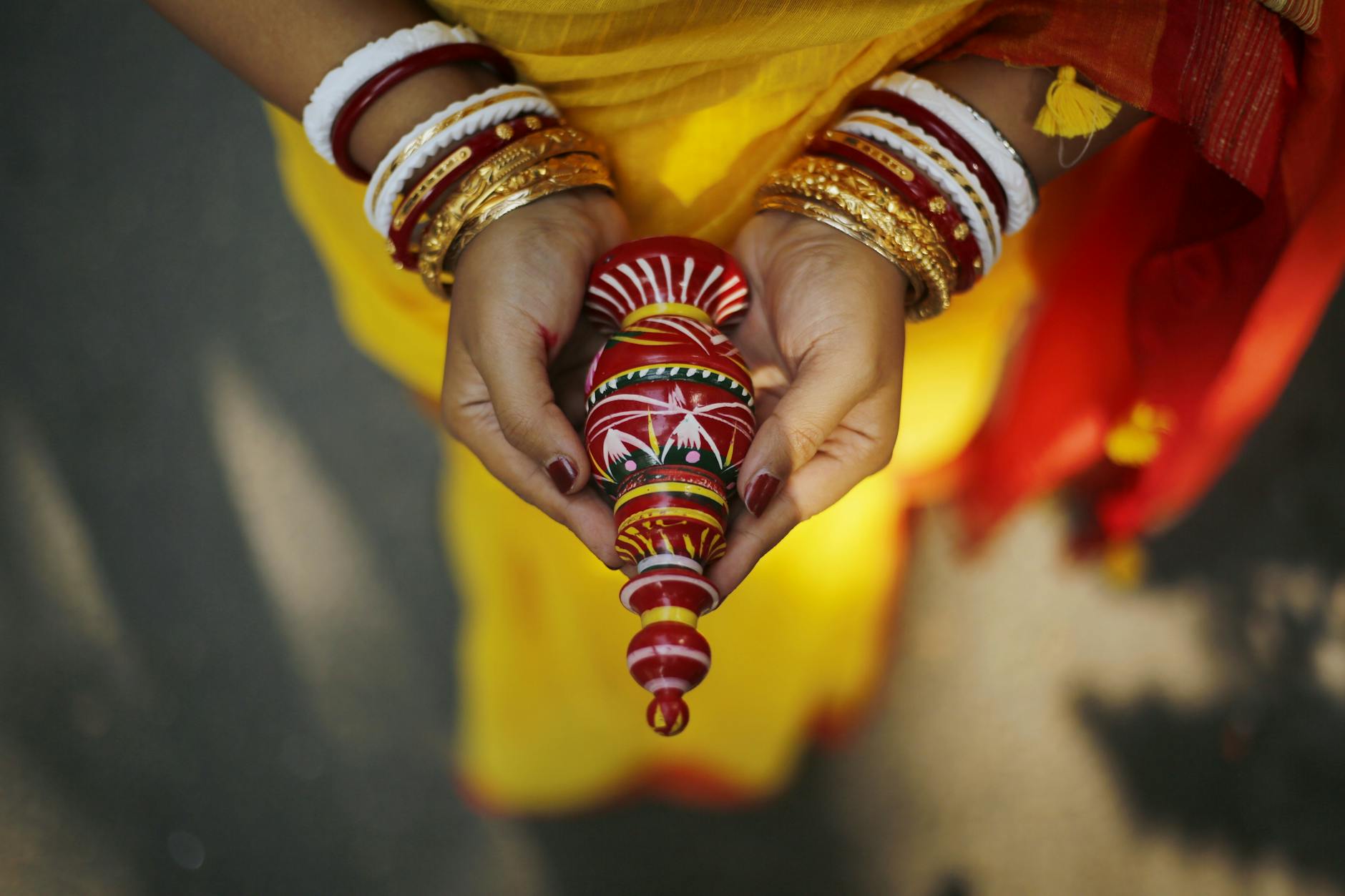
The red coral bangle (pola) is worn alongside the shankha on both wrists — always together as a pair of white (shankha) and red (pola).
Traditionally the pola is made from genuine red coral (moonga), though today many women wear polished red glass or resin bangles that replicate the colour without the expense or the sourcing challenges of genuine coral (red coral is a CITES-listed species with import restrictions).
The shankha-pola combination — white and red on both wrists — is the visual signature of Bengali married women and is so deeply embedded in cultural consciousness that it is referenced constantly in Bengali literature, cinema, and art.
The colours have specific meanings: white for purity and the cool energy of the moon, red for the heat of life and the shakti of the bride.
Loha: The Iron Bangle
The loha — a thin iron bangle — is the third element of the traditional Bengali married woman's bangle set.
Iron represents strength, endurance, and the protective quality of the husband's bond.
In practice, many modern Bengali families have replaced plain iron with gold-plated iron or even yellow gold bangles that fulfil the symbolic role while appearing in coordination with the shankha-pola aesthetic.
Noa: The Gold Companion
The noa is a thin gold bangle traditionally worn alongside the shankha-pola set — typically one gold noa per hand.
It complements the white and red of shankha-pola with gold warmth, and its presence ensures that the married woman's bangle set incorporates all three materials: shell, coral/glass, and gold.
The Mukut: Bengal's Bridal Crown
The mukut is one of the most spectacular pieces of bridal jewellery in any Indian tradition — a towering gold crown worn by the Bengali bride during the wedding ceremony.
Unlike any other Indian bridal head ornament (the maang tikka of North India or the nethi chutti of South India are relatively discreet), the Bengali mukut is a genuine crown — rising 8–15 centimetres above the head, in elaborate gold repoussé work with peacock feather motifs, lotus patterns, and sometimes the image of goddess Durga.
The mukut is worn during the primary ceremony (particularly the subho drishti — the first auspicious sight between bride and groom) and is then removed for the remainder of the wedding events.
It is typically a family heirloom, passed through generations, though it can be purchased new or rented from jewellers who specialise in traditional Bengali bridal jewellery.
The weight of a traditional gold mukut can be significant — 50–150 grams — and a hairdresser experienced with Bengali bridal jewellery is essential for securing it properly.
The Mathapatti and Tikli: Forehead Ornaments
The mathapatti is a chain ornament running along the hairline and connecting to a tikli (forehead bindhi-style pendant).
Bengali bridal mathapatti is typically more delicate than South Indian equivalents — fine gold chains with small stone or gold bead accents rather than the broad nethi chutti of Tamil Nadu.
The tikli is a small circular pendant that sits at the centre forehead, often with a diamond or coloured stone centre.
The Gold Jewellery Set: Necklace, Earrings, Bangles
Alongside the symbolic non-gold pieces, Bengali brides wear a traditional gold jewellery set characterised by a distinctive aesthetic:
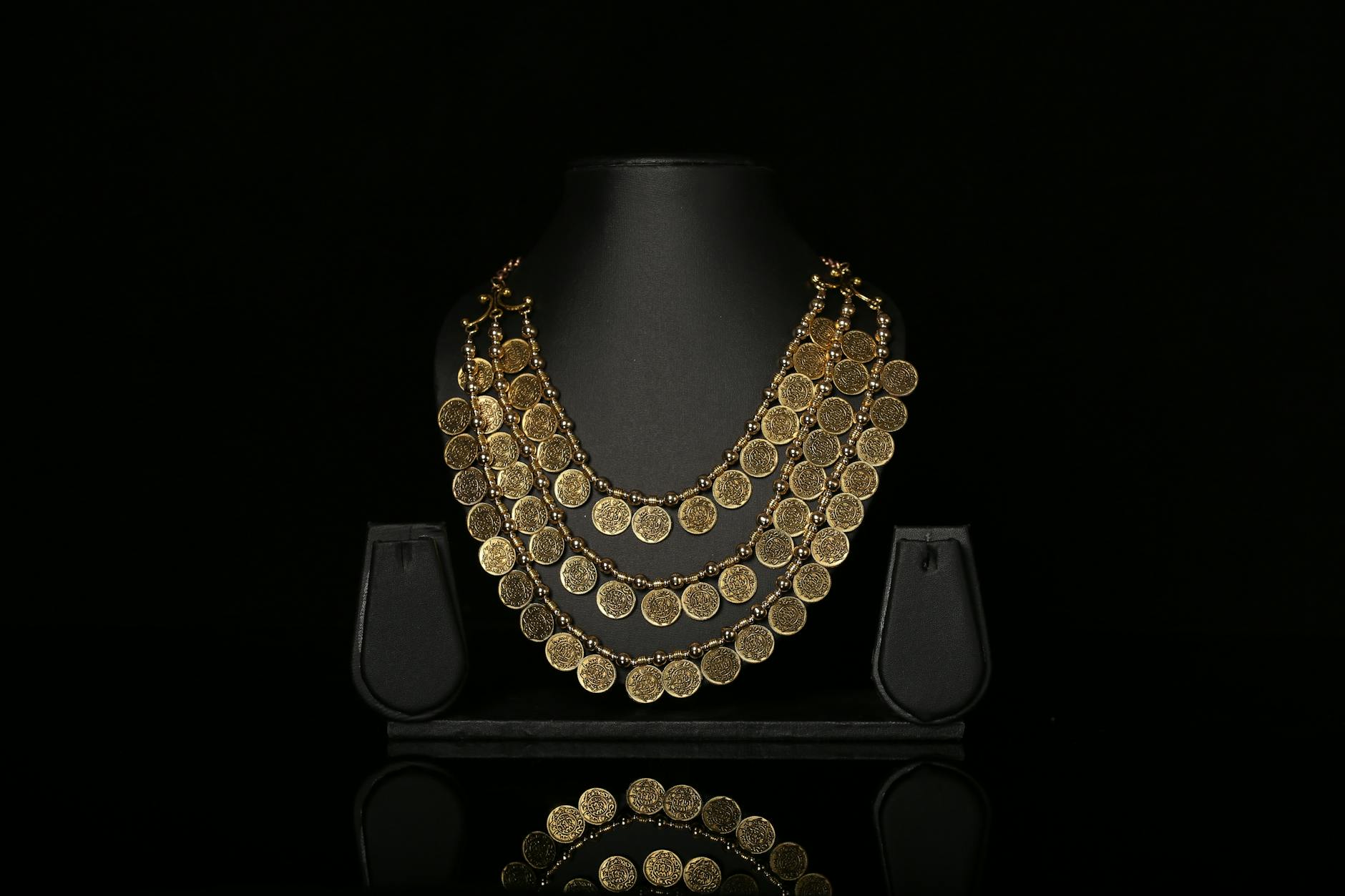
- Necklace: Typically a layered look — a short close-fitting piece combined with a longer pendant chain. Traditional Bengali necklace designs feature elaborate filigree work, gold granulation, and sometimes enamel accents in a style distinct from both North and South Indian traditions.
- Kanbaala: Bengali bridal earrings, typically elaborate chandelier-style drops in gold with stone accents. The filigree work in Bengali kanbaala is among the finest in Indian earring craft.
- Gold kadas: Additional gold bangles worn above the shankha-pola on special occasions — not the everyday set but reserved for the wedding ceremony and significant festivals.
- Nupoor: Anklets in gold or silver; typically in Bengali tradition gold anklets are worn at the wedding, with silver for everyday post-wedding wear.
The Sindoor Khela: The Post-Wedding Ceremony
The sindoor khela (literally "playing with vermilion") is a distinctive Bengali post-wedding tradition where married women of the family gather and apply sindoor (vermilion powder) to each other's foreheads and partings.
The jewellery worn for sindoor khela is typically the shankha-pola set (which all married Bengali women wear) along with a simple gold set.
The sindoor dabbi — the container for sindoor — is itself a small piece of gold or silver jewellery in many families, an engraved box that becomes an heirloom.
The Bowbazar Goldsmith Tradition
Bowbazar — a neighbourhood in central Kolkata — is the historic centre of Bengali goldsmithing.
The narrow lanes of this area house dozens of multigenerational goldsmith families who have practised the distinctive Bengali gold craft for centuries.
This is where to find genuine traditional Bengali bridal jewellery — the mukut, the mathapatti, the traditional necklace forms that are specific to Bengal.
Bowbazar workshops are not glamorous showrooms; they are working artisan spaces where pieces are made to order and the quality can be extraordinary.
Buying Shankha-Pola: What You Need to Know
Shankha bangles require precise wrist measurement — they cannot be resized after purchase.
Buy from established shankha craftsmen (Bowbazar area in Kolkata, or traditional shankha shops in Bengali neighbourhoods across India).
Genuine shell shankha has a different texture and weight from resin imitations — ask the craftsman to show you genuine shell pieces alongside imitation.
The crack pattern of the shell interior is visible in genuine shankha and absent in resin.
Price range: ₹1,500–₹15,000 per set depending on shell quality and carving complexity.
Budget Ranges for Bengali Bridal Jewellery
| Category | Items | Budget Range |
|---|---|---|
| Symbolic pieces (shankha-pola-loha) | Shankha set + pola set + loha + noa | ₹3,000–₹25,000 |
| Mukut (bridal crown) | Gold mukut — purchase | ₹35,000–₹2,00,000+ |
| Mukut (rental) | One-day rental from specialist | ₹5,000–₹20,000 |
| Gold bridal set | Necklace + earrings + mathapatti | ₹80,000–₹5,00,000 |
| Complete traditional Bengali bridal | All of the above combined | ₹2,00,000–₹8,00,000+ |
Bengali bridal jewellery is a tradition that cannot be reduced to aesthetics alone — each piece carries meaning that has been articulated and reaffirmed across generations of Bengali culture, literature, and ceremony.
Wearing it is participation in something that goes far deeper than any individual wedding. It is the continuation of a living cultural inheritance.
More in Wedding & Bridal
Share this article
Our editorial team comprises jewellery industry veterans, certified gemmologists, and passionate writers with decades of combined experience across India's gold, diamond, and gemstone markets. Every article is researched, fact-checked, and written to help Indian buyers make smarter, safer jewellery decisions.
Passionate about jewellery and love to write? We'd love to hear from you.
Join us as a writer →Ready to buy? Find verified jewellers near you
Browse 10,000+ BIS hallmark certified jewellers across India. Compare ratings, check today's gold rate, and book a visit.
Keep Reading