Walk into any jewellery market in India — from Mumbai's Zaveri Bazaar to Jaipur's Tripolia Bazaar to Delhi's Dariba Kalan — and you will encounter rubies priced everywhere from ₹500 to ₹5,00,000 per carat. The startling, uncomfortable truth is this: in India's accessible price range below ₹10,000 per carat, an estimated 80–90% of the stones sold as "rubies" have been treated with lead glass filling — a process that transforms worthless, shattered corundum into visually attractive red stones. This treatment is not fraud if disclosed and priced correctly. It becomes fraud — and it is extremely common fraud — when it isn't. This comprehensive guide tells you everything you need to know to navigate this market safely.
What is Lead Glass Filling and How Widespread Is It?
Lead glass filling (also called "fracture filling," "composite ruby," or by the Thai industry term "high lead glass filling") is a treatment process that originated in Thailand in the early 1990s. The technique was revolutionary in its market impact: it takes corundum rough that is so heavily fractured and opaque as to be commercially worthless as a gemstone — often called "geuda" or low-grade corundum — and transforms it into transparent, richly coloured red stones by filling all internal fractures and cavities with lead-silicate glass under high heat and pressure.
The lead glass used has a refractive index (approximately 1.57–1.70) similar enough to corundum (1.76–1.78) to make the filled areas optically blend with the surrounding natural material when viewed in normal conditions. The colour of the glass can also be manipulated to enhance or saturate the stone's red colour. The result is a stone that visually resembles a natural ruby but is fundamentally a composite material — part natural corundum, part manufactured glass filler.
The treatment's structural weakness: Lead glass is significantly softer (Mohs 5.5–6) than natural corundum (Mohs 9). It expands and contracts at a different rate than corundum with temperature changes. It is soluble in hydrofluoric acid and attacked by many milder cleaning chemicals. It is physically damaged by hard impact in ways that corundum is not. A glass-filled ruby's filled fractures can crack, cloud, or lose their filler over years of normal jewellery wear — particularly if exposed to the harsh acidic cleaners that jewellers routinely use in ultrasonic machines.
Prevalence in India: Industry estimates consistently suggest that 70–90% of rubies sold in Indian jewellery markets in the accessible ₹1,000–15,000/carat range are glass-filled composite material. This is not a marginal phenomenon — it is the dominant product category in the Indian mass market. The vast majority of these sales occur without disclosure, at prices that imply natural ruby quality. This makes understanding detection methods not merely interesting but financially essential for any ruby buyer in India.
Detection Method 1: The Flash Effect (Most Reliable Visual Test)
The most reliable at-the-counter test for glass filling requires no specialised equipment — just a directional light source and a trained eye. Here is the complete procedure:
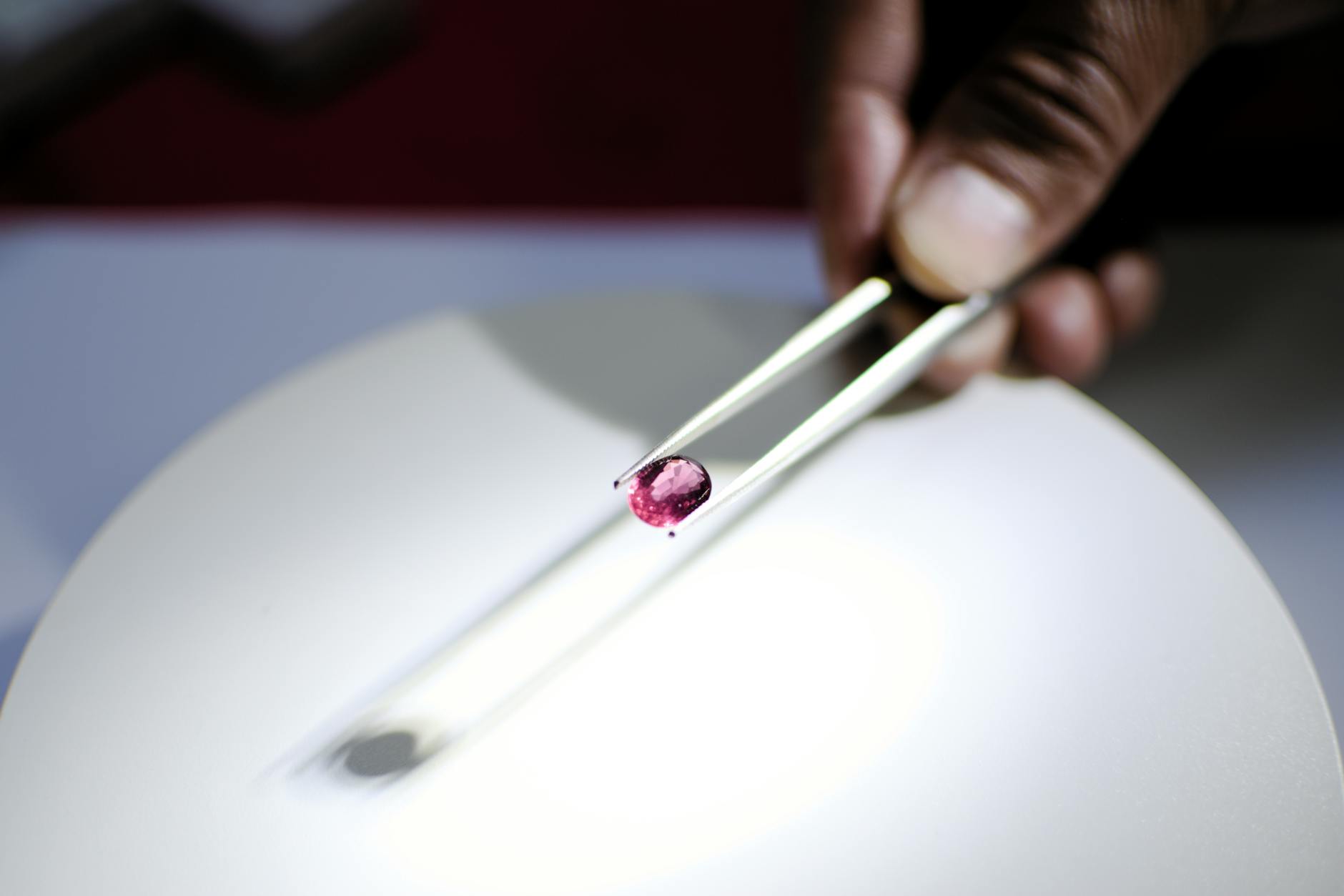
Hold the stone between your thumb and forefinger. Position it approximately 15–20 cm from a strong, directional point light source (an LED torch, a jeweller's bench lamp, or even a bright phone flashlight held close). Slowly rotate and tilt the stone through approximately 180 degrees while keeping it in the light beam.
In a glass-filled ruby, you will observe a sudden, distinctive colour flash — typically bright blue or orange — appearing abruptly in sections of the stone before disappearing as you continue tilting. This "flash effect" is caused by the light hitting the glass-filled fracture planes at the specific angle where their optical properties produce a flash of anomalous colour. The flash is sudden and unmistakeable once you have seen it — it does not gradually transition; it appears and disappears sharply.
Natural rubies may show some degree of colour change (they can appear more or less saturated from different angles due to natural dichroism — rubies are pleochroic), but they do not produce the sudden, sharp, anomalous blue or orange flash characteristic of glass-filled fractures. Practice this test on a confirmed glass-filled ruby (very cheap ones are easy to find) before attempting it on purchase decisions — the experience of seeing the characteristic flash once makes future identification immediate.
Detection Method 2: Magnification (10x Loupe Test)
Under 10x magnification (a standard jeweller's loupe, available for ₹200–400 online or at photography shops), glass-filled rubies display several diagnostic features:
Gas bubbles: The single most diagnostic feature of glass filling. Trapped gas bubbles appear as rounded or slightly elongated transparent spheres within the stone — often arranged in chains or clusters along fracture planes. Gas bubbles do not occur in natural corundum under any circumstances. Their presence is absolute, irrefutable evidence of glass or resin filling. Under 10x, they may be subtle or obvious depending on the amount of filling — but even one confirmed gas bubble ends all doubt about glass treatment.
Surface flow structures: When glass solidified on and between the facets, it can leave behind characteristic flow patterns — solidified fluid textures visible on facet surfaces. These look like frozen flowing liquid: irregular curves and swirls on an otherwise flat facet surface. Natural ruby facets (polished corundum) are flat, optically consistent surfaces without flow structures.
Network of fractures (relict inclusions): The fractures that the glass fills are sometimes still partially visible under high magnification as a network of internal "healed fractures" — the glass fills them but their boundaries remain detectable. In contrast, natural ruby inclusions include needle-like rutile "silk," fingerprint-like two-phase inclusions, and growth planes — these are structurally completely different from the planar, parallel fracture networks seen in heavily fractured and filled material.
| Detection Test | Natural Ruby | Glass-Filled Ruby | Equipment | Reliability |
|---|---|---|---|---|
| Flash effect | No anomalous colour flash | Bright blue or orange flash | Directional light | Very high |
| Gas bubbles | None present | Rounded bubbles in fractures | 10x loupe | Definitive |
| Surface flow structures | Clean flat facets | Irregular flow patterns on facets | 10x loupe | High |
| Relative density (SG) | SG ~3.99–4.00 | Higher (lead glass SG ~4.4–4.8) | Precision scale + water | Moderate (comparative) |
| Chelsea filter | Glows red-orange strongly | May show weaker/different response | Chelsea filter (₹800–1,500) | Supportive (not definitive) |
| UV fluorescence (LW) | Strong red (Burmese) to inert | Glass areas may fluoresce differently | UV lamp 365nm | Supportive |
Ruby Origins and the Price Premium Structure
Beyond treatment status, geographic origin is the second most critical driver of ruby value. The origin premium for top Burmese rubies versus other sources can multiply value 3–8 times for comparable quality stones.
Burma (Myanmar) — Mogok Valley and Mong Hsu: The world's most prestigious ruby origin. Mogok (the "Valley of Rubies") has produced exceptional rubies for 2,500+ years. The finest Mogok stones have extraordinary chromium content that drives strong fluorescence — the stone appears to glow with an inner fire, creating the legendary "pigeon's blood" colour (pure vivid red with a hint of fluorescent pink-red). Mong Hsu rubies (discovered 1992) are heat-treatable and have different characteristics; they rarely achieve the finest Mogok colour. Certified "Burmese origin" on a GRS or Gübelin certificate for a 2-carat+ fine stone can add USD 20,000–50,000+ in value versus a Thai stone of identical appearance.
Mozambique (Montepuez mining area): The world's most significant ruby source by production volume since 2009. Montepuez rubies are vivid red with good saturation and excellent size potential (stones above 5 carats are relatively common, unlike Mogok). They typically show less fluorescence than Burmese stones, giving a slightly cooler red. In India's certified market, fine Mozambique rubies trade at approximately 40–65% of comparable Burmese stone prices — representing the most accessible route to genuinely fine, certified natural rubies.
Thailand (Chanthaburi/Kanchanaburi): Thai rubies typically have higher iron content (lower chromium), resulting in darker, sometimes brownish-red stones that lack the vibrancy of Burmese or Mozambique material. They heat-treat extremely well and have been the historical "workhorse" of the commercial ruby trade. Thai commercial-quality heat-treated rubies trade at ₹5,000–50,000 per carat in India depending on quality — affordable entry points for certified natural material.
Sri Lanka (Ceylon): Sri Lankan corundum is typically pink to light pinkish-red — what gemologists and the trade categorise as "pink sapphire" or "light ruby." True "vivid red" rubies from Sri Lanka are exceptional and rare. Most Sri Lankan "rubies" sold in India are better described as pink corundum. They are beautiful stones but should not be priced as or confused with saturated commercial ruby.
The Complete Treatment Spectrum for Rubies
Natural ruby exists on a treatment spectrum from completely unheated (extremely valuable) to composite glass-filled material (essentially worthless as a gemstone investment). Understanding each category is essential for price assessment.
Unheated natural ruby: Ruby that has not been subjected to any heat treatment — perhaps 2–5% of commercial ruby production qualifies. GRS and Gübelin certificates explicitly stating "no indications of heating" are required documentation. These stones command extraordinary premiums — a fine unheated Burmese ruby above 2 carats with top colour is among the rarest, most valuable natural objects on earth. In India's market, certified unheated fine rubies are investment/collector pieces priced at ₹3,00,000–20,00,000+ per carat.
Heated only (standard market treatment): The overwhelming majority (90%+) of commercial rubies have been heat-treated (typically 1,200–1,800°C for hours) to dissolve needle-like rutile inclusions, improve transparency, and enhance colour saturation. This is universally accepted in the international trade and is considered a "normal" enhancement that does not meaningfully reduce price. All standard benchmark prices for rubies assume heat treatment.
Flux-residue heating: Some rubies are heated in a borax or chemical flux environment, which leaves residue (re-solidified flux) in surface fractures. This is a step beyond simple heating, partially filling fractures with natural silicate residue. Certification notes this as "minor residues in fractures." Price impact: 15–30% below equivalent heat-only stones.
Lead glass filling: As detailed above — composite material not deserving of ruby pricing. Maximum fair price: ₹500–3,000 per carat as a decorative stone. Any higher price without full treatment disclosure is consumer fraud.
| Treatment Category | Certificate Language | Price vs Unheated | Market Acceptance |
|---|---|---|---|
| Unheated natural | "No indications of heating" | 100% (premium benchmark) | Investment grade |
| Heat treated (standard) | "Indications of heating" | 30–60% of unheated | Standard commercial |
| Minor flux residue | "Minor residues in fractures" | 20–40% of unheated | Acceptable if disclosed |
| Lead glass filled | "Composite ruby" / "glass filling" | 1–5% of unheated | Only if disclosed + correct price |
| Synthetic corundum | "Synthetic corundum" | Less than 1% | Fashion only; must be disclosed |
Manik in Jyotish Astrology: Requirements for Astrological Buyers
Ruby (Manik) is the Navagraha stone for Surya (the Sun) in Vedic astrology — one of the most important of the nine astrological gems. For astrological purposes, virtually all Jyotish traditions require natural ruby. Synthetic corundum and glass-filled material are explicitly excluded as ineffective.
Specific requirements for astrological Manik rings:
- Minimum weight: Most practitioners prescribe 3 ratti (2.73 carats) minimum for effective solar influence. Some specify higher weights for more prominent Surya placements.
- Treatment: Natural ruby. Heat treatment is accepted by most contemporary practitioners; unheated is preferred. Glass-filled and synthetic material is unanimously excluded across all traditions as inert for astrological purposes.
- Origin: Burmese (Manik from Mogok) is traditionally preferred in Jyotish texts. Mozambique ruby is increasingly accepted by contemporary practitioners as Jyotish-effective natural ruby.
- Setting: Yellow gold (22K standard), ring finger of the right hand. Some traditions specify Panchdhatu.
- Documentation: Increasingly, responsible astrologers specify IGI or GRS certification as a requirement, particularly for purchases above ₹30,000.
Budget reality for genuine astrological Manik: A certified natural ruby (heat treated acceptable) from Mozambique or Thailand at 3 ratti (2.73 carats), commercial quality (medium red, some inclusions), with IGI India certification: ₹22,000–60,000 for the stone, plus ₹5,000–12,000 for gold ring. Total minimum for certifiable astrological Manik: ₹28,000–75,000. Any "certified Burmese Manik ring" at 3+ ratti below ₹15,000 total is almost certainly glass-filled or synthetic.
⚠️ Watch Out: Astrologer-Dealer Referral Networks
A common fraud pattern in India involves an astrologer recommending a specific gem dealer for the required stone, where the astrologer receives a kickback (10–30% of sale value) from the dealer. The dealer, in turn, sells an overpriced or misrepresented stone to the buyer who is psychologically committed to the purchase for astrological reasons and less likely to negotiate or verify independently. This conflict of interest is extremely common. Always purchase astrological stones independently from the astrologer's recommendation — conduct your own research, get independent certification, and choose your own certified dealer. A genuine astrologer's service is interpretation, not retail commission.
Other Common Ruby Frauds in India's Market
Beyond glass filling, several other misrepresentations circulate in India's ruby market. A sophisticated buyer should be aware of all of them:
Synthetic corundum sold as natural ruby: Lab-created ruby (Verneuil/flame-fusion synthesis has existed since the 1890s) is chemically identical to natural ruby (both are Al₂O₃ with chromium impurities) but worth a tiny fraction of natural prices. Synthetic rubies are typically perfectly transparent with no natural inclusions. Under magnification, they may show curved growth striations — a pattern impossible in natural corundum (which shows straight growth patterns). Detection: a gemmologist with a spectroscope can immediately differentiate. Synthetic rubies properly labelled and priced are entirely legitimate for fashion jewellery — the fraud is selling them as natural stones.
"Burmese ruby" without origin certificate: Claiming Burmese origin without a GRS, Gübelin, or GIA origin determination report is a price-manipulating misrepresentation. Origin determination for corundum requires spectroscopic analysis of trace element chemistry in a fully equipped gem lab. No jeweller, however experienced, can determine ruby origin with the naked eye or a loupe. If a seller claims "Burmese ruby" without a lab certificate, they are either deceiving you or deceiving themselves. The origin claim without certification is worth exactly nothing to your purchase decision.
Red spinel sold as ruby: Red spinel is a naturally beautiful gemstone (Mohs 8, different crystal system from corundum) that can be visually similar to ruby. Historically, all red stones were called "rubies" — the famous "Black Prince's Ruby" in the British Crown Jewels is actually a red spinel. Today, selling spinel as ruby is fraud. Spinel has a single refractive index (isometric, no birefringence) versus ruby's double refraction — detectable with a refractometer. Red spinel is actually a desirable gemstone in its own right, commanding significant prices for fine material — it should be sold honestly as spinel, not masqueraded as ruby.
Garnet and red glass: At the lowest price points, red glass cabochons and red garnets (almandine or pyrope) are sometimes sold as "rubies" in informal markets. Red glass: SG significantly lighter than corundum, shows air bubbles, warm under light; easily identified by a trained eye. Garnets: do not show the doubling of back facets visible in corundum under magnification; distinct spectroscopic signature. These frauds are most common in roadside markets and informal contexts — buying from registered jewellers essentially eliminates this risk.
Where to Buy Certified Natural Rubies in India
For purchases above ₹20,000 total, these channels provide reasonable assurance of certified natural material:
Jaipur — certified dealers: Jaipur's M.I. Road gem corridor (near IGI Jaipur's office) and GJEPC-registered dealers in Johari Bazaar. Request the IGI or GRS certificate before any price discussion. Reputable dealers: members listed on the GJEPC website under Jaipur Rajasthan gem exporters.
Mumbai's Zaveri Bazaar premium firms: Several multi-generational Mumbai gem dealers operate with high documentation standards for investment-grade rubies. Prices are somewhat higher than Jaipur but certification standards for fine stones are typically excellent.
Online platforms with per-stone certification: For accessible certified natural rubies online, look for platforms displaying individual IGI/GIA/GRS certificate numbers (verifiable on the respective lab's website) for each stone. Generic "natural ruby certified" claims without per-stone verifiable certificate numbers are not sufficient assurance for any purchase above ₹10,000.
Care for Glass-Filled Rubies vs Natural Rubies
Natural rubies (heat treated or not) are among the most durable gemstones — Mohs 9 hardness, excellent toughness, resistant to most chemicals. Standard jewellery cleaning methods are safe: ultrasonic (for stones without fractures reaching the surface), steam, mild chemicals. Natural ruby jewellery requires no special care beyond avoiding impact from extreme angles.
Glass-filled rubies are fragile in ways natural rubies are not. The lead glass filling is attacked by: hydrofluoric acid and many commercial jewellery cleaners; ultrasonic vibration (which can crack or expel the glass from fractures, making previously invisible fractures suddenly obvious); steam (thermal shock); household bleach; and concentrated acids in some professional cleaning processes. If you own glass-filled ruby jewellery (knowingly or unknowingly): clean only with a soft damp cloth; avoid professional ultrasonic cleaning; never expose to harsh chemicals; and store separately from harder stones that can damage the glass-filled areas.
Frequently Asked Questions
Can I test a ruby for glass filling at home without equipment?
The flash effect test (tilting under a directional point light looking for anomalous blue or orange flash) and gas bubble check under 10x magnification are the two most reliable home tests. A 10x loupe costs ₹200–400 online and is a worthwhile investment for anyone buying gemstones regularly. However, home tests are indicative, not definitive — confirmation requires a professional gemmologist or lab certification. For any single stone purchase above ₹5,000, insist on professional certification before finalising the transaction.
Is a glass-filled ruby worthless?
Not entirely worthless as a decorative object — it is an attractive red stone with reasonable visual appeal as costume jewellery. But as a gemstone investment, its value is minimal (₹500–3,000/carat at honest pricing), it has zero astrological utility in any tradition, and its durability is compromised compared to natural corundum. If you knowingly purchased a glass-filled ruby at a price that reflects that treatment status, it is a legitimate transaction for decorative purposes. The problem — which is widespread in India — is purchasing at natural ruby prices without disclosure of the treatment status.
What should a seller disclose about ruby treatments under Indian consumer law?
Under the Consumer Protection Act 2019, any misrepresentation of a product's material characteristics constitutes consumer fraud. For gemstones, selling a glass-filled ruby as a "natural ruby" without disclosure of the treatment is explicitly misrepresentation of the product's fundamental nature. You have the right to a full refund plus compensation if this misrepresentation is proven. Document everything: photograph the stone, retain the purchase receipt, and commission an IGI or GIA certification showing glass filling as evidence. File complaints at consumerhelpline.gov.in (1915) with this documentation.
Can glass filling in a ruby be reversed or removed?
The glass filling can technically be removed (hydrofluoric acid dissolves glass), but what remains after removal is the original heavily fractured, largely opaque corundum that had no commercial value before treatment. Removing the glass does not restore or "reveal" a better natural ruby — it destroys the illusion that was the product's only value. A glass-filled ruby cannot be converted into a natural ruby by any process. The underlying material was never a good ruby.
How do I get my existing ruby tested to know if it is glass-filled?
Take it to any IGI India office (Mumbai, Delhi, Jaipur, Surat, Ahmedabad, Hyderabad) for a formal identification report. The cost for a ruby identification report (species, treatment) is typically ₹2,000–4,500 depending on the stone size and report type. The report will explicitly state whether glass filling is present. If the stone is in a ring setting, it can usually be tested in setting; unmounting is not required for the flash test and XRF analysis. GIA India offices in Mumbai and Delhi offer the same service at comparable fees.
More in Buying Guides
Share this article
Our editorial team comprises jewellery industry veterans, certified gemmologists, and passionate writers with decades of combined experience across India's gold, diamond, and gemstone markets. Every article is researched, fact-checked, and written to help Indian buyers make smarter, safer jewellery decisions.
Passionate about jewellery and love to write? We'd love to hear from you.
Join us as a writer →Ready to buy? Find verified jewellers near you
Browse 10,000+ BIS hallmark certified jewellers across India. Compare ratings, check today's gold rate, and book a visit.
Keep Reading