Blue Sapphire (Neelam) Buying Guide for India: Gem Quality, Origins, Astrology, and Price
Blue sapphire occupies a unique position in Indian culture — it is simultaneously one of the world's most prized gemstones by pure gemological standards and one of the most consequential stones in Vedic astrological tradition. Whether you are buying Neelam for astrological purposes, as a fine jewellery investment, or simply as a beautiful gemstone, this guide covers everything the Indian buyer needs to know: origins, quality factors, treatment disclosure, certification, pricing, where to buy in India, and how to avoid fakes and overpricing.
Blue Sapphire in Indian Tradition: The Astrological Significance
In Vedic astrology, blue sapphire (Neelam in Hindi; Indraneelam in Sanskrit) is the gemstone of Saturn (Shani) — the planet of karma, discipline, hard work, delays, and ultimate justice. Shani is considered the most powerful and demanding of the nine planets in the Navagraha system. When Saturn is well-placed in your birth chart — or when you are entering a Shani Mahadasha (Saturn main period, lasting 19 years) or Sade Sati (Saturn's 7.5-year transit over your moon sign) — wearing a high-quality blue sapphire is traditionally believed to amplify Saturn's beneficial influences.
The Trial Period Tradition
Unlike most gemstones, blue sapphire is traditionally worn on a "trial basis" before committing permanently. The conventional practice: wear the stone for 3 to 7 days (some traditions say 3 days, some 72 hours). During this period, observe carefully:
- Positive signs: Improved mental clarity, energy, financial opportunities appearing, sense of calm and focus, positive dreams
- Negative signs: Bad dreams, accidents or near-misses, sudden illness, significant conflict, a sense of heaviness or discomfort, financial loss
If negative signs appear, remove the stone immediately and consult an experienced Vedic astrologer. This tradition is taken extremely seriously — blue sapphire is one of very few stones in the Vedic tradition where trial wearing is considered non-optional before permanent adoption.
Astrological Quality Requirements
For astrological effectiveness, traditional Vedic criteria differ somewhat from gemological grading:
- Untreated (natural): Heat treatment is strongly discouraged for astrological use; the stone must be as nature produced it
- Inclusions: Minor inclusions are acceptable — traditional texts accept "flaws that do not reduce brilliance"; what matters is that the stone is alive with colour
- Contact with skin: The stone must be set in an open-back (bezel or prong) setting so it touches the skin directly — closed-back settings are not acceptable for astro use
- Metal: Silver is traditionally prescribed for Neelam; some modern astrologers accept white gold or platinum
- Finger: Middle finger of the right hand (Saturn's finger per Vedic tradition)
- Minimum weight: Most astrologers recommend a minimum of 2–3 Ratti (approximately 1.8–2.7 carats)
Which Ascendants Should Exercise Caution
Saturn rules Capricorn and Aquarius in Vedic astrology. Generally, individuals with these ascendants (Lagna) may benefit most from Neelam, particularly during Saturn periods. Proceed with great caution — always consult an astrologer first — if your ascendant is Aries, Cancer, Leo, Scorpio, or Sagittarius. For these ascendants Saturn often rules malefic houses, and wearing Neelam without expert guidance could have adverse effects.
Origins: Where Blue Sapphires Come From and Why It Matters for Price
Origin is the single largest price differentiator for fine blue sapphires — far exceeding differences in size or even colour quality at the top of the market. Here is the complete origin guide relevant to Indian buyers:
| Origin | Characteristic Colour | Typical Quality | Price Range (per ct) |
|---|---|---|---|
| Kashmir (India) | "Cornflower blue" — velvety, sleepy, slightly milky | Finest in the world; antique stones only (no active mining) | ₹1,00,000–₹5,00,000+ |
| Ceylon (Sri Lanka) | Vivid royal to cornflower blue; excellent brilliance | Most common fine sapphire in Indian market; widely certified | ₹10,000–₹2,00,000 |
| Burma (Myanmar) | "Royal blue" — deep, highly saturated | Excellent quality; less available than Ceylon in India | ₹15,000–₹3,00,000 |
| Thailand | Darker, often greenish-blue or inky | Commercial grade; most stones are heat-treated | ₹1,000–₹15,000 |
| Madagascar | Wide range; can rival Ceylon quality | Increasingly popular; good quality becoming available | ₹2,000–₹50,000 |
| Tanzania | Good blue, sometimes violet component | Solid commercial-to-fine range; less known in Indian market | ₹1,500–₹30,000 |
| Synthetic / Lab-grown | Identical to natural; very pure blue | No inclusions, no astrological value (per tradition) | ₹500–₹3,000 |
Kashmir Sapphire: The Holy Grail
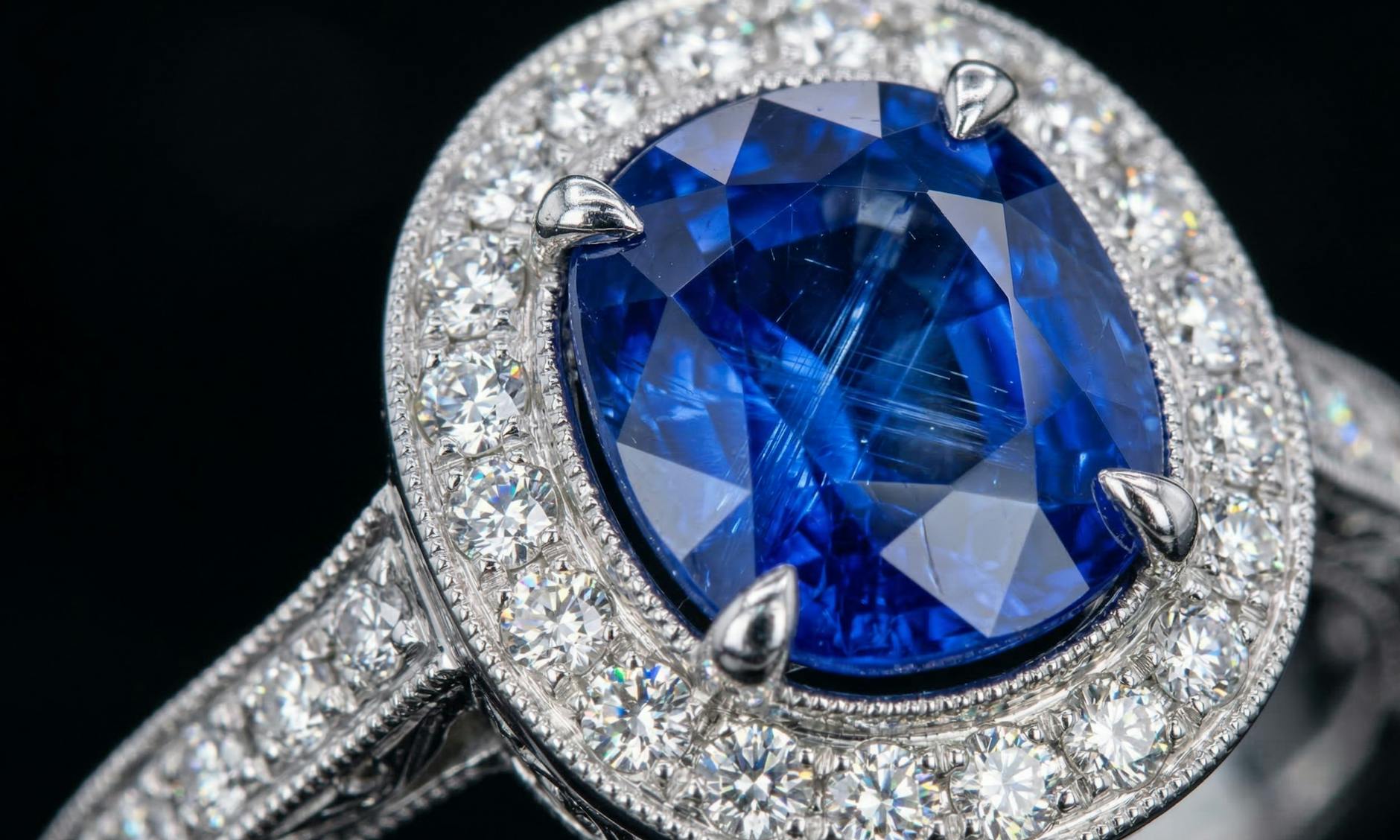
The Paddar mines in the Zanskar range of Jammu & Kashmir (and the Kudi deposits) produced what is widely considered the finest blue sapphire ever found. The characteristic "velvety" or "sleepy" appearance — caused by microscopic rutile silk inclusions scattering the light — is unique to Kashmir stones and cannot be replicated by any other origin. Active mining effectively ceased in the early 20th century; all Kashmir sapphires on today's market are antique stones or from old parcels.
A GRS or Gübelin certificate confirming Kashmir origin on a fine stone of 3+ carats can place the price at ₹3,00,000–₹10,00,000 per carat or more. Fraudulent "Kashmir" claims are rampant — never accept a Kashmir origin claim without a certificate from Gübelin, GRS, or AGL specifically. These laboratories conduct origin determination using chemical analysis, spectroscopy, and microscopy; a visual claim of "Kashmir quality" by a dealer is meaningless.
Ceylon / Sri Lanka: The Market Leader in India
Sri Lankan sapphires dominate the quality segment of the Indian market, particularly in Jaipur. The best Ceylon stones have a vivid, open blue colour with excellent transparency and brilliance — the opposite of Kashmir's velvety look. Both are extraordinary; neither is objectively "better" — they are different expressions of perfection. Fine unheated Ceylon sapphires with GRS or Gübelin certification fetch ₹50,000–₹2,00,000 per carat. Good-quality, heated Ceylon stones with IGI certification are available from ₹10,000–₹40,000 per carat.
Quality Factors: How Blue Sapphires Are Graded
Colour: The Most Important Factor (50–60% of Value)
Sapphire colour is described by three dimensions:
- Hue: Pure blue is the ideal. Violet-blue is accepted and can be beautiful. Greenish-blue is less desirable. The "purer" the blue, the higher the value. Very slight violet can enhance perceived vividness.
- Tone: The lightness/darkness scale from 0 (colourless) to 10 (black). For sapphires, medium (4–6) to medium-dark (6–7) tone is ideal. Too light = watery and lacks presence. Too dark = inky and loses life.
- Saturation: The intensity or purity of the colour. Vivid saturation commands maximum premium. Grey or brown modifiers reduce saturation and substantially reduce value.
The prized "royal blue" designation from labs like GRS indicates a pure, vivid, medium-dark blue that is the gold standard for fine sapphires. The "cornflower blue" designation references the softer, lighter pure blue of finest Kashmir and some fine Ceylon stones.
Clarity: Inclusions Are Normal and Expected
Unlike diamonds, sapphires are assessed with the understanding that virtually all natural stones contain inclusions. The question is whether inclusions affect the stone's beauty or structural integrity — not whether they exist.
- Silk (rutile needles): Fine silk inclusions in Kashmir stones are a feature, not a flaw — they create the famous velvety appearance and actually confirm natural origin. Do not reject a Kashmir stone for silk.
- Fingerprints and liquid inclusions: Common in Ceylon sapphires; usually invisible to the naked eye; no negative impact on beauty.
- Fractures: Cracks or breaks — particularly those that reach the surface — are negative. They can harbour dyes or fillers and may affect durability.
- Cavities: Surface pits — reduce polish quality; problematic if large.
- Cloudiness: Heavy diffuse inclusions reducing transparency are negative for both beauty and value.
For astrological use, a stone with minor inclusions but excellent colour and good transparency is preferred over a heavily included stone of any purity rating.
Cut: Oval and Cushion Dominate the Indian Market
Indian buyers and jewellers strongly favour oval and cushion cuts for sapphires — both for their traditional aesthetic suitability for Indian jewellery designs and because these cuts minimise weight loss from the rough stone, preserving maximum carat weight. Round brilliant sapphires are growing in popularity for modern designs and white metal settings.
The critical cut quality issue is windowing — when a stone is cut too shallow, light passes straight through the centre without reflection, creating a transparent "window" in the middle of the stone. Hold the stone face-up over a white background: if you can see through to the white background clearly, the stone is windowed and has been cut to preserve weight at the cost of beauty. Avoid windowed stones.
The opposite defect — excessive depth ("extinction") — creates dark areas in the stone. The ideal depth-to-width ratio for an oval sapphire is approximately 60–70%.
Carat Weight: Non-Linear Pricing
Sapphire pricing is non-linear — the price per carat increases dramatically at certain weight thresholds. A 3-carat fine sapphire is not simply 3× the price of a 1-carat equivalent; it may be 6–10× the price per carat. Important thresholds:
- Under 1 carat: commercial grade widely available
- 1–2 carats: where certified fine quality stones are commonly bought for jewellery
- 2–3 carats: astrological sweet spot; price per carat rises significantly for certified unheated stones
- 3–5 carats: fine quality commands substantial premium; Kashmir stones at this size are rare collector items
- Above 5 carats: exceptional stones command auction-level pricing
For astrological use, most astrologers recommend a minimum of 2 Ratti (approximately 1.8 carats), with 3–5 Ratti (2.7–4.5 carats) for maximum effectiveness. One Ratti = approximately 0.9 carats (conversion varies slightly by tradition).
Heat Treatment: The Critical Disclosure
Approximately 95% of commercial blue sapphires on the global market are heat-treated. Heating sapphire rough at 1,600–1,800°C dissolves silk inclusions, improves colour, and enhances clarity. The process is permanent and stable. There is nothing deceptive about heat-treated sapphires as long as the treatment is fully disclosed — and this is where problems arise in the Indian market.
Unheated Premium
A certified unheated (no indications of heating, "NIH") sapphire commands a 2–5× price premium over an equivalent heated stone at fine quality. This premium exists because untreated stones are rare, and because the treatment is considered to diminish the stone's "natural" status. For astrological buyers, traditional Vedic gemology strongly prefers untreated stones — the belief is that heating alters the stone's energy.
How Treatment Is Disclosed on Lab Certificates
A GIA, GRS, or Gübelin certificate will state one of:
- "No indications of heating" — the highest premium category; stone is natural and untreated
- "Indications of heating" — stone has been heat-treated; standard commercial treatment
- "Indications of fracture filling" — more significant treatment where fractures are filled with a foreign substance; substantially reduces value and is problematic for durability
Visual identification of heat treatment by a dealer is unreliable. A laboratory report is the only credible method. Any seller claiming a stone is "natural and unheated" without a reputable laboratory certificate is making an unverifiable claim.
Certification: Which Labs to Trust
| Laboratory | Reputation in India | Origin Determination | When to Use |
|---|---|---|---|
| GIA (USA) | Excellent — internationally accepted | Yes, but not primary focus | Good for treatment disclosure; widely recognised for resale |
| IGI (India/International) | Good — widely used in Indian market | Yes | Commercial-grade stones; acceptable for stones under ₹50,000 |
| Gübelin (Switzerland) | Gold standard — essential for Kashmir | Premier origin authority | Mandatory for any Kashmir origin claim; fine stones above ₹1 lakh |
| GRS (Switzerland) | Highly regarded — quality designations | Excellent; "royal blue" / "pigeon's blood" designations | Fine quality sapphires and rubies; colour quality designations add value |
| AGL (USA) | Respected — detailed quality grading | Excellent | Fine quality stones; quality descriptors useful for collectors |
| GII (India) | Acceptable for low-value commercial | Limited | Commercial stones only; do not rely for fine quality decisions |
Critical rule for Kashmir origin: Only Gübelin and GRS carry sufficient authority for Kashmir sapphire provenance. If a dealer offers you a stone with an Indian lab certificate claiming "Kashmir origin," that certificate does not carry the necessary credibility. The certificate cost for a 3-carat stone is approximately ₹25,000–₹50,000 from these labs — a worthwhile investment when the stone itself is worth ₹5–₹15 lakh.
Buying Blue Sapphire in India: Where to Go
Jaipur: India's Gem Capital
Jaipur is the dominant hub for coloured gemstones in India — both wholesale and quality retail. Key areas:
- Johari Bazaar: Traditional retail market; hundreds of shops; wide selection from commercial to fine; negotiate hard; ask for certificates
- Gopal Ji Ka Rasta: Wholesale gem market; most dealers sell to the trade but some will accommodate retail buyers; prices are significantly lower than retail; quality verification knowledge essential
- Gem and Jewellery Export Promotion Council (GJEPC) registered dealers: Higher accountability; ask at Jaipur Gem Bourse
Mumbai: Zaveri Bazaar
Mumbai's Zaveri Bazaar (Bhuleshwar area) has established gem dealers, particularly for sapphires. Dealers here are generally more formal than Jaipur's bazaar environment. Good selection of certified stones; quality fine-gem dealers operate alongside commercial traders.
Delhi: Chandni Chowk and Karol Bagh
Chandni Chowk's gem section (Dariba Kalan) has commercial-grade sapphires widely available. Karol Bagh has more organised jewellery-focused dealers. Both markets are good for commercial quality at negotiated prices; less reliable for certified fine quality.
Online Platforms
Reputable online options include GemPundit (Jaipur-based, strong certification focus), CaratLane (branded, good transparency), and international platforms accessed through Indian buyers. For any online purchase above ₹15,000: insist on a certificate from a named reputable lab, a detailed stone video, a clear return policy of minimum 7 days, and confirmation of whether the stone is heated or unheated.
Price Guide: What to Expect to Pay
| Quality Tier | Description | Price per Carat (₹) |
|---|---|---|
| Commercial (no cert) | Thai origin, heated, dark/greenish, no certificate | ₹500–₹3,000 |
| Commercial (IGI cert) | Ceylon/Madagascar/Thai, heated, IGI certified | ₹2,000–₹10,000 |
| Good Ceylon/Burma (IGI/GIA) | Good colour, heated, certified, VS clarity | ₹5,000–₹50,000 |
| Fine Ceylon unheated (GRS/Gübelin) | Vivid blue, NIH, excellent cut, top certification | ₹50,000–₹2,00,000 |
| Fine Burma unheated (GRS/Gübelin) | Royal blue, NIH, Burmese origin confirmed | ₹75,000–₹3,00,000 |
| Kashmir (Gübelin/GRS) | Cornflower/velvety blue, Kashmir origin confirmed | ₹1,00,000–₹5,00,000+ |
Setting Recommendations
For Astrological Use
The traditional setting for Neelam follows Vedic prescription: a silver ring with an open-back setting (prong or bezel that allows the stone to touch the skin). The stone is set in the middle finger of the right hand. The ideal day to wear it for the first time is a Saturday during the Shukla Paksha (waxing moon), ideally during Shani Hora (Saturn's planetary hour).
Modern astrologers increasingly accept white gold (18K or 22K) or platinum as alternatives to silver for the setting metal, particularly for expensive stones where silver may seem inadequate in presentation. The critical requirement is the open-back contact-with-skin condition, regardless of the setting metal chosen.
For Fine Jewellery Use
- Yellow gold (22K/18K): Classical Indian aesthetic; the warm gold colour contrasts richly with vivid blue sapphire; traditional and highly suitable for bridal or occasion pieces
- White gold or platinum: Contemporary aesthetic; the neutral metal allows the blue of the sapphire to dominate visually; popular for solitaire rings and modern pendants
- Oval/cushion cut: Both are suited to almost every setting style and are the dominant choices in the Indian market for good reason
Simulants, Synthetics, and Fraud: What to Watch For
The blue sapphire market — particularly the astrological segment in India — is plagued by misrepresentation. Common substitutions:
- Blue topaz: Much lighter blue (sky blue), lower density (3.5 vs 4.0 for sapphire), softer (8 Mohs vs 9). Very easy to confuse for an inexperienced buyer when presented at a similar size.
- Tanzanite: Violet-blue colour with strong pleochroism (colour changes when viewed from different angles); much softer (6–7 Mohs); beautiful stone but not sapphire; genuinely valuable itself but sometimes misrepresented as sapphire.
- Synthetic sapphire (Verneuil flame-fusion): Chemically identical to natural sapphire (Al₂O₃ with chromophores); extremely affordable to produce; sold widely in Indian markets as "natural" Neelam by unscrupulous dealers. Detection: curved growth lines (striae) visible under microscope; gas bubbles; absence of natural inclusions. A gemological loupe examination by an expert will distinguish — but the best protection is a reputable lab certificate.
- Glass-filled / fracture-filled sapphire: Natural sapphire with fractures filled with blue-coloured glass or resin to improve apparent clarity. Detection: under oblique lighting you see a blue or orange "flash" effect from the filling material at different angles. Heavily filled stones are significantly less valuable and less durable.
- Composite ("doublet") stones: A thin slice of natural sapphire cemented to a glass or synthetic base. The crown looks like natural sapphire; the base is not. Common in older stock; detect by examining the girdle (junction) under magnification — you may see the cement layer.
- Dyed stones: Other blue stones (blue quartz, pale sapphire, chalcedony) dyed blue. Colour concentrated in fractures is the visual tell; UV light test can help; laboratory test is definitive.
The safest protection against all of these: purchase only certified stones from reputable laboratories, buy from established dealers with physical premises, and insist on a return policy of at minimum 7 days.
Frequently Asked Questions
Q: My astrologer recommended Neelam but I'm not sure I should wear it. How do I decide?
The trial period is specifically designed for this uncertainty. Wear the stone for 72 hours (some traditions say 3 days, some 7 days). Observe carefully without bias. Negative signs — bad dreams, accidents, illness, financial losses, general unease — are a clear signal to remove it and not continue. Positive signs — mental clarity, energy, opportunities, calm — suggest the stone suits you. For important astrological decisions involving Saturn, consulting two independent experienced Jyotishis is worthwhile given the long Shani Mahadasha period (19 years). Never let a gem dealer double as your astrologer.
Q: What is the difference between Kashmir, Ceylon, and Burma sapphires in practical terms for an Indian buyer?
In practical terms: Kashmir sapphires are exceptionally rare antique stones commanding ultra-premium prices — buying one requires a Gübelin/GRS certificate and significant budget. For most buyers, fine Ceylon (Sri Lankan) sapphires offer the best combination of availability, quality, and certified authenticity at manageable prices. Burma sapphires offer similar quality to fine Ceylon with a slightly different colour character (deeper royal blue vs vivid cornflower blue). For astrological use, a quality certified natural unheated Ceylon sapphire of good colour is entirely appropriate and far more accessible than Kashmir.
Q: How important is the "unheated" status for astrological use?
In traditional Vedic gemology, an unheated (untreated) stone is strongly preferred for astrological purposes. The reasoning is that the stone's natural energetic properties are considered intact only if it has not been artificially altered. Most traditional astrologers will specifically recommend an untreated stone. Practically, unheated stones of good quality carry a 2–5× price premium. If budget is a constraint, a quality heated stone of good colour from a reputable origin with full certification is considered acceptable by many modern practitioners — always confirm with your own astrologer what their guidance is.
Q: Can I buy a good blue sapphire in Jaipur without being cheated?
Yes — Jaipur is a legitimate and deep market. However, the same market that has world-class stones also has many unscrupulous dealers targeting uninformed buyers. Protect yourself: always insist on a certificate from a named reputable lab (IGI, GIA, GRS, or Gübelin) for any stone above ₹5,000. Never accept a dealer's verbal assurance of origin or treatment status. Visit multiple dealers before buying — price comparison is highly informative. If a stone is being offered significantly cheaper than market rates, ask specifically why. Having a GIA-certified gemologist accompany you, or using a gemological loupe yourself, adds meaningful protection.
Q: What should I look for in the physical stone when evaluating colour?
Evaluate colour in natural daylight (not fluorescent or incandescent shop lighting — both distort sapphire colour significantly). Look for: a pure blue hue without visible green or grey modifiers; a tone that feels rich but not so dark it loses light return (if the stone looks black in natural light, it is over-toned); and vivid saturation that makes the blue feel intense and alive rather than dull or milky. A stone that looks beautiful in the shop under focused halogen spotlights may look grey and dull in natural daylight outdoors. Always evaluate in natural light before purchasing.
Q: Is a lab-grown blue sapphire acceptable for jewellery if not for astrology?
Absolutely. Lab-grown (synthetic) sapphire is chemically and physically identical to natural sapphire — it is corundum with the same hardness (9 Mohs), brilliance, and durability. For fashion jewellery, engagement rings, or any non-astrological use, a lab-grown blue sapphire at ₹500–₹3,000 per carat offers extraordinary value. The only requirement is full disclosure — a dealer must tell you the stone is lab-grown. Demand this in writing on the bill. For astrological Neelam, lab-grown is universally rejected by traditional Vedic tradition as it is not a product of nature.
Q: How do I care for a blue sapphire in jewellery?
Sapphire (corundum) is the second hardest natural material at 9 Mohs, making it one of the most durable gemstones for daily wear — significantly more durable than emerald or opal. Clean with warm soapy water and a soft brush; rinse thoroughly and dry with a lint-free cloth. Ultrasonic cleaning is safe for untreated and heat-treated sapphires (avoid for fracture-filled stones). Avoid prolonged exposure to bleach or harsh chemicals. Store separately from diamonds (which can scratch almost anything, including each other) in individual pouches. Blue sapphire is an excellent choice for everyday rings precisely because of its hardness.
More in Buying Guides
Share this article
Our editorial team comprises jewellery industry veterans, certified gemmologists, and passionate writers with decades of combined experience across India's gold, diamond, and gemstone markets. Every article is researched, fact-checked, and written to help Indian buyers make smarter, safer jewellery decisions.
Passionate about jewellery and love to write? We'd love to hear from you.
Join us as a writer →Ready to buy? Find verified jewellers near you
Browse 10,000+ BIS hallmark certified jewellers across India. Compare ratings, check today's gold rate, and book a visit.
Keep Reading