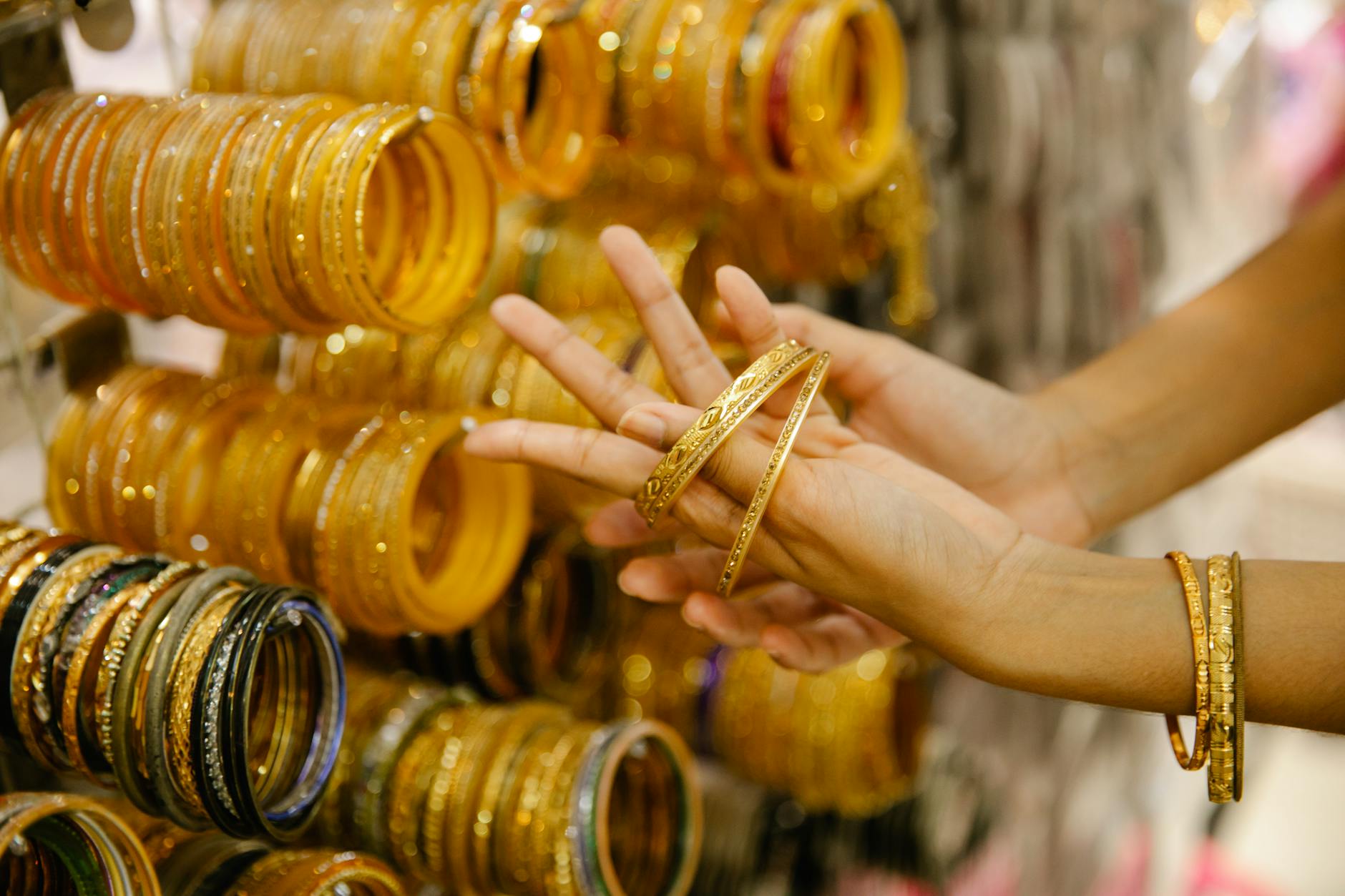
When you buy gold jewellery in India, you will see a series of tiny stamped marks on the surface — a triangle, some numbers, a letter, perhaps a circular logo. These are not decorations. They are the BIS hallmark: a legally mandated quality assurance system that tells you exactly how much gold is in what you are buying. Understanding these marks is the single most important skill any gold buyer in India can develop. This guide explains every component, every purity code, and every protection the hallmarking system gives you — from the legal framework to the step-by-step verification process to the penalties jewellers face for selling substandard gold.
What Is BIS Hallmarking?
BIS hallmarking is a voluntary-turned-mandatory certification scheme administered by the Bureau of Indian Standards (BIS), the national standards body operating under the BIS Act 2016. A hallmark on gold jewellery is a third-party assurance — issued not by the jeweller but by an independent, BIS-accredited Assaying and Hallmarking Centre (AHC) — that the gold article meets the declared purity.
Hallmarking was introduced voluntarily in India in 2000. For two decades, honest jewellers adopted it; dishonest ones did not. That changed on 16 June 2021, when the Government of India made BIS hallmarking mandatory for gold jewellery and gold artefacts sold in India. As of 2024, mandatory hallmarking applies across all 758 districts of India. Selling non-hallmarked gold jewellery in any notified zone is a criminal offence under the BIS Act.
Before mandatory hallmarking, studies by the BIS and consumer organisations consistently found that 30–40% of gold jewellery sold in Indian markets did not match its claimed purity. A piece sold as 22K 916 frequently tested at 18K 750 or lower. The consumer had no easy recourse — testing required melting the piece and paying an assay fee. Mandatory hallmarking with the HUID system changed this entirely, putting real-time verification power in every buyer's smartphone.
The Legal Foundation — BIS Act 2016
The Bureau of Indian Standards Act 2016 replaced the older BIS Act 1986 and gave BIS significantly broader enforcement powers. Under this Act:
- BIS is empowered to make hallmarking compulsory for any article through a government notification.
- The Hallmarking (Compulsory) Order issued under this Act specifies which articles must be hallmarked, the applicable standards, and exemptions.
- BIS officers are empowered to conduct inspections, seize non-compliant stock, and initiate prosecution.
- The Act applies to manufacturers, importers, and traders — anyone in the supply chain who sells gold jewellery to consumers.
The Indian Standard governing gold hallmarking is IS 1417 (Grades of Gold and Gold Alloys — Jewellery and Allied Products). This standard defines the permitted purity grades, the tolerance allowed (±0.5 per thousand), and the marking requirements. Assaying methods are defined under IS 1418.
Purity Numbers Decoded — From 999 to 375
The purity number is expressed in parts per thousand. Gold marked 916 means 916 parts out of 1000 are pure gold — i.e., 91.6% purity. This is mathematically the same as saying 22 out of 24 parts are gold, which is why 916 gold is called 22 karat.
| Hallmark Number | Karat | Gold Purity % | Common Uses in India |
|---|---|---|---|
| 999 | 24K | 99.9% | Investment coins, gold biscuits, digital gold; not used for jewellery (too soft) |
| 958 | 23K | 95.8% | Rare; some traditional Calcutta gold jewellery styles |
| 916 | 22K | 91.6% | Most Indian jewellery — bangles, necklaces, chains, earrings, wedding sets |
| 875 | 21K | 87.5% | Middle Eastern gold jewellery; rare in India |
| 750 | 18K | 75.0% | Diamond-set jewellery, contemporary designs, rose gold, white gold |
| 585 | 14K | 58.5% | Export jewellery, western-style fashion jewellery, studded pieces |
| 375 | 9K | 37.5% | Uncommon in India; sometimes seen in imported jewellery |
Why 916 Dominates the Indian Jewellery Market
Walk into any jewellery shop across India — from a small-town goldsmith in Rajasthan to a large chain store in Mumbai — and the default offering is 22-karat 916 hallmark gold. The dominance of 916 is not accidental. It is the product of centuries of Indian jewellery tradition meeting practical metallurgy.
Pure 24-karat gold (999) is beautiful but extremely soft — a Vickers hardness of around 25 HV. A ring made from pure gold would bend out of shape with daily wear; a necklace clasp would deform after a few uses; prong settings for stones would spread open and the stones would fall. Alloys are added — typically silver, copper, or zinc — to increase hardness significantly. 22K 916 gold has a typical hardness of 120–150 HV, making it suitable for virtually all traditional Indian jewellery forms.
The colour is equally important. Indian consumers associate the warm, deep yellow of 22K gold with authenticity and cultural identity. The yellow deepens slightly with higher purity and becomes noticeably paler as the alloy content increases. 18K 750 gold, with 25% alloy content, is visibly lighter yellow — fine for contemporary diamond-set pieces but considered "not gold enough" for traditional forms.
There is also a strong investment dimension. Gold in India is simultaneously jewellery and liquid savings. 916 gold holds its value well because its high gold content means a lower premium over raw gold value compared to heavily worked or lower-karat jewellery. When you sell 916 jewellery, you receive close to the IBJA rate for the gold content — making it a rational choice for families treating jewellery as financial security.
The Old 5-Component Hallmark System (Pre-2021)
Before September 2021, a BIS hallmark consisted of five components stamped on the jewellery:
- BIS logo — a triangle with the letters BIS inside, confirming the piece was tested by a BIS-accredited centre
- Purity/Fineness grade — the number (916, 750, etc.) indicating gold content per thousand parts
- Assaying and Hallmarking Centre mark — a letter-number code (e.g., HM20) identifying which specific AHC tested the piece
- Jeweller's identification mark — a unique alphanumeric code assigned to the registered jeweller by BIS
- Year of marking — a letter code cycling A through Z (A=2000, B=2001, C=2002 and so on)
This system worked reasonably well for establishing basic trust but had significant weaknesses. The stamps were tiny and required magnification to read accurately. The AHC mark and jeweller's identification codes were not in any publicly searchable database — a consumer had no way to verify them without contacting BIS directly. The year code helped with dating pieces but was not part of any verification system. Most critically, the stamps could be copied — a skilled engraver could recreate the entire five-component stamp on non-hallmarked gold at negligible cost.
The New HUID System (Post September 2021)
On 1 September 2021, BIS introduced the Hallmark Unique Identification (HUID) system. Every piece of hallmarked gold jewellery now receives a unique 6-alphanumeric character code — the HUID — which is registered in the BIS central hallmarking database. Think of it as an Aadhaar number for gold jewellery.
A new HUID hallmark has three components (instead of five):
- BIS logo (the triangle mark)
- Purity mark (999, 916, 750, 585, etc.)
- HUID — 6 alphanumeric characters, e.g., AA8134 or BC7291
Why HUID Is a Game Changer
Each HUID is unique to one specific piece of jewellery. When you scan it using the BIS Care app, the database returns the exact purity, the name of the AHC that tested it, the jeweller who registered it, and the date of hallmarking. A fraudster cannot reuse a HUID from another piece — the database will show a mismatch if scanned twice at different shops. Approximately 45 crore pieces of jewellery had been assigned HUIDs by 2024, with the database growing by 40–60 lakh pieces per month.
How to Verify a Hallmark Using the BIS Care App
BIS has released a free official app — BIS Care — for both Android and iOS. Every gold buyer in India should have it installed before visiting any jewellery shop. Here is the step-by-step verification process:
- Download BIS Care from Google Play Store or Apple App Store. Search "BIS Care" and look for the official Bureau of Indian Standards developer listing.
- Open the app and tap "Verify HUID" from the home screen. No login or registration is required for HUID verification.
- Enter the 6-character HUID from the hallmark stamped on the jewellery. You may need a magnifying glass or your smartphone camera zoom to read the tiny alphanumeric characters clearly. Some jewellers can help you locate it.
- Tap Verify. The app queries the BIS central hallmarking database in real time via the internet.
- Read the result. A genuine piece will show: purity grade, AHC name and code, jeweller's BIS registration number, and date of hallmarking.
- Cross-check purity: The purity shown in the database must match exactly what is stamped on the piece. If the stamp says 916 and the database shows 750, do not purchase and report the discrepancy to BIS.
- If the HUID is not found in the database — possible with very recent pieces not yet synced, but also a red flag — ask the jeweller for the AHC receipt for the specific piece. Legitimate jewellers have this documentation.
Important: Verify Before You Pay
Always verify the HUID while you are still at the jewellery counter, before making payment. Once you leave the shop, proving that you received a different piece than the one you inspected becomes nearly impossible. Take a screenshot of the BIS Care verification result and save it alongside your purchase invoice.
BIS-Approved Assaying and Hallmarking Centres — Major Ones by State
AHCs are the independent laboratories that physically test gold jewellery and stamp the hallmark. There are over 1,400 BIS-recognised AHCs across India as of 2026. Jewellers must submit their jewellery articles to a registered AHC — the AHC tests purity using X-ray fluorescence (XRF) spectrometry or fire assay methods, and if the piece meets the declared grade, stamps it and enters the HUID in the BIS database.
| State | Major AHC Locations |
|---|---|
| Maharashtra | Mumbai (Zaveri Bazaar area), Pune, Nashik, Nagpur, Aurangabad |
| Tamil Nadu | Chennai (multiple — Sowcarpet, T. Nagar), Coimbatore, Madurai, Salem, Tirupur |
| Gujarat | Ahmedabad (Manek Chowk), Surat, Rajkot, Vadodara, Bhavnagar |
| Rajasthan | Jaipur (Johari Bazaar), Udaipur, Jodhpur, Bikaner, Ajmer |
| West Bengal | Kolkata (Bowbazar, Burrabazar), Howrah, Durgapur, Asansol |
| Delhi NCR | New Delhi (Karol Bagh, Dariba Kalan), Noida, Gurgaon, Faridabad |
| Karnataka | Bengaluru (multiple), Mysuru, Hubli, Mangaluru, Belagavi |
| Kerala | Thrissur (gold hub), Kochi, Thiruvananthapuram, Kozhikode, Kannur |
| Uttar Pradesh | Varanasi, Lucknow, Agra, Kanpur, Allahabad, Meerut |
| Andhra Pradesh / Telangana | Hyderabad, Vijayawada, Guntur, Visakhapatnam |
The complete, searchable list of all AHCs including their contact details and the jewellers registered with each is available on the official BIS website (bis.gov.in) under the "Hallmarking" section. You can search by district to find your nearest AHC if you want to get existing jewellery tested.
What Hallmarking Does NOT Guarantee
This is one of the most misunderstood aspects of BIS hallmarking. A hallmark certifies one thing only: the purity of the gold in the article. It does not guarantee or regulate any of the following:
- Making charges: The fabrication fee charged by the jeweller. These can range from ₹150 to ₹1,500 per gram for standard jewellery and up to ₹4,000 per gram for intricate handcrafted pieces. Hallmarking has zero influence on making charges, which are entirely the jeweller's discretion.
- Stone weight and quality: A hallmarked necklace with embedded stones has its gold purity certified, but the weight of the stones (which you should NOT pay for at the gold rate) and their quality are not part of the hallmarking assessment. Always ask for a separate stone certificate.
- Overall price fairness: A jeweller can charge twice the market rate for perfectly hallmarked gold. The hallmark does not mean the price is competitive.
- Craftsmanship quality: Finish smoothness, durability of prong settings, clasp reliability, and solder quality are not BIS hallmarking parameters.
- Weight accuracy: The hallmark does not guarantee that the weight shown on the bill matches the actual weight. Always weigh pieces independently at the shop on a calibrated scale.
Hallmarking for Silver Jewellery
BIS hallmarking covers silver jewellery and artefacts as well. Silver purity grades under IS 2112 are expressed in the same parts-per-thousand system:
| Hallmark | Purity | Common Name | Typical Use |
|---|---|---|---|
| 999 | 99.9% | Fine silver | Investment coins, bullion |
| 970 | 97.0% | Britannia silver | High-quality silverware |
| 925 | 92.5% | Sterling silver | Most silver jewellery, chains, rings |
| 900 | 90.0% | Coin silver | Traditional utensils, some jewellery |
| 835 | 83.5% | European silver | Exported and imported silverware |
| 800 | 80.0% | Lower-purity silver | Budget silverware; note "German silver" may contain no silver at all |
Silver hallmarking is particularly important for Dhanteras purchases — the market is flooded with silver-plated and white-metal items presented alongside genuine silver. Always verify the BIS hallmark on silver Lakshmi-Ganesh idols, silver coins, and silver utensils before buying.
Platinum Hallmarking
BIS also covers platinum jewellery under IS 4107. The three recognised purity grades are:
| Hallmark | Purity % | Notes |
|---|---|---|
| 950 | 95.0% | Standard for most platinum jewellery sold in India; internationally widely used |
| 900 | 90.0% | Less common; slightly harder due to higher palladium or iridium alloy |
| 850 | 85.0% | Used for some fashion and studded platinum pieces; important to distinguish from white gold |
A critical consumer awareness point: white gold (750 or 585 gold alloyed with palladium and rhodium-plated) is not the same as platinum, though both appear silver-white. A hallmarked white gold piece will show 750 or 585 (gold purity) while a hallmarked platinum piece will show 950 or 900 (platinum purity). Ensure you are buying what you think you are buying — the prices differ significantly.
Legal Penalties for Selling Non-Hallmarked Gold
The BIS Act 2016 is not a toothless regulation. Section 29 of the Act, read with the Hallmarking (Compulsory) Order 2021, prescribes serious penalties:
- For a first offence: Fine up to ₹1,00,000 (one lakh rupees) OR imprisonment up to one year, OR both.
- For subsequent offences: Fine may be doubled; imprisonment terms may increase.
- BIS officers have powers to seize and seal non-compliant stock during inspections.
- The jeweller's BIS registration and HUID hallmarking access can be suspended or cancelled.
- For fraudulent hallmarks (fake BIS stamp), additional provisions under IPC for cheating and fraud may apply.
Exemptions Under Mandatory Hallmarking
A few categories are currently exempt: gold jewellery below 2 grams, watch straps and watch dials, fountain pen nibs, special types manufactured for export, and items made to order for religious use under government schemes. These exemptions are narrow; the vast majority of jewellery you will encounter in any shop must be hallmarked.
Consumer Complaint Procedure
If you are sold non-hallmarked gold in a mandatory hallmarking zone, or if BIS Care verification shows a purity mismatch, you have multiple legal recourses:
- BIS Complaint Portal: File at cms.bis.gov.in or via the BIS Care app's complaint section. Provide the shop name, address, bill number, HUID (if any), and photographs. BIS enforcement officers will investigate and can conduct raids.
- BIS Helpline: 1800-11-4000 (toll-free). Complaints are forwarded to the relevant regional BIS office.
- Consumer Court: File a complaint at the District Consumer Disputes Redressal Commission under the Consumer Protection Act 2019. You can claim refund, replacement, and compensation for mental distress. The process has been simplified and many districts now have online complaint filing.
- National Consumer Helpline: 1800-11-4000 or 14404 — both toll-free.
Keep all evidence: purchase bill with HUID, original jewellery, BIS Care screenshot, photographs. Consumer courts have been awarding meaningful compensation in hallmarking fraud cases — documented cases in Kolkata and Mumbai consumer courts have resulted in full refunds plus ₹25,000–₹75,000 compensation for fraud.
Common Hallmark Frauds and How to Detect Them
- Fake BIS triangle logo: Jewellers stamp a triangle with "BIS" on gold never submitted to an AHC. Without a genuine HUID in the database, the BIS Care app returns "not found" — exposing the fraud immediately.
- Wrong purity stamp: Stamping 916 on gold that is actually 750 or lower. HUID verification catches this — the purity shown in the database differs from what is stamped on the piece.
- Reused hallmarks: Using a hallmark stamp from a melted piece on a new article. The HUID is unique per piece and per registered article — it cannot be legitimately transferred.
- Pre-HUID hallmarks presented as current: Very old jewellery may have the 5-component old-system hallmark without a HUID. This is legal for pieces made before September 2021, but if a shop is selling "new" jewellery with only old-system marks and no HUID, that is a compliance violation.
- Inflated gold weight on bill: The gold is genuinely 916, but the bill shows 12 grams when the piece actually weighs 10 grams. Always weigh at the counter on their scale and compare with the bill figure.
Hallmark and Resale Value
Hallmarking has a direct and significant impact on what you receive when you sell gold. When you sell old gold to a jeweller or gold buyer:
- Hallmarked 916 gold is typically bought back at 95–98% of the current IBJA 22K rate. The 2–5% deduction covers the buyer's transaction cost and margin.
- Non-hallmarked gold triggers a melting and assay requirement. The buyer deducts assay fees, a purity risk premium, and handling — you might receive only 85–90% of the true gold value.
- Organised buyback programmes (Tanishq Karatmeter exchange, Malabar Gold exchange, CaratLane exchange) require hallmarked jewellery to offer accurate buyback pricing. Non-hallmarked gold is accepted but at lower, discretionary valuations.
- Banks and digital platforms that purchase gold (PhonePe's gold buyback, Paytm Gold) require verifiable HUID-hallmarked pieces for online transaction flows.
Buying Hallmarked Gold: A Practical Checklist
- ✓ Confirm the BIS triangle logo and purity number are visibly stamped on the piece
- ✓ Note the 6-character HUID before making payment
- ✓ Open BIS Care app, enter the HUID, confirm purity matches the stamp
- ✓ Confirm the app shows the jeweller's BIS registration number and AHC name
- ✓ Save a screenshot of the BIS Care result
- ✓ Weigh the piece on the shop's scale and verify it matches the bill
- ✓ Ask for an itemised bill: gross weight, stone weight (if any), net gold weight, making charges per gram, HUID
- ✓ Photograph the hallmark stamp (HUID clearly visible) and store with the invoice
- ✓ For diamond or gemstone pieces, ask for a separate stone grading certificate (IGI, GIA, or equivalent)
Frequently Asked Questions
Does a hallmark guarantee karatage?
Yes, within the tolerance prescribed by BIS IS 1417: ±0.5 per thousand. A piece stamped 916 must assay between 915.5 and 916.5 parts per thousand. In practice, reputable AHCs ensure the piece meets or slightly exceeds the declared purity to maintain their accreditation standing.
What if the hallmark rubs off over time?
The hallmark stamp is physically engraved into the metal — it should not rub off under normal wear. If it becomes difficult to read after years of wear, a jeweller or AHC can re-read it under magnification. Keep your purchase invoice and HUID recorded separately as backup documentation from day one.
Is 916 better than 750 for investment?
For pure liquid gold investment, 916 is better than 750 because each gram of 916 jewellery contains more actual gold. However, for investment that compounds through appreciation in design value (high-end antique pieces, collector's items), the gold content matters less. For truly liquid investment, 999 gold coins and bars — with no making charge burden — are the best form.
Can I get old, non-hallmarked jewellery hallmarked now?
Yes. Take any existing gold article to a BIS-accredited AHC for testing and hallmarking. The AHC tests purity, stamps the appropriate hallmark, assigns a HUID, and registers it in the BIS database. Charges are typically ₹35–₹45 per article for hallmarking, plus testing charges. The AHC will give you a receipt confirming the hallmarking — this becomes part of your jewellery's provenance documentation.
Does the hallmark cover the entire article or just the stamped spot?
The hallmark certifies the article as a whole. AHCs use XRF spectrometry to test multiple points on the article, or in some cases the full piece is analysed non-destructively. If a jeweller has soldered lower-purity gold into an otherwise high-purity article (a known fraud technique), XRF testing will detect the inconsistency across multiple readings.
BIS hallmarking, particularly with the HUID system, has made India's gold jewellery market significantly more transparent and consumer-friendly than it was a decade ago. Used correctly — combined with price comparison against IBJA rates and making charge negotiation — it gives Indian buyers a powerful toolkit for purchasing gold jewellery with genuine confidence. The 30 seconds it takes to verify a HUID on BIS Care is the single best investment of time in any gold purchase.
More in Buying Guides
Share this article
Our editorial team comprises jewellery industry veterans, certified gemmologists, and passionate writers with decades of combined experience across India's gold, diamond, and gemstone markets. Every article is researched, fact-checked, and written to help Indian buyers make smarter, safer jewellery decisions.
Passionate about jewellery and love to write? We'd love to hear from you.
Join us as a writer →Ready to buy? Find verified jewellers near you
Browse 10,000+ BIS hallmark certified jewellers across India. Compare ratings, check today's gold rate, and book a visit.
Keep Reading