The 4Cs of Diamonds: A Complete Guide for Indian Buyers (2026)
Buying a diamond in India is one of the most significant jewellery investments you will ever make. Whether it is an engagement ring, a wedding gift, or a milestone purchase, understanding the 4Cs — Cut, Color, Clarity, and Carat — is essential before you spend a single rupee. The Indian diamond market has its own dynamics: IGI certification dominates, lab-grown diamonds are rising sharply in popularity, and the value sweet spots differ from Western markets. This guide explains every aspect of the 4Cs specifically for Indian buyers, so you can walk into any jewellery store in Mumbai, Delhi, Surat, or Bangalore with complete confidence.
Why the 4Cs Matter — And Why India Is Different
The 4Cs were invented by the Gemological Institute of America (GIA) in the mid-20th century as a universal language for diamond quality. Before the 4Cs system, buyers had no objective way to compare diamonds — a jeweller in Jaipur could describe a stone completely differently from one in Kolkata. Today, every reputable diamond sold in India comes with a grading certificate from an independent laboratory that formally measures all four characteristics.
India is now the world's largest diamond cutting and polishing hub (Surat processes roughly 90% of the world's diamonds by volume), yet paradoxically, Indian retail buyers have historically accepted lower quality information than their Western counterparts. That is changing rapidly. Young urban buyers, especially those shopping for engagement rings, are now researching online before visiting stores. Understanding the 4Cs puts you firmly in the driver's seat of any negotiation.
The Indian market differs in a few important ways: IGI (International Gemological Institute) certificates are far more common here than GIA certificates; lab-grown diamonds are being aggressively marketed and now represent 30–40% of diamond jewellery sales in major cities; and yellow gold (which affects how you perceive diamond color) remains more popular than white gold or platinum in many regions.
1. Cut — The Most Important of the 4Cs
Cut is widely acknowledged by gemologists as the single most important of the 4Cs because it determines how brilliantly a diamond sparkles. Unlike color or clarity — which are natural characteristics of the rough stone — cut is entirely the work of the craftsman. A poorly cut diamond will look dull and lifeless even if it has a perfect D color and flawless clarity. Conversely, an expertly cut diamond with modest color and clarity grades can be absolutely stunning.
Cut grade assesses three visual effects:
- Brightness — total internal and external white light reflected from the diamond
- Fire — the dispersion of white light into spectral colors (the rainbow flashes)
- Scintillation — the pattern of light and dark areas and the sparkle visible when the diamond moves
GIA Cut Grade Scale (Round Brilliant)
| Cut Grade | Description | Recommendation |
|---|---|---|
| Excellent | Maximum brilliance, fire, and scintillation; optimal light return | Best choice — target this |
| Very Good | Slightly less optimal proportions; still beautiful to the eye | Good value choice |
| Good | Noticeable reduction in sparkle; reflects most light that enters | Acceptable on tight budget |
| Fair | Significant brilliance sacrifice; noticeably dull face-up | Avoid for centre stones |
| Poor | Majority of light leaks out the sides and bottom | Avoid entirely |
For a round brilliant diamond, the ideal proportions are: table percentage 54–57%, depth percentage 61–62.5%, crown angle 34–35°, and pavilion angle 40.6–40.9°. These numbers produce the Tolkowsky Ideal Cut, the mathematical sweet spot that maximises light return. You do not need to memorise these — just look for "Excellent" on the certificate.
AGS vs GIA Cut Grades
The American Gem Society (AGS) uses a 0–10 scale where 0 is the best (AGS Ideal). GIA uses descriptive terms (Excellent being the highest). Both are highly respected. In India you will almost never see an AGS-graded stone — GIA and IGI dominate. IGI also grades cut and uses similar descriptive terms (Excellent, Very Good, Good).
Fancy Shapes — What Is Popular in India
While round brilliant is the global gold standard for brilliance (and has the only standardised cut grade), fancy shapes are gaining popularity in India. Currently trending among Indian brides:
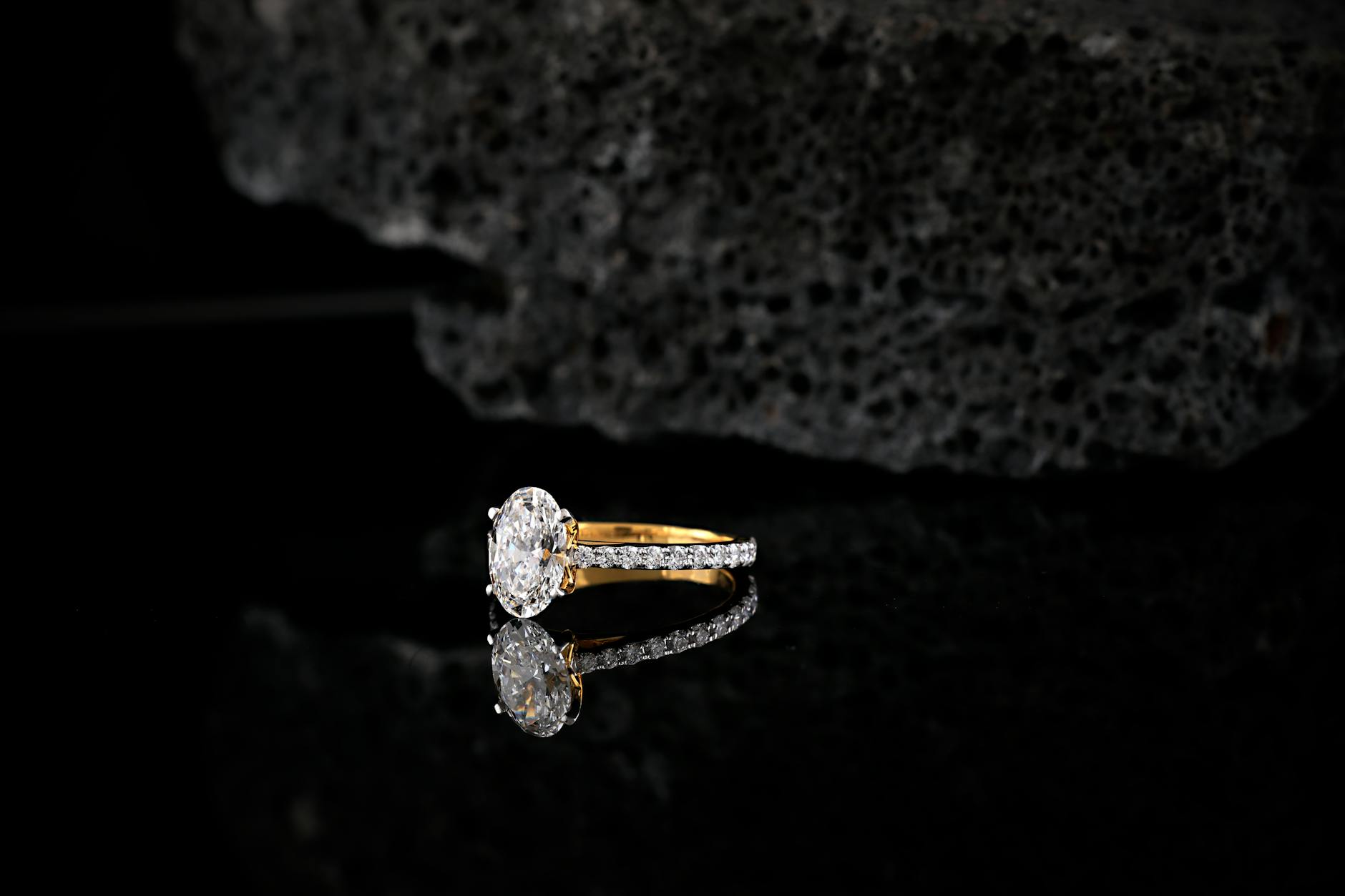
- Oval — elongates the finger, fashionable since 2022 and still dominant in engagement rings
- Cushion — soft pillow shape, suits traditional settings and solitaire pendants
- Pear — popular in pendants and three-stone rings, especially in South India
- Princess — square/rectangular, modern look, common in everyday rings
- Emerald — step-cut, hall-of-mirrors effect, increasingly fashionable for minimalist aesthetic
Note: fancy shapes do NOT receive a formal cut grade on GIA or IGI certificates. Instead, the certificate notes length-to-width ratio and symmetry/polish grades. For ovals, a ratio of 1.30–1.50 is considered most flattering. Cushions: 1.00–1.05 for square, 1.15–1.35 for elongated.
The "Spread" Diamond Trick — Know Before You Buy
Some jewellers offer "spread" diamonds — stones cut shallower than ideal proportions so they look larger face-up for their carat weight. A 0.90ct spread diamond might measure 6.4mm across (the face-up size of a typical 1.00ct). The trade-off: brilliance suffers because light leaks through the shallow pavilion. If the diamond's depth percentage is below 58%, be cautious. Always compare face-up diameter in millimetres, not just carat weight.
2. Color — How Yellow Is Too Yellow?
Diamond color is graded on a scale from D (absolutely colorless) to Z (light yellow or brown tint). This is a confusing backward scale to many Indian buyers — the best is D, not A. The scale begins at D because the original graders wanted to start fresh with no pre-existing associations (earlier systems had used A, B, C, AA, AAA inconsistently).
Diamond Color Grade Reference Table
| Grade | Category | Description | Notes for India |
|---|---|---|---|
| D, E, F | Colorless | Icy white; no detectable color even under magnification | Premium price; only noticeable in platinum/white gold settings |
| G, H | Near-Colorless | Tiny trace of color visible only when compared to colorless diamonds face-down | Best value for India — virtually indistinguishable face-up |
| I, J | Near-Colorless | Slight warmth; nearly undetectable face-up, especially in yellow gold | Excellent value in yellow gold settings; fine for solitaires under 0.75ct |
| K, L, M | Faint | Noticeable warmth to the naked eye, especially in larger stones | Acceptable only in antique/yellow gold settings |
| N–Z | Very Light/Light | Clearly yellow or brown tint | Avoid for jewellery centre stones |
Metal Color and Diamond Color: The Critical Interaction
The most practical advice for Indian buyers: your metal choice dramatically affects which color grade you need.
- Yellow gold (18K/22K) — the warm metal reflects yellow light into the diamond, masking any trace of yellow in the stone. You can comfortably buy G, H, even I color in yellow gold and no one will notice the difference from a D color. This is exceptional value.
- White gold (18K) or platinum — these metals do not mask warmth. Any color below G may appear visibly warmer against the bright white metal. Stick to D–G for white gold/platinum settings.
- Rose gold — the warm pinkish tone is very forgiving; G–I color grades work beautifully.
The Value Sweet Spot for India
Given India's strong preference for yellow and rose gold, the G–H color range offers the best price-to-performance ratio for the majority of buyers. You pay a significant premium for D–F colors that will be invisible in a yellow gold setting. For a 1.00ct round brilliant diamond:
- D/Excellent/VS1 in white gold: pay for the D color
- H/Excellent/VS1 in yellow gold: save 20–30% vs D color, zero visible difference
3. Clarity — What Is Inside the Stone?
Clarity measures the absence of internal inclusions (characteristics within the stone) and external blemishes (surface features). Diamonds form under extreme heat and pressure deep in the Earth; almost all contain some internal birthmarks. The question is whether these inclusions affect the stone's beauty and durability.
Diamond Clarity Grade Reference Table
| Grade | Category | Description | Eye Clean? |
|---|---|---|---|
| FL | Flawless | No inclusions or blemishes under 10x magnification | Yes — perfect |
| IF | Internally Flawless | No inclusions; only minor surface blemishes under 10x | Yes — perfect |
| VVS1, VVS2 | Very Very Slightly Included | Minute inclusions extremely difficult to detect at 10x | Yes |
| VS1, VS2 | Very Slightly Included | Minor inclusions; difficult to detect at 10x, not visible to naked eye | Yes |
| SI1 | Slightly Included 1 | Inclusions noticeable at 10x; usually not visible to naked eye | Usually yes — best value |
| SI2 | Slightly Included 2 | Inclusions easily seen at 10x; may be visible to naked eye in some stones | Often yes; check each stone |
| I1 | Included 1 | Inclusions visible to naked eye; may affect transparency/brilliance | No |
| I2, I3 | Included 2, 3 | Obvious inclusions; significant effect on brilliance and durability | No |
The "Eye Clean" Concept — The Most Important Clarity Principle
An "eye clean" diamond is one where no inclusions are visible to the unaided eye when viewed face-up from a normal viewing distance (about 25–30 cm). Here is the key insight: there is no visual difference between an FL diamond and a VS1 diamond when both are eye clean. You are paying for microscopic differences that exist only under 10x magnification. This is why VS1/VS2 and SI1 represent the best value for most buyers.
Inclusions to Avoid
Not all inclusions are equal. Some are benign; others can affect beauty or even durability:
- Black carbon crystals (black spots) — visible to the naked eye as dark dots; extremely obvious in a brilliant-cut diamond; avoid any stone where these are visible without magnification
- Fractures / cleavages near the girdle — structural weakness; a knock could cause the diamond to chip along these fracture lines; critical to avoid
- Feathers (fractures) — thin fractures; small feathers away from the girdle are generally stable; large feathers are a durability concern
- Clouds — clusters of tiny pinpoints; extensive clouding reduces transparency and kills brilliance even in VS grades; the certificate will note "cloud not shown" when it is pervasive
- Twinning wisps — irregular growth patterns; moderate impact on clarity; common in fancy-shaped diamonds
The most important rule: always ask to see the actual diamond under magnification or request a high-resolution video of the stone rotating. For online purchases, many Indian platforms (CaratLane, Bluestone, Malabar Diamond Square) now provide 360° HD videos for each stone.
4. Carat — Weight vs Size
Carat is a unit of weight. One carat equals 0.2 grams. This is the most misunderstood of the 4Cs because people often conflate "heavy" with "large." The face-up size of a diamond (its apparent diameter) depends on both its carat weight AND its cut proportions. A well-cut 1.00ct round brilliant is approximately 6.4–6.5mm in diameter. A deeply cut or poorly proportioned 1.00ct might measure only 6.0mm across — smaller looking despite identical weight.
Round Brilliant: Carat Weight to Diameter Guide
| Carat Weight | Typical Diameter (mm) | Visual Size Reference |
|---|---|---|
| 0.25ct | ~4.0 mm | Small accent stone |
| 0.50ct | ~5.1 mm | Petite solitaire |
| 0.75ct | ~5.8 mm | Classic solitaire |
| 1.00ct | ~6.4–6.5 mm | Statement solitaire |
| 1.50ct | ~7.4 mm | Large solitaire |
| 2.00ct | ~8.1 mm | Showstopper |
Magic Weights and Price Jumps
Diamond prices do not increase smoothly — they jump sharply at round carat milestones. The "magic weights" of 0.50ct, 0.75ct, 1.00ct, 1.50ct, and 2.00ct all command significant premiums because consumer demand concentrates there. A 0.98ct diamond costs meaningfully less than a 1.00ct diamond of identical cut/color/clarity grades — sometimes 15–20% less — with a face-up size difference of less than 0.1mm (invisible to the eye). Smart buyers target just below magic weights: 0.48–0.49ct, 0.72–0.73ct, 0.95–0.98ct.
Lab-Grown Diamonds: More Carat Per Rupee
Lab-grown diamonds are chemically, physically, and optically identical to mined diamonds. The only difference is origin. In India, lab-grown diamond prices in 2025–2026 are approximately 50–70% lower than equivalent mined diamonds. This means a budget that buys a 0.50ct natural diamond can purchase a 1.00ct or even 1.25ct lab-grown diamond of the same cut/color/clarity. For buyers who prioritise visual size and sparkle over "natural origin" investment narrative, lab-grown is transformative. IGI (the most common certification lab in India) certifies lab-grown diamonds with the same rigour as natural diamonds, and the certificate clearly states "Laboratory Grown."
Price Impact of the 4Cs: A Practical Summary
| Factor | Price Impact | Indian Sweet Spot |
|---|---|---|
| Cut | High — up to 30% between Excellent and Good | Excellent always; never compromise |
| Color | High — D vs H can be 25–40% premium | G–H in white gold; H–I in yellow gold |
| Clarity | Moderate — FL vs VS1 is large; VS1 vs SI1 is smaller | VS1/VS2 or eye-clean SI1 |
| Carat | Very high — exponential at magic weights | Just below magic weights (0.48, 0.72, 0.95ct) |
The 4Cs Priority Ranking for Indian Buyers
If you have a fixed budget, here is the recommended priority order:
- Cut — Never compromise. An Excellent cut is non-negotiable for a brilliant diamond.
- Color — Buy the minimum grade for your metal: G–H for white gold/platinum, H–I for yellow gold.
- Clarity — Eye-clean SI1 or VS2. Do not pay for FL/IF/VVS grades unless you want them for their rarity.
- Carat — Buy just below magic weights for maximum size per rupee.
A common mistake Indian buyers make is doing this in reverse — buying the largest carat they can afford while cutting corners on cut quality. The result is a big, dull, lifeless stone. A smaller, perfectly cut diamond will always outshine a larger poorly-cut one.
Diamond Certificate Verification in India
Every diamond above 0.20ct sold by a reputable jeweller should come with a grading certificate from an independent laboratory. This is non-negotiable — never buy a significant diamond without a certificate.
Major Labs in India
- IGI (International Gemological Institute) — Most common in India. Offices in Mumbai, Delhi, Surat, Kolkata. Verify at igi.info using the report number. Newer certificates have a QR code.
- GIA (Gemological Institute of America) — Gold standard globally. Stricter grading standards than IGI India. Verify at gia.edu/report-check. Common on imported and luxury diamonds.
- SGL (Solitaire Gemological Laboratories) — India-based. Common for lower-value commercial diamonds. Acceptable for fashion jewellery; less prestigious for investment pieces.
How to Verify Your Certificate
- Locate the report/certificate number (printed prominently on the cert)
- Visit igi.info or gia.edu/report-check
- Enter the report number
- Confirm the grades shown online match the physical certificate exactly
- For IGI: scan the QR code on the certificate with your phone — it should open the online report instantly
- Check the laser inscription: every GIA and IGI-certified diamond has the report number laser-inscribed on its girdle (the thin rim around the circumference). Your jeweller can show this under magnification.
Approximate Price Benchmarks (India, 2026)
Prices vary by city and retailer, but these INR ranges give a realistic framework for natural mined diamonds:
| Carat | Grade | Approx. Price Range (₹) |
|---|---|---|
| 0.50ct | Excellent/H/VS2 (IGI) | ₹40,000 – ₹60,000 |
| 0.50ct | Excellent/D/VVS1 (GIA) | ₹80,000 – ₹1,20,000 |
| 1.00ct | Excellent/H/VS2 (IGI) | ₹1,20,000 – ₹1,80,000 |
| 1.00ct | Excellent/D/VVS1 (GIA) | ₹3,50,000 – ₹5,00,000 |
| 1.00ct Lab-grown | Excellent/E/VS1 (IGI) | ₹40,000 – ₹70,000 |
Note: Making charges (typically 8–18% of diamond value for solitaire settings) are additional. GST at 3% applies to all jewellery.
Fluorescence — The Often-Misunderstood Fifth Factor
While not officially one of the 4Cs, fluorescence appears on every GIA and IGI certificate and can affect price. Fluorescence describes whether a diamond glows (usually blue) when exposed to ultraviolet (UV) light. The grades are: None, Faint, Medium, Strong, Very Strong.
The effect in normal lighting is minimal to none for the vast majority of diamonds. Slight to medium blue fluorescence in near-colorless diamonds (G–J range) can actually be a slight advantage — the blue glow counteracts the faint yellow tint, making the stone appear whiter in sunlight. This is why some G–H fluorescent diamonds actually appear brighter outdoors than non-fluorescent equivalents.
Strong or Very Strong fluorescence in colorless D–F range diamonds can occasionally cause a "milky" or "oily" haziness in direct sunlight — this is rare (affecting perhaps 5–10% of strongly fluorescent diamonds) but is why the industry applies a small discount for strong fluorescence in the top color grades. For the Indian buyer: strong fluorescence in G–I range is generally fine and may save you 5–10% on the purchase price with zero visible drawback in typical indoor jewellery lighting.
Diamond Shapes: Which Is Right for Indian Jewellery Styles?
India has a rich diversity of jewellery traditions, and the diamond shape often needs to complement the design context:
- Round Brilliant — universally popular for solitaire rings and pendants; maximum light return; most standardised pricing; the safe choice for any buyer unsure of preferences
- Oval — the dominant trend in engagement rings since 2022; the elongated shape makes fingers appear slender; looks larger than a round of equal carat weight because of greater surface area; popular in South Indian and urban North Indian markets
- Cushion — soft, vintage look; popular for haars (necklaces) and statement rings; pairs beautifully with yellow gold settings; wide variety of cushion proportions so always request a video
- Pear (Teardrop) — traditionally popular for solitaire pendants (mangalsutra pendants in particular); also seen in earring drops and cocktail rings; orient the pointed end away from the hand when worn as a ring
- Marquise — most elongated shape; maximises face-up size per carat; traditional in older Indian bridal sets; less fashionable today but seeing a revival in contemporary designs
- Princess (Square Brilliant) — modern, architectural look; popular for everyday rings; note the sharp corners are a vulnerability point — ensure the setting protects the corners with prongs
- Emerald/Asscher — step-cut faceting; the "hall of mirrors" effect; increasingly fashionable for minimalist, modern aesthetic; requires higher clarity (VS2 minimum) because the large, open facets expose inclusions more than brilliant cuts
- Heart — a romantic novelty; less versatile; requires skilled setting to display the shape well; look for symmetrical lobes and a clean point
Understanding Making Charges: The Real Cost of Diamond Jewellery
In India, diamond jewellery pricing has two distinct components: (1) the diamond value based on 4Cs and certificate, and (2) the making charges for the metal setting. Understanding both is essential to avoid overpaying.
Making charges vary widely:
- Simple solitaire setting (18K gold) — 8–12% of the gold metal value, or ₹800–₹1,500 per gram of gold used
- Intricate bridal set (multiple diamonds + melee) — 15–25% of gold value, sometimes higher for handcrafted karigari work
- Mass-manufactured chain settings — 6–10% (lower due to machine manufacturing)
Always ask the jeweller to itemise: diamond value (as per certificate), gold/metal value (weight in grams × current gold rate), and making charges separately. This transparency is your right as a consumer and a sign of a trustworthy jeweller. The total invoice should show all three components plus GST (3% on the total value of jewellery). Be cautious of any jeweller who quotes only a "final price" without breakdown — this is often where overpricing hides.
Red Flags: When to Walk Away
- Jeweller cannot produce a certificate or shows a photocopy only (insist on the original certificate)
- Certificate is from an unrecognised laboratory (check if it is IGI, GIA, or SGL at minimum)
- Jeweller refuses to show the diamond's laser inscription under magnification
- Online report number does not match the physical certificate
- Pressure to decide immediately without time to verify
- Price is dramatically lower than market rates (usually indicates a quality issue)
- Jeweller grades the diamond themselves ("our own quality check") rather than using an independent lab
8 Questions to Ask Your Jeweller Before Buying
- Can I see the original grading certificate and verify it online before I buy?
- What is the cut grade, and is this an Excellent or Ideal cut?
- Is this a natural or lab-grown diamond? (Both are fine; you just need to know.)
- Can you show me the laser inscription on the girdle under magnification?
- What is your buy-back/exchange policy for this diamond?
- What are the making charges for this setting, and are they negotiable?
- Does the price include GST? What is the breakup of diamond value vs making charges?
- Is this an IGI India or IGI Antwerp-graded stone? (Important — see our lab comparison guide.)
Frequently Asked Questions
Which is more important — color or clarity?
Cut is more important than both. Between color and clarity, for most Indian buyers clarity matters slightly more because inclusions can affect brilliance. However, the eye-clean test supersedes both: if the diamond looks clean to your eye, going higher in clarity grade is paying for microscopic perfection. Focus on G–H color and VS2/SI1 clarity for excellent everyday value.
Are IGI diamonds as good as GIA diamonds?
A diamond is a diamond regardless of which lab certified it. What differs is the grading standard — GIA is generally considered slightly stricter, meaning an "H/VS2" on GIA may actually be graded "G/VS1" on IGI India. For equal certificate grades, a GIA stone is typically 10–25% more expensive. See our full IGI vs GIA vs SGL comparison article for a complete analysis.
Should I buy a 1ct diamond or two 0.50ct diamonds?
Two 0.50ct diamonds of the same total cut/color/clarity will cost significantly less than one 1.00ct diamond, because 1.00ct occupies the premium magic weight. If you want a two-stone or cluster design, two smaller diamonds are excellent value. For a solitaire where the single stone is the focal point, the 1.00ct makes visual sense despite the price premium.
Do lab-grown diamonds lose value faster?
Yes — lab-grown diamond prices have fallen significantly (40–60%) since 2021 due to improved production technology and oversupply. Resale value of lab-grown diamonds is currently very low. If your primary goal is investment or heirloom value, natural mined diamonds retain value better. If your goal is visual beauty at a given budget, lab-grown diamonds are exceptional value. Buy lab-grown for aesthetics, buy natural for investment.
What is the minimum clarity grade I should accept?
Eye-clean SI1 for most shapes. However, emerald and asscher cuts have large open facets that show inclusions more easily — aim for VS2 or VS1 minimum for these step-cut shapes. For brilliant cuts (round, oval, cushion), well-chosen SI1 and many SI2 stones are eye-clean.
Is it safe to buy diamonds online in India?
Yes, from reputable platforms. CaratLane, Bluestone, Hazoorilal, and Malabar Diamond Square all carry certified diamonds with return policies. Always verify the certificate number online before purchase is confirmed. Ensure the platform offers a 30-day return window with a full refund — any legitimate diamond retailer will offer this.
More in Buying Guides
Share this article
Our editorial team comprises jewellery industry veterans, certified gemmologists, and passionate writers with decades of combined experience across India's gold, diamond, and gemstone markets. Every article is researched, fact-checked, and written to help Indian buyers make smarter, safer jewellery decisions.
Passionate about jewellery and love to write? We'd love to hear from you.
Join us as a writer →Ready to buy? Find verified jewellers near you
Browse 10,000+ BIS hallmark certified jewellers across India. Compare ratings, check today's gold rate, and book a visit.
Keep Reading