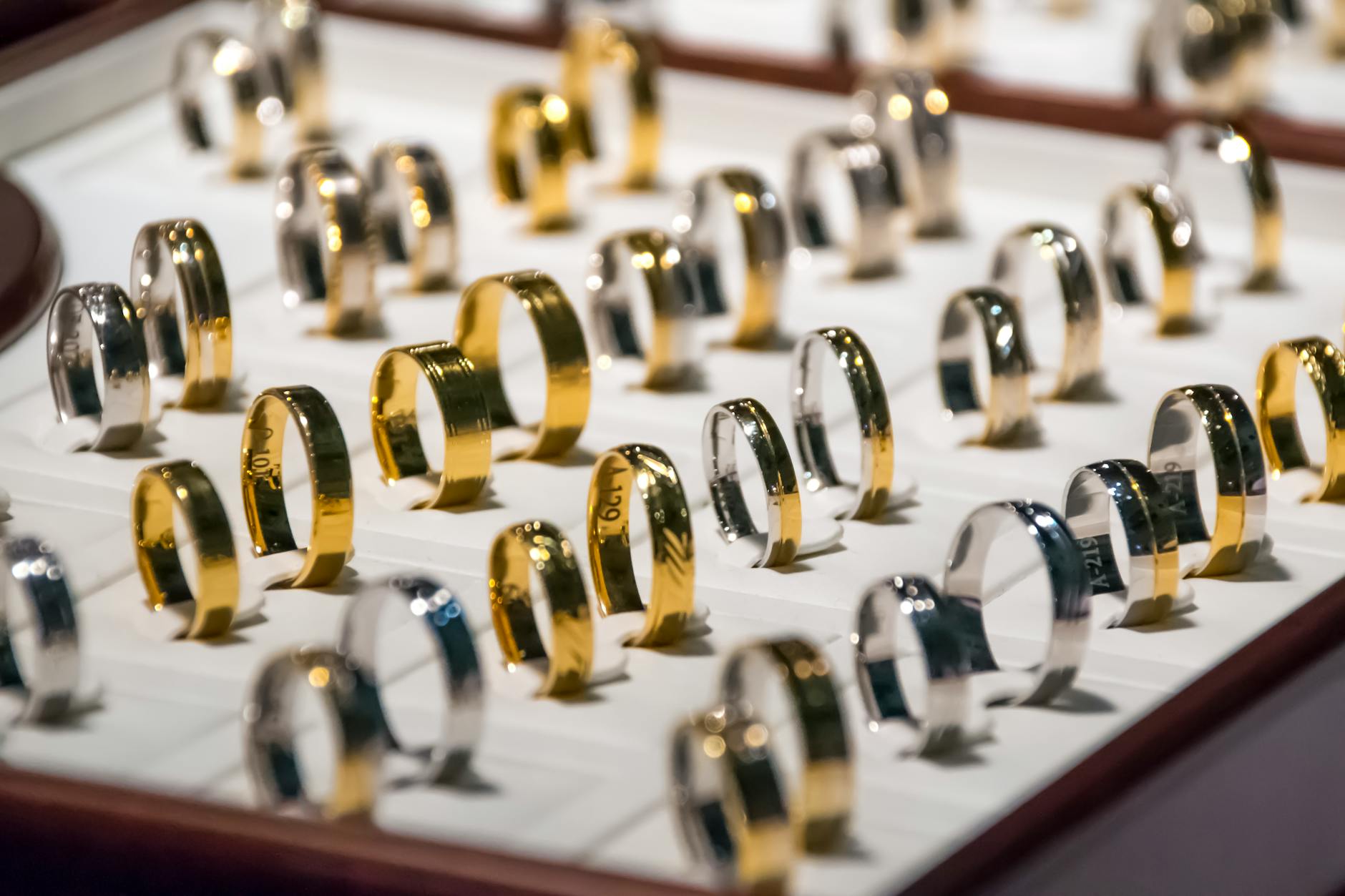
If you examine a piece of gold jewellery under a loupe, you will find a set of tiny stamped or laser-engraved marks that contain a surprising amount of information.
These marks — collectively called hallmarks, assay marks, maker's marks, or purity stamps depending on their type and origin — are permanent records impressed directly into the metal.
Learning to read them takes minutes and gives you immediate, independent verification of what you are buying or selling.
The Modern BIS HUID Hallmark (India, post-2021)
Since September 2021, BIS (Bureau of Indian Standards) hallmarking is mandatory for all gold jewellery sold in India.
The current hallmarking system consists of two elements laser-engraved on every certified piece.
The first is the BIS mark — a triangle with the letters BIS inside.
This triangle indicates that the piece has been independently tested and certified by a BIS-recognised Assaying and Hallmarking Centre (AHC).
The second is the HUID (Hallmark Unique Identification) — a six-character alphanumeric code (a mix of letters and numbers, such as AZ4721).
This code is unique to every individual piece of jewellery in India.
It is registered in the BIS database and links the piece to the specific jeweller who submitted it for hallmarking.
You can verify the HUID on the BIS Care app (Android/iOS) or the BIS website in seconds.
Note that the purity grade (916, 750, 585) is no longer stamped separately as a mandatory mark under the post-2021 system, because the HUID contains the purity information in the database.
However, many jewellers continue to stamp the purity mark as well for buyer clarity.
Gold Purity Marks and Their Karat Equivalents
| Purity Mark | Karat Equivalent | Gold Content | Common Use in India |
|---|---|---|---|
| 999 | 24K | 99.9% gold | Coins, bars, investment gold |
| 958 | 23K | 95.8% gold | Rare; some South Indian temple jewellery |
| 916 | 22K | 91.6% gold | Most common for jewellery in India |
| 875 | 21K | 87.5% gold | Middle Eastern jewellery imports |
| 750 | 18K | 75.0% gold | Diamond jewellery, designer pieces |
| 585 | 14K | 58.5% gold | Western-style jewellery, some exports |
| 375 | 9K | 37.5% gold | Rarely used in India; common in UK |
| 999 (Silver) | Fine Silver | 99.9% silver | Investment silver bars |
| 925 (Silver) | Sterling Silver | 92.5% silver | Standard for silver jewellery |
| 950 (Platinum) | Pt950 | 95.0% platinum | Standard for platinum jewellery in India |
The Pre-2021 Indian Hallmark (Five-Part System)
Jewellery purchased before September 2021 may carry the older voluntary five-part BIS hallmark, which you will still encounter when dealing with older pieces.
Reading left to right on the hallmarked area:
Part 1 — BIS logo: The BIS triangle mark, confirming independent certification.
Part 2 — Purity grade: The numerical purity stamp (916, 750, etc.).
Part 3 — Assaying and Hallmarking Centre code: A letter or letter-number combination identifying which AHC tested the piece.
For example, "A" commonly denotes a specific AHC. This code allowed traceability to the testing laboratory.
Part 4 — Jeweller's identification mark: A four-character code identifying the BIS-registered jeweller who submitted the piece for hallmarking.
Part 5 — Year letter: A letter denoting the year of hallmarking, from a rotating alphabetical code published by BIS. "A" = 2000, "B" = 2001, etc. (with some years skipped).
This allows you to determine approximately when a piece was hallmarked.
International Hallmarks You May Encounter
If you travel abroad, inherit pieces from relatives who lived overseas, or buy from online platforms selling imported jewellery, you will encounter international hallmarks that follow different systems.
British hallmarks: Among the world's oldest and most rigorous.
A British hallmarked piece carries: an Assay Office mark (an anchor for the Birmingham Assay Office; a castle for Edinburgh; a rose for Sheffield; a crown — historically — for London's Goldsmiths' Company); a fineness mark (375 for 9K, 585 for 14K, 750 for 18K, 916 for 22K, 999 for 24K); and a maker's mark.
The lion passant (a walking lion) is an additional mark guaranteeing the piece is sterling silver and hallmarked in England. Date letters are also used.
Italian marks: Italy is a major jewellery exporting nation. Italian gold typically carries 750 for 18K or 585 for 14K, often inside a small oval or rectangular cartouche.
Italian pieces also have a maker's code and a province code.
American marks: The United States has no mandatory hallmarking law. Karat stamps (14K, 18K, 10K) are voluntary and self-declared by the manufacturer.
American gold jewellery carries a manufacturer's responsibility mark alongside the karat claim, but there is no independent government verification.
This makes American-origin pieces slightly harder to verify without independent testing.
French marks: The French eagle's head mark on gold means 18K purity has been independently verified by a French Assay Office.
France also has marks for imported goods and for lower-karat gold.
Maker's Marks on Antique Indian Jewellery
On Indian jewellery made before the BIS hallmarking system existed, you may find maker's marks in the form of symbols, letters in regional scripts, or abstract shapes stamped into the metal.
These were traditionally used by goldsmiths as signatures — identifiers of their workshop.
Some of these marks are traceable to specific historical craft centres: certain marks from Murshidabad (Bengal), Hyderabad's historic jewellery quarter, or the goldsmiths of Jaipur's old city are documented in antique trade references.
For genuinely antique pieces, a specialist appraiser with knowledge of regional Indian goldsmith marks is needed for authentication.
Comprehensive Marks Reference
| Mark Type | Who Applies It | What It Means | Independent Verification? |
|---|---|---|---|
| BIS HUID (India, post-2021) | BIS-recognised AHC | Purity certified; piece traceable in database | Yes — BIS Care app |
| BIS triangle (India) | BIS-recognised AHC | Independent certification body mark | Yes — part of HUID system |
| 916 / 750 / 585 etc. | Manufacturer or AHC | Declared purity in parts per thousand | Only if accompanied by BIS mark |
| British Assay Office mark (anchor/castle) | UK Assay Office | Office of independent testing identified | Yes — Assay Office records |
| Lion passant (UK) | UK Assay Office | Sterling silver (925) certified in England | Yes |
| French eagle's head | French Assay Office | 18K gold independently certified | Yes |
| 18K / 14K stamp (USA) | Manufacturer | Self-declared purity — no independent body | No — self-declaration only |
| Italian cartouche (750, 585) | Manufacturer + provincial mark | Purity declared; province of origin identified | Partial — provincial code traceable |
| Jeweller's maker mark (pre-2021 India) | Manufacturer | Identifies registered jeweller who submitted for hallmarking | Via BIS registration records |
The practical takeaway: when buying jewellery in India, the BIS HUID — verifiable in seconds on your phone — is the only mark that provides real-time, independent confirmation of both purity and provenance.
All other marks — manufacturer's self-stamps, undocumented symbols, or foreign marks you cannot verify — should prompt additional scrutiny before you commit to a purchase.
More in Education
Share this article
Our editorial team comprises jewellery industry veterans, certified gemmologists, and passionate writers with decades of combined experience across India's gold, diamond, and gemstone markets. Every article is researched, fact-checked, and written to help Indian buyers make smarter, safer jewellery decisions.
Passionate about jewellery and love to write? We'd love to hear from you.
Join us as a writer →Ready to buy? Find verified jewellers near you
Browse 10,000+ BIS hallmark certified jewellers across India. Compare ratings, check today's gold rate, and book a visit.
Keep Reading