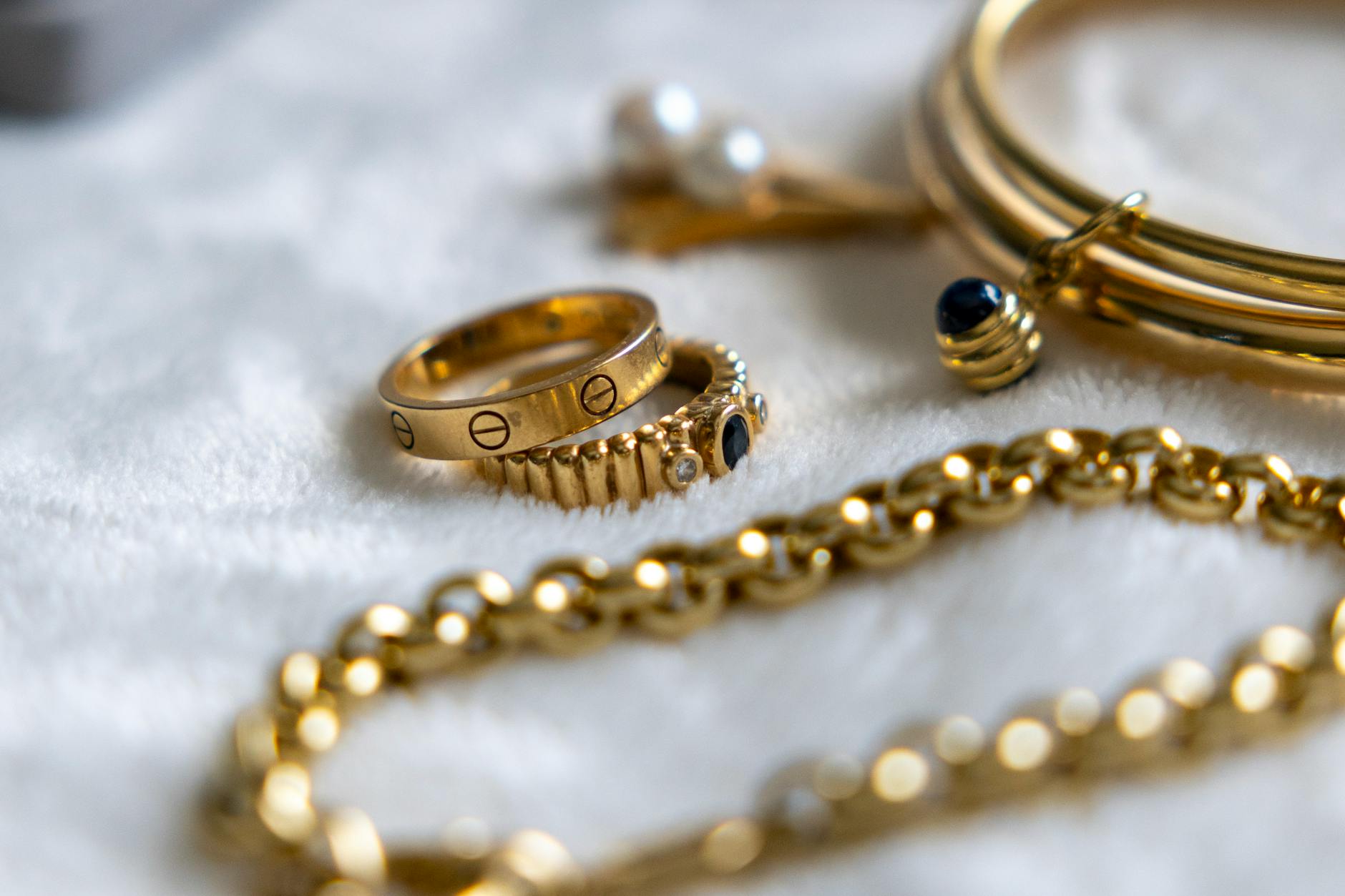
India's gold jewellery market, valued at over ₹6 lakh crore annually, is one of the largest in the world. With that scale comes an unfortunate reality: counterfeit hallmarks are a persistent problem that costs Indian consumers crores of rupees every year. Despite the introduction of mandatory HUID-based hallmarking in 2021, unscrupulous operators continue to find ways to stamp fake hallmarks onto substandard or impure gold jewellery.
Knowing how to distinguish genuine hallmarks from counterfeits is an essential skill for every Indian gold buyer. This guide equips you with ten clear visual indicators, explains the most common counterfeiting methods, and outlines exactly what steps you should take if you discover fake hallmarks on your jewellery.
Understanding the Genuine Hallmark Format
Before you can spot a fake, you need to understand precisely what a real hallmark looks like. Since April 2023, the hallmark on gold jewellery in India consists of three marks applied in sequence.
The Three Marks of a Genuine Hallmark
Mark 1 — BIS Standard Mark: The triangular logo of the Bureau of Indian Standards. It features the letters "BIS" within a distinctive triangular border. The triangle is equilateral with clean, precise edges. Mark 2 — Purity/Fineness Grade: A three-digit number indicating the gold content:- 999 = 24 Karat (99.9% pure gold)
- 916 = 22 Karat (91.6% pure gold)
- 750 = 18 Karat (75.0% pure gold)
- 585 = 14 Karat (58.5% pure gold)
Real vs Fake Hallmark Comparison
| Characteristic | Genuine Hallmark | Fake Hallmark |
|---|---|---|
| Engraving method | Laser-engraved, crisp and uniform | Stamped, hand-engraved, or acid-etched; often uneven |
| BIS triangle | Perfect equilateral triangle with clean lines | Slightly irregular, rounded corners, or distorted proportions |
| Character depth | Uniform depth across all characters | Varying depth, some characters deeper than others |
| Character spacing | Consistent, machine-precise spacing | Irregular spacing between characters |
| Font consistency | Standardised font, all characters match | Mixed font styles or sizes |
| Surface around marks | Clean, no damage to surrounding gold | Scratches, dents, or discolouration around stamped area |
| HUID verification | Returns valid record in BIS database | Returns no result or mismatched details |
| Mark alignment | All three marks aligned on same axis | Marks at different angles or misaligned |
| Mark location | Standard locations (inner band, clasp area) | Unusual locations or partially hidden |
| Overall appearance | Professional, clean, readable | Rough, amateur, partially illegible |
10 Visual Indicators to Spot Fake Hallmarks
Indicator 1: Uneven Engraving Depth
Genuine hallmarks are applied using precision laser engraving machines at BIS-recognised Assaying and Hallmarking Centres. The laser produces marks of perfectly uniform depth across every character. If you examine the hallmark under magnification and notice that some characters are deeper than others, or that parts of a character are fading while other parts are deeply cut, you are likely looking at a manually applied fake.
Use a jeweller's loupe with at least 10x magnification. Tilt the jewellery under a bright light source so that shadows form inside the engraved characters. Genuine laser marks will cast uniform shadows, while fake stamps will show irregular shadow patterns.
Indicator 2: Irregular BIS Triangle
The BIS logo is an equilateral triangle — all three sides are exactly equal in length, and all three internal angles are 60 degrees. Counterfeiters often get this wrong. Common mistakes include:
- One side noticeably shorter or longer than the others
- Rounded corners instead of sharp points
- The triangle appearing "squashed" or elongated
- The "BIS" text inside the triangle being oversized, undersized, or poorly centred
Compare the triangle on your jewellery against the official BIS logo on the BIS website (bis.gov.in). Even slight proportional differences indicate a fake.
Indicator 3: Rough or Damaged Surrounding Metal
Laser engraving does not physically deform the surrounding metal. The laser vaporises a thin layer of gold to create the mark, leaving the area around the hallmark smooth and undamaged. Hand-stamping, by contrast, pushes metal aside, often creating small ridges, dents, or scratches around the mark.
Run your fingertip gently over the hallmarked area. If you feel raised ridges or rough spots around the marks, the hallmark was likely stamped mechanically rather than laser-engraved. While some older genuine hallmarks (pre-2021) were indeed stamped, any new hallmark should be laser-applied.
Indicator 4: Incorrect Number of Marks
Since April 2023, genuine hallmarks consist of exactly three marks: BIS logo, purity grade, and HUID. If you see fewer marks, additional marks, or marks in a different sequence, the hallmark may be fake.
Some counterfeiters still replicate the old four-mark format (which included the jeweller's mark and AHC mark) because they have older fake stamps. If you see a four-mark hallmark on jewellery with a recent purchase date (after April 2023), it is almost certainly counterfeit.
| Hallmark Era | Number of Marks | Marks Present |
|---|---|---|
| Pre-June 2021 (voluntary) | 4 marks | BIS logo, purity, jeweller mark, AHC mark |
| June 2021 - March 2023 | 3 marks + transition | BIS logo, purity, HUID (some with old format) |
| April 2023 onwards | 3 marks only | BIS logo, purity, HUID |
Indicator 5: Blurred or Smudged Characters
Genuine laser-engraved characters have razor-sharp edges. Each line and curve is crisply defined with no bleeding or smudging. Fake hallmarks, particularly those applied using acid etching or low-quality stamps, often show:
- Blurred edges on characters
- Characters that appear to "bleed" into each other
- Fine details (like the serifs on numbers or the internal structure of the BIS triangle) that are lost or smudged
- An overall fuzzy appearance even under magnification
If the hallmark looks sharp and clear to the naked eye but becomes blurry under magnification, that is a strong indicator of counterfeiting.
Indicator 6: Inconsistent Font Style
BIS-recognised Assaying and Hallmarking Centres use standardised fonts for the purity grade and HUID. The font is clean, sans-serif for numbers and alphanumeric characters, with consistent stroke width. Fake hallmarks often exhibit:
- Mixed font styles (some characters serif, others sans-serif)
- Inconsistent character heights
- Different stroke widths on different characters
- Characters that appear hand-drawn rather than machine-generated
Pay special attention to the numbers in the purity grade. The digits 9, 1, and 6 are the most commonly faked, and counterfeiters often struggle to replicate the exact proportions of these characters.
Indicator 7: Wrong Purity Numbers
This seems obvious, but counterfeiters sometimes stamp incorrect or non-standard purity numbers. The only valid purity grades for hallmarked gold jewellery in India are:
- 999 (24K)
- 916 (22K)
- 750 (18K)
- 585 (14K)
If you see numbers like 917, 915, 920, 800, 875, or any other non-standard figure, the hallmark is fake. Some counterfeiters also stamp "22K" or "22CT" instead of the numeric fineness grade — this is not a valid BIS hallmark format.
Indicator 8: Hallmark in an Unusual Location
Genuine hallmarks are placed in specific, standardised locations on each type of jewellery. These locations are chosen to be visible for verification while not affecting the aesthetic appearance of the piece. If you find a hallmark in an unusual location — such as on the decorative face of a ring instead of the inner band, or on a visible outer surface of a bangle — be suspicious.
Additionally, some counterfeiters try to hide fake hallmarks in hard-to-examine locations, hoping the buyer will take the hallmark's existence at face value without scrutinising it closely.
Indicator 9: Mismatch Between Hallmark and Gold Colour
This indicator requires some experience with gold, but it is remarkably effective. Different purities of gold have distinctly different colours:
- 24K (999): Deep, rich yellow with a slightly orange tone
- 22K (916): Warm yellow, the classic "gold" colour most Indians associate with jewellery
- 18K (750): Lighter yellow, sometimes with a slightly greenish or pinkish tinge depending on alloy composition
- 14K (585): Pale yellow, noticeably less saturated than 22K
If a piece is hallmarked as 22K (916) but has the pale colour of 14K or 18K gold, or conversely, if it is hallmarked as 18K but has the deep colour of 22K, there is a mismatch that warrants professional testing.
Indicator 10: The Price Is Too Good to Be True
While not a visual indicator per se, pricing is one of the most reliable red flags. Gold jewellery pricing follows a predictable formula:
Total Price = (Gold weight × Gold rate per gram for that purity) + Making charges + GST (3%)As of April 2026, the approximate gold rates are:
| Purity | Rate per Gram (April 2026) |
|---|---|
| 24K (999) | ₹8,950 |
| 22K (916) | ₹8,200 |
| 18K (750) | ₹6,710 |
| 14K (585) | ₹5,235 |
Common Counterfeiting Methods Explained
Understanding how counterfeiters operate helps you stay one step ahead.
Method 1: Hand Stamping with Replica Dies
The most basic counterfeiting method involves creating metal dies that replicate the hallmark design and manually stamping them onto gold articles. These stamps are often made by skilled engravers who copy the hallmark from genuine articles. The resulting marks look convincing at first glance but reveal irregularities under magnification.
Detection cost: A jeweller's loupe (₹200-₹500) is usually sufficient to spot these fakes.Method 2: Acid Etching
Some counterfeiters use acid-resistant masks and chemical etching to create hallmark impressions. The mask is placed on the gold surface, acid is applied, and the unmasked areas are etched away, leaving a raised or recessed pattern resembling a hallmark. Acid-etched marks tend to have softer edges and less uniform depth than laser marks.
Detection cost: Magnification (₹200-₹500) plus careful observation of edge quality.Method 3: Laser Engraving with Non-BIS Equipment
More sophisticated counterfeiters invest in laser engraving machines to create marks that closely resemble genuine BIS laser hallmarks. However, the fonts, spacing, and BIS logo proportions still differ from the authentic template. The HUID will also fail online verification.
Detection cost: Online HUID verification (free) plus careful font comparison.Method 4: Transplanting Genuine Hallmarks
In this advanced method, a small section of genuinely hallmarked gold is carefully cut from one article and soldered onto a different, non-hallmarked piece. This is particularly common with rings and bangles where a small hallmarked section can be seamlessly incorporated.
Detection cost: Professional inspection (₹300-₹1,000) to identify solder joints. XRF testing (₹200-₹500) to verify purity across the entire article, not just the hallmarked section.Method 5: Gold Plating over Base Metal
The most egregious form of fraud involves plating base metals (copper, brass, or tungsten) with a thin layer of real gold and then applying a hallmark. The hallmark may even be genuine in some cases — applied to the gold-plated surface which tests as gold at the surface level.
Detection cost: XRF testing (₹200-₹500) or specific gravity testing (₹100-₹300) to detect the base metal beneath the plating.Tools for Verification
Free Tools
| Tool | What It Does | Accessibility |
|---|---|---|
| BIS CARE App | Verifies HUID against BIS database | Free download, Android & iOS |
| BIS Website (verify.bis.gov.in) | Online HUID verification | Free, any web browser |
| Jeweller's Loupe (10x) | Visual inspection of hallmark quality | ₹200-₹500, available on Amazon |
| Smartphone Macro Photography | Digital magnification of hallmark | Free (most phones have macro mode) |
Professional Tools
| Tool | What It Does | Cost |
|---|---|---|
| XRF Analyser | Non-destructive purity testing | ₹200-₹500 per test at AHC |
| Specific Gravity Test | Density-based purity estimation | ₹100-₹300 at jewellery shops |
| Touchstone Test | Acid-based purity comparison | ₹100-₹200 at traditional jewellers |
| Fire Assay | Destructive but most accurate test | ₹500-₹1,000 at AHC |
What to Do If You Find a Fake Hallmark
Discovering a fake hallmark on your gold jewellery can be distressing, but Indian law provides strong protections for consumers. Here is a step-by-step action plan.
Step 1: Document Everything
Before confronting anyone, create a thorough record:
- Take high-resolution photographs of the jewellery from multiple angles
- Photograph the hallmark under magnification
- Take screenshots of the failed HUID verification
- Preserve your purchase invoice, payment receipts, and any certificates
- Note the date of purchase, amount paid, and any verbal claims made by the jeweller
Step 2: Get Independent Testing
Visit a BIS-recognised Assaying and Hallmarking Centre (not the one shown on the fake hallmark) and get the jewellery tested independently. This costs ₹200-₹500 for XRF testing. The test report serves as critical evidence of the purity mismatch.
Step 3: Confront the Jeweller
Visit the jeweller with your documentation and the independent test report. Many cases of fake hallmarks involve middlemen or suppliers, and the retail jeweller may not even be aware. A reputable jeweller will typically offer a replacement, refund, or compensation.
Step 4: File a Complaint with BIS
If the jeweller is uncooperative, file a formal complaint with BIS:
- Online: Through the BIS CARE app's complaint section
- Email: hallmarking@bis.gov.in
- Phone: BIS helpline 011-23230131
- Written: To the Director General, Bureau of Indian Standards, 9 Bahadur Shah Zafar Marg, New Delhi 110002
BIS has the authority to raid premises, seize counterfeit hallmarking equipment, and impose penalties of up to ₹1,00,000 per offence.
Step 5: File a Consumer Complaint
For financial recovery, file a complaint with:
- National Consumer Helpline: 1800-11-4000 (toll-free)
- INGRAM Portal: consumerhelpline.gov.in
- District Consumer Forum: For claims up to ₹1 crore (filing fee ₹100-₹5,000 based on claim amount)
Step 6: File a Police Complaint (FIR)
If the fraud amount is significant (typically above ₹50,000) or if you believe a pattern of fraud exists, file an FIR at your local police station under:
- Section 420 of IPC (cheating and dishonestly inducing delivery of property)
- Relevant sections of the BIS Act, 2016
- Consumer Protection Act, 2019
Legal Recourse and Compensation
Indian courts have been increasingly strict with jewellers found guilty of hallmark fraud. Here are some recent precedents:
Consumer Forum Compensation Examples
| Case Type | Fraud Amount | Compensation Awarded | Forum Level |
|---|---|---|---|
| Fake 22K hallmark on 18K gold | ₹1,45,000 | ₹2,10,000 (refund + damages) | District Forum, Delhi |
| Counterfeit HUID on gold chain | ₹85,000 | ₹1,20,000 (refund + damages) | District Forum, Mumbai |
| Unhallmarked jewellery sold as hallmarked | ₹3,20,000 | ₹4,50,000 (refund + damages + legal costs) | State Commission, Chennai |
| Gold-plated brass sold as 22K gold | ₹2,40,000 | ₹5,00,000 (refund + punitive damages) | State Commission, Kolkata |
BIS Enforcement Statistics (2025-2026)
BIS has significantly ramped up enforcement:
- Over 15,000 raids conducted in 2025-26 on suspected jewellers
- More than 3,200 complaints received through the BIS CARE app
- Over ₹45 crore in fines imposed on non-compliant jewellers
- 287 BIS registrations cancelled for repeated violations
Prevention: How to Protect Yourself Before Purchase
Choose Verified Jewellers
Always purchase from BIS-registered jewellers. You can verify a jeweller's registration status on the BIS website or find trusted, verified jewellers through our store finder. Jewellers listed on our platform are verified for valid BIS registration and customer reviews.
Verify at the Counter
Never leave a jewellery store without verifying the HUID on the BIS CARE app while you are still at the counter. This takes less than one minute and can save you from months of legal battles.
Request an Assay Certificate
For high-value purchases (above ₹1,00,000), ask the jeweller for a separate assay certificate from the hallmarking centre in addition to the standard invoice. This provides an additional layer of documentation.
Compare Prices Across Multiple Stores
Gold prices are standardised. If one jeweller is offering significantly lower prices than competitors, question where the savings are coming from. Use our gold rate calculator to know the exact prevailing rate before you shop.
Buy Insurance
For valuable gold jewellery, consider purchasing jewellery insurance that covers not just theft and loss but also purity misrepresentation. Some insurers offer policies that cover the difference if your jewellery is later found to be of lower purity than claimed.
Frequently Asked Questions
1. How common is hallmark counterfeiting in India?
While exact statistics are difficult to establish, BIS estimates that approximately 2-3% of gold jewellery sold in India carries suspect or counterfeit hallmarks. In smaller towns and less regulated markets, the percentage can be higher. The introduction of HUID and online verification has significantly reduced counterfeiting from the pre-2021 era when an estimated 8-10% of hallmarks were questionable.
2. Can a jeweller put a genuine hallmark on impure gold?
A jeweller cannot directly apply hallmarks — only BIS-recognised Assaying and Hallmarking Centres can do so. However, some dishonest jewellers tamper with articles after hallmarking, such as by removing gold and replacing it with base metal, or by swapping hallmarked clasps onto unhallmarked pieces. This is why the weight recorded in the HUID database is an important cross-check.
3. Are laser-engraved hallmarks always genuine?
No. While genuine hallmarks are laser-engraved, counterfeiters with access to laser engraving equipment can also create laser marks. The key differentiator is the HUID verification — a laser-engraved HUID that fails online verification is fake regardless of how professional it looks.
4. What magnification do I need to examine a hallmark?
A 10x magnification jeweller's loupe is the standard tool. These are widely available online for ₹200-₹500. For smartphone-based examination, use your phone's macro mode or attach a clip-on macro lens (available for ₹300-₹800). Professional gemologists use 20x to 60x magnification for detailed analysis.
5. Does the acid test damage my jewellery?
The traditional acid test (touchstone test) involves rubbing the gold against a touchstone and applying acid to the streak. This does not damage the jewellery itself — only the streak on the stone is tested. However, some aggressive testers may scratch the surface of the jewellery while making the streak. A skilled jeweller performs the acid test without leaving any visible marks.
6. Can fake hallmarks pass XRF testing?
No. XRF (X-ray fluorescence) testing measures the actual elemental composition of the metal, completely independent of whatever hallmark is stamped on it. A fake hallmark claiming 22K purity will be contradicted by an XRF reading showing the true gold content. XRF testing is the definitive non-destructive test for gold purity.
7. Are hallmarks on antique or heritage gold jewellery different?
Yes. Jewellery made before 2000 may not carry any hallmark at all, as hallmarking was entirely voluntary until the phased mandatory rollout began. Jewellery from 2000-2021 may carry the old four-mark format. Only jewellery hallmarked after June 2021 carries the HUID. Antique jewellery is typically evaluated based on its actual purity through testing rather than hallmarks.
8. What should I do if a jeweller claims hallmarking is optional?
Hallmarking has been mandatory across India since the completion of the phased rollout. Any jeweller claiming hallmarking is optional is either misinformed or deliberately misleading you. Report such claims to BIS through the BIS CARE app. The only exceptions are for jewellery meant for export, jewellery below a certain threshold weight (currently 2 grams), and specific categories like kundan, polki, and jadau jewellery where hallmarking is technically challenging.
9. Can I get my old unhallmarked jewellery hallmarked now?
Yes. You can take any gold jewellery to a BIS-recognised Assaying and Hallmarking Centre and get it hallmarked. The cost is capped at ₹45 per article by BIS regulation. The AHC will test the purity and, if it meets one of the standard grades (999, 916, 750, or 585), will hallmark it with the appropriate purity grade and a HUID. If the purity falls between grades, it will be certified at the lower grade.
10. How do I find the nearest BIS-recognised Assaying and Hallmarking Centre?
The BIS website (bis.gov.in) maintains a searchable directory of all recognised AHCs across India. You can search by state, city, or PIN code. The BIS CARE app also has an AHC locator feature. Additionally, our jeweller directory lists jewellers who can direct you to their nearby AHC.
11. Is there a difference between BIS hallmark and international hallmarks?
Yes. BIS hallmarks follow Indian Standard IS 1417 and are specific to India. International hallmarks follow different conventions — for example, the UK uses the Assay Office marks, while the Vienna Convention on the Control of the Fineness and the Hallmarking of Precious Metals governs hallmarks in participating European countries. International hallmarks are not substitutes for BIS hallmarks in India; jewellery imported into India must still be hallmarked by a BIS-recognised AHC before retail sale.
12. Can I claim compensation if the gold purity is only slightly lower than hallmarked?
Yes. Any discrepancy between the hallmarked purity and the actual purity — no matter how small — is a legal violation. BIS allows a tolerance of only 2 parts per thousand (0.2%). So 22K (916) gold can be as low as 914 fineness and still be considered compliant. Below 914 fineness, you have grounds for a complaint and compensation. Consumer Forums have awarded compensation even for relatively small purity shortfalls when the intent to defraud was established.
Protect yourself by purchasing from verified jewellers. Use our store finder to discover BIS-registered jewellers near you, check today's gold rates on our gold rate page, and learn more about gold purity in our HUID verification guide.
More in Education
Share this article
Our editorial team comprises jewellery industry veterans, certified gemmologists, and passionate writers with decades of combined experience across India's gold, diamond, and gemstone markets. Every article is researched, fact-checked, and written to help Indian buyers make smarter, safer jewellery decisions.
Passionate about jewellery and love to write? We'd love to hear from you.
Join us as a writer →Ready to buy? Find verified jewellers near you
Browse 10,000+ BIS hallmark certified jewellers across India. Compare ratings, check today's gold rate, and book a visit.
Keep Reading